
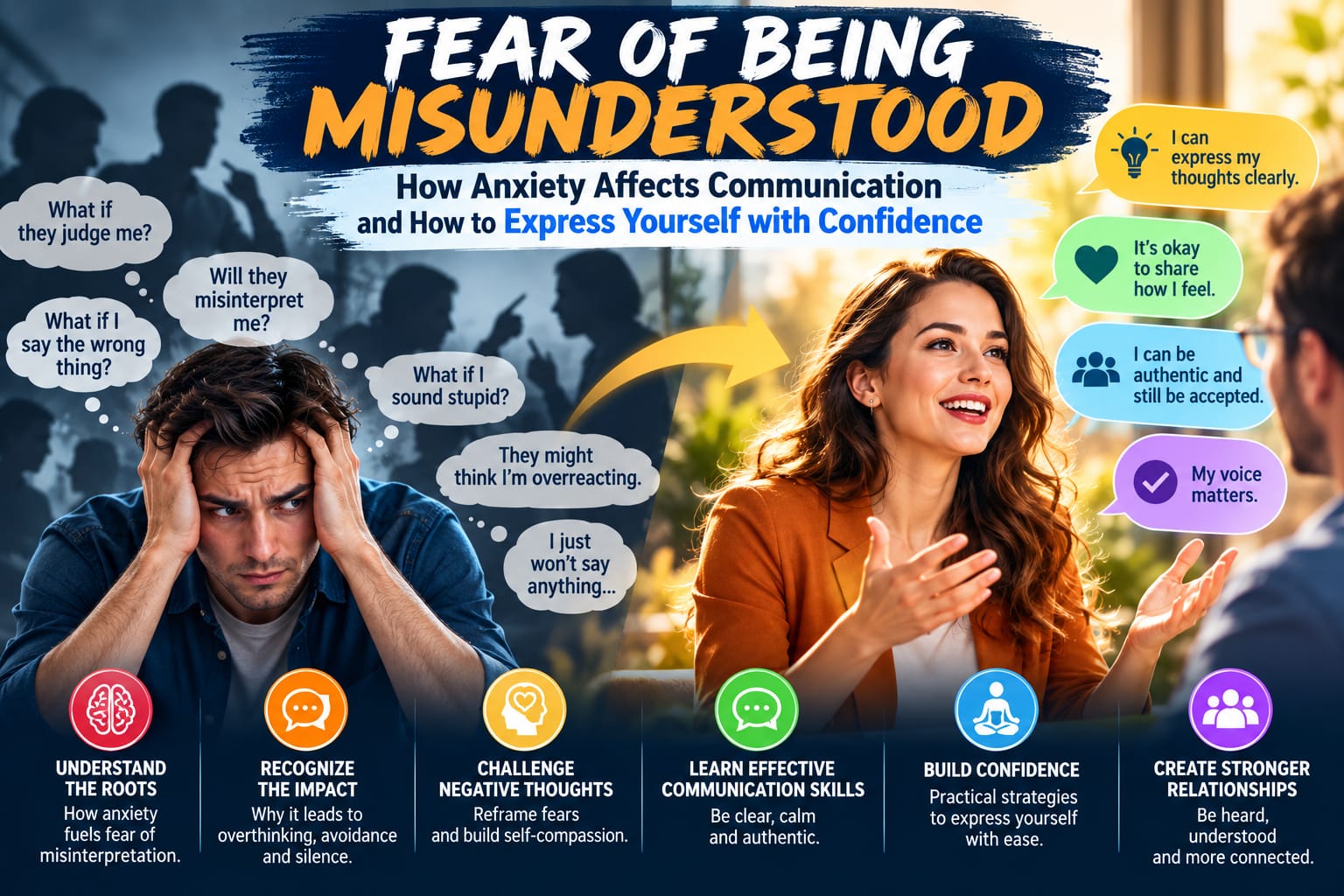
The fear of being misunderstood: How anxiety impacts self-expression and communication—and practical strategies to help others understand what you really mean.
Have you ever walked away from a conversation wondering whether the other person understood what you were trying to say? Perhaps you replayed your words repeatedly, questioned your tone, or worried that someone interpreted your intentions differently than you meant them.
For many people, the fear of being misunderstood can become a significant source of anxiety. It can affect relationships, friendships, professional interactions, and even the way we perceive ourselves. Sometimes, the problem is not that we struggle to communicate, but that we become so concerned about how others might interpret our words that expressing ourselves naturally becomes difficult.
Learning to communicate effectively begins with understanding this fear and recognizing that being understood by everyone, all the time, is neither realistic nor necessary.
Why Are We So Afraid of Being Misunderstood?
Human beings naturally seek connection, acceptance, and a sense of belonging. We want others to understand our intentions, respect our perspectives, and recognize who we truly are.When we fear being misunderstood, however, communication can begin to feel like a test we must pass rather than an opportunity to connect.
Several factors can contribute to this fear:
Fear of rejection: We worry that someone might judge us, become disappointed in us, or distance themselves because of what we say.
Past negative experiences: Previous conflicts, criticism, or situations in which our words were misinterpreted may make us more cautious in future conversations.
Perfectionism: We may believe that every sentence must be carefully constructed to prevent mistakes or misinterpretations.
Anxiety and overthinking: We anticipate negative outcomes before a conversation even begins, making it difficult to express ourselves naturally.
A strong need for approval: We may feel responsible for ensuring that everyone understands and agrees with our perspective.
Over time, these concerns can create a frustrating cycle: the more we worry about communicating correctly, the more difficult communication becomes.
How Anxiety Changes the Way We Communicate
Anxiety can influence both what we say and how we say it. For example, someone who fears being misunderstood might overexplain a simple point, repeatedly justify their decisions, or apologize unnecessarily. Others may avoid difficult conversations altogether because they anticipate conflict or criticism. Some people become unusually quiet, while others speak excessively in an attempt to eliminate every possible misunderstanding.
Anxiety can also affect our ability to listen. Instead of concentrating on what the other person is saying, we may become preoccupied with how we are being perceived or what we should say next.
Consider a simple example: You tell a friend that you cannot attend an event. Instead of communicating your decision clearly, you provide several explanations, worry that your friend will feel rejected, and continue sending messages to make sure they are not upset.
Your intention may be to protect the relationship, but excessive explanations can leave you feeling emotionally exhausted. Effective communication is not about finding perfect words. It is about expressing your message clearly, honestly, and respectfully.
Five Strategies to Communicate with Greater Confidence
1. Identify the fear behind your words
Before an important conversation, ask yourself: What am I afraid will happen if this person misunderstands me?
Are you worried about rejection, conflict, disappointment, or being judged?
Identifying the underlying fear helps you distinguish between a realistic communication challenge and an anxious prediction. You cannot control every interpretation, but you can choose how thoughtfully you express yourself.
2. Focus on clarity rather than perfection
You do not need to anticipate every possible misunderstanding before speaking.
Organize your thoughts around three simple questions:
What do I want to communicate?
Why is it important?
What do I want the other person to understand?
Keep your message focused. If clarification becomes necessary, you can address it as the conversation develops.
3. Use “I” statements
When discussing sensitive subjects, express your experience without automatically assuming the other person’s intentions.
Instead of saying, “You never listen to me,” consider saying, “I sometimes feel unheard when I cannot finish explaining my thoughts.”
This approach communicates your feelings while reducing the likelihood that the other person will feel immediately attacked.
4. Allow yourself to clarify without overexplaining
If someone misunderstands you, take a breath and calmly restate your intention.
You might say, “I can see how my words could have sounded different from what I intended. What I meant was…”
Clarification is a normal part of communication, not proof that you have failed.
At the same time, remember that repeatedly explaining yourself does not guarantee that another person will agree with you. Understanding and agreement are two different things.
5. Accept that you cannot control every interpretation
This may be the most important lesson of all.
Even when you communicate carefully, people interpret information through their own experiences, beliefs, emotions, and expectations. You can take responsibility for expressing yourself respectfully, listening to feedback, and correcting genuine mistakes. However, you cannot assume responsibility for every conclusion another person reaches.
Your responsibility is to communicate with integrity, not to control everyone else’s perception of you.
Learning to Trust Your Own Voice
The fear of being misunderstood often becomes less overwhelming when we stop treating every conversation as an opportunity to prove ourselves. Healthy communication requires both courage and flexibility. It means being willing to express an opinion, acknowledge uncertainty, ask questions, and accept that occasional misunderstandings are part of being human. It also means recognizing when a conversation requires patience and when repeated attempts to explain yourself are no longer productive. If communication anxiety consistently interferes with your relationships, work, or daily life, speaking with a qualified mental health professional may help you explore its underlying causes and develop practical coping strategies.
How do connection begins when we stop chasing perfect understanding
We all want to feel understood. We want our words to reflect our intentions and our relationships to provide a sense of safety and acceptance. But meaningful communication does not require flawless expression. It requires honesty, active listening, empathy, and a willingness to clarify when necessary.
The next time you find yourself overthinking a conversation, remember this: you are allowed to pause, gather your thoughts, make mistakes, and explain yourself without endlessly apologizing for being human.
You do not need to find the perfect words to deserve to be heard. You need the courage to express yourself authentically and the wisdom to recognize that genuine understanding is something two people build together.

dr.dan
Related Posts

The dangers of FOMO (Fears Of Missing Out). How to not fall into that trap and find happiness in life.
If you all recall the events that transpired during the peak of the pandemic in...

Avoiding these narcissistic parenting styles or your children may follow similar narcissistic behaviors. Some hope in sight.
To prevent your children from adopting narcissistic behaviors, it is crucial...

The many faces of Trauma: The many strategies in building coping skills for trauma triggers. Not ONE solution fits all!
Trauma can have a profound and lasting impact on an individual’s mental,...

Complexities of S.A.D (Seasonal Affective Disorders): Coping with mood disorders related to winters and cold temperatures. Effective Strategies that can work during these long winter months to alleviate these moods.
Seasonal Affective Disorder (SAD) is a type of mood disorder that recurs...