
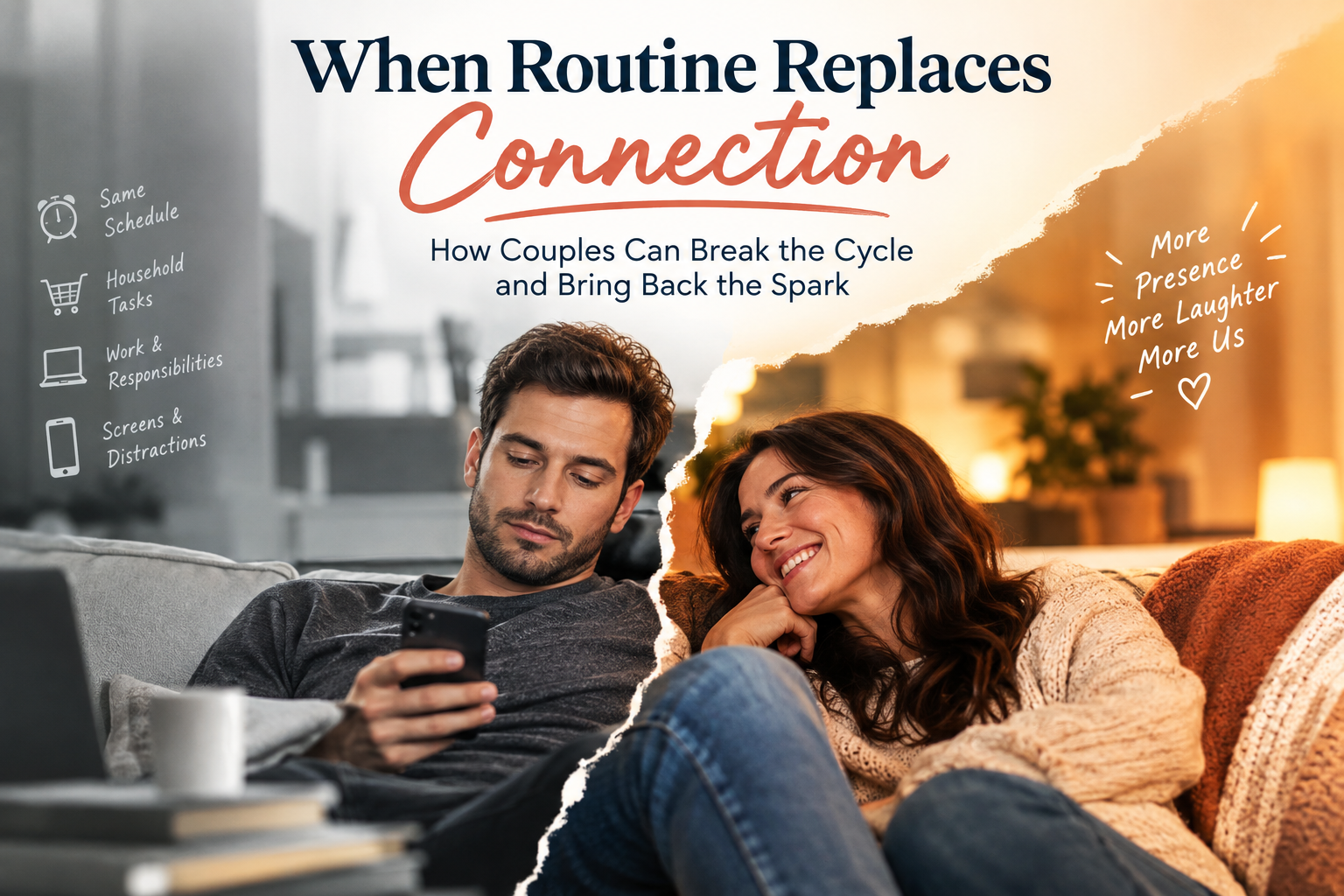
When Routine Replaces Connection: How Couples Can Break the Cycle and Bring Back the Spark
There is something comforting about routine in a relationship. Knowing what your partner likes for breakfast, who usually makes dinner, what time they come home, how weekends typically unfold, and even which side of the bed they sleep on can create a sense of stability and security. Routine can make life easier, especially when couples are balancing careers, children, finances, household responsibilities, and countless other demands. But there is a point at which a healthy routine can quietly become emotional autopilot. The couple may still live together, eat together, sleep beside each other, and say “I love you,” yet somehow feel increasingly disconnected. Nothing dramatic has necessarily happened. There may be no major argument, betrayal, or obvious crisis. Instead, the relationship can slowly become predictable to the point where partners stop actively discovering each other. They know the schedule, but they may no longer know what is happening inside each other.
This is one of the paradoxes of long-term relationships: the familiarity that initially creates comfort can eventually reduce curiosity. In the beginning of a relationship, partners naturally pay close attention to one another. They want to know what the other person is thinking, what makes them laugh, what they dream about, what scares them, what they find attractive, and what they want their future to look like. Novelty creates excitement, anticipation, and emotional engagement. As the relationship becomes established, however, that intentional attention can diminish. Conversations may become primarily logistical: “What time are you coming home?” “Did you pay the bill?” “What are we doing this weekend?” “Can you pick something up from the store?” Communication continues, but emotional connection can gradually disappear from the conversation.
The problem is not necessarily routine itself. In fact, healthy relationships require some predictability. The problem occurs when routine replaces intentional connection. When almost every day begins and ends the same way, couples can begin interacting more like teammates managing a household than romantic partners nurturing an intimate relationship. They may become highly efficient at functioning together while becoming increasingly unfamiliar with each other’s emotional worlds. A couple can therefore be physically close while psychologically distant.
Psychologically, this can happen because the human brain naturally adapts to repeated experiences. Something that once felt exciting can eventually become familiar and require less attention. This process, sometimes described as hedonic adaptation, does not mean that love has disappeared. It means that the emotional intensity associated with something familiar can diminish when there is little novelty, growth, or variation. The first date may have produced anticipation and excitement because everything was new. Years later, sitting across from the same person at the same restaurant every Friday may not generate the same emotional response. The relationship has not necessarily become worse; it may simply need new experiences and renewed attention.
There is another psychological factor that deserves attention: emotional neglect can occur without intentional neglect. A partner does not have to be cruel, dismissive, or abusive to make the other person feel emotionally unseen. Sometimes people become so absorbed in work, parenting, financial responsibilities, technology, or personal stress that they unconsciously stop investing emotional energy in their relationship. They may assume, “My partner knows I love them,” and therefore stop expressing it in meaningful ways. But relationships do not thrive solely on what we feel internally. They thrive on what we consistently communicate and demonstrate.
Over time, a lack of emotional engagement can create a subtle cycle. One partner feels disconnected and begins seeking more attention. The other may interpret those requests as criticism or pressure and withdraw. The first partner then feels even more rejected and increases their attempts to reconnect. The second partner withdraws further. Eventually, both people may conclude that the other has changed, when what has actually changed is the interaction pattern between them. The relationship becomes caught between pursuit and withdrawal, frustration and defensiveness, longing and avoidance.
Routine can also affect intimacy. Sexual and emotional intimacy often require more than physical proximity. They require attention, anticipation, vulnerability, playfulness, and psychological presence. When couples spend most of their time discussing responsibilities, intimacy can begin to feel like another task on the schedule rather than a meaningful expression of connection. Partners may still love one another deeply but feel less desire because they rarely create the emotional environment in which desire can flourish. Desire often benefits from anticipation, individuality, novelty, and feeling genuinely seen by the other person.
Technology can intensify this problem. Two people can sit on the same couch for an entire evening while mentally living in completely different worlds through their phones. Social media, streaming services, work emails, gaming, and constant notifications can fragment attention. When this becomes habitual, couples may unintentionally communicate a powerful message: “What is happening on my screen is more deserving of my attention than what is happening between us.” Even when neither partner consciously means this, repeated divided attention can create emotional distance.
Another important issue is that many couples confuse the absence of conflict with the presence of connection. They may say, “We rarely argue, so our relationship must be healthy.” But emotional intimacy is not simply the absence of fighting. A couple can have very little conflict because they have stopped engaging deeply with each other. They may avoid difficult conversations, stop sharing vulnerable thoughts, or simply coexist peacefully without much emotional interaction. Peace is valuable, but emotional connection requires more than peace. It requires curiosity, affection, vulnerability, appreciation, laughter, meaningful conversation, and shared experiences.
Breaking out of relationship routine therefore begins with recognizing that the goal is not to destroy stability. The goal is to reintroduce intentionality into the stability. Couples do not necessarily need extravagant vacations, expensive dinners, or dramatic romantic gestures. Sometimes the most powerful changes are surprisingly simple. A couple might intentionally have dinner without phones, take a different route during an evening walk, cook something neither person has tried before, revisit the location of their first date, listen to music from an important period in their relationship, or spend an evening asking each other questions they have not discussed in years. The activity itself is often less important than the psychological experience of doing something together with genuine attention.
One particularly effective strategy is to restore curiosity. Never assume that because you have been with someone for years, you already know everything about them. People change. Their priorities evolve. Their fears change. Their ambitions develop. Their definition of happiness may look different at 30 than it does at 40 or 50. Ask your partner what they are currently excited about. Ask what they are worried about. Ask what they would do if money and fear were not obstacles. Ask what they miss about their younger self. Ask what they want the next five years of their life to look like. These questions can transform a routine conversation into an opportunity for rediscovery.
Couples should also deliberately create novel experiences together. Novelty can increase attention because the brain has to process something unfamiliar. You do not have to travel internationally to create novelty. Take a class together. Try a new restaurant. Attend an event you have never experienced. Go somewhere neither of you has visited. Learn a new skill. Exercise together in a different environment. Plan a spontaneous afternoon. Even small changes can interrupt the psychological predictability of everyday life. The purpose is not simply entertainment. Shared novelty creates new memories, new conversations, and new opportunities to see your partner in a different context.
Another powerful strategy is to bring back flirting. Many couples stop flirting once the relationship becomes secure. They may still love each other, but the playful behavior that once created romantic tension gradually disappears. Compliment your partner in a way that goes beyond appearance. Send a playful message during the day. Make eye contact a little longer. Give an unexpected kiss. Tell your partner something you find attractive about them. Create anticipation instead of waiting for intimacy to happen automatically. Romance often survives when couples continue to behave like people who are choosing each other rather than people who simply happen to live together.
Physical affection is equally important. Holding hands, hugging, kissing, sitting close, touching a partner’s shoulder, or giving a spontaneous embrace can communicate safety and affection without requiring a conversation. For many couples, physical touch gradually becomes associated almost exclusively with sexual activity. Reintroducing nonsexual physical affection can help rebuild comfort, warmth, and emotional closeness without creating pressure for sex.
Couples also need to protect quality time rather than simply shared time. Being in the same room is not necessarily quality time. Watching television while scrolling through phones is shared physical space, but it may not create meaningful connection. Quality time requires psychological presence. Even 20 or 30 minutes of focused conversation can be more emotionally nourishing than several hours of distracted coexistence. Put the phones away. Make eye contact. Listen without immediately solving the problem. Ask follow-up questions. Let your partner finish their thoughts. Sometimes what people want most is not advice but the experience of feeling heard.
Gratitude can also change the emotional climate of a relationship. Familiarity has a strange psychological effect: we can become more aware of what is missing than what is present. The things our partner does every day can become invisible because we have become accustomed to them. Intentionally expressing appreciation reverses this process. Instead of assuming your partner knows you appreciate them, say it. Recognize their effort. Thank them for something specific. Tell them what you admire about them. Appreciation is not merely politeness; it can help shift attention toward the positive aspects of the relationship and remind both partners that their efforts matter.
Couples should also learn to distinguish relationship boredom from relationship dissatisfaction. Sometimes the relationship is fundamentally healthy but predictable. In other situations, boredom is a symptom of deeper unresolved problems. If there is persistent resentment, emotional disconnection, unresolved betrayal, chronic criticism, contempt, avoidance, or a significant lack of trust, simply planning more date nights may not solve the underlying issue. Novel experiences can create temporary excitement, but deeper relational wounds require honest communication and, when necessary, professional support.
Communication is therefore essential. Instead of accusing a partner by saying, “You don’t care about me anymore,” a more constructive approach might be, “I miss feeling close to you, and I want us to find our way back to that connection.” The difference is significant. One statement attacks the partner’s character; the other communicates vulnerability and invites collaboration. Healthy communication is not about winning an argument. It is about creating enough emotional safety for two people to tell the truth without immediately becoming enemies.
It is also important for each partner to maintain some individuality. Ironically, complete emotional or behavioral merging can sometimes reduce attraction. Healthy relationships allow two people to remain individuals with their own interests, friendships, goals, passions, and personal growth. When partners continue developing independently, they bring new experiences and perspectives back into the relationship. There is something attractive about discovering that the person you love is still becoming someone new.
Ultimately, bringing back the spark is less about recreating the beginning of the relationship and more about creating a new chapter of the relationship. Couples often make the mistake of trying to become the people they were when they first met. But neither person is the same anymore. The goal should not be to return to the past. It should be to become curious about who you are now and who you can become together.
Love does not necessarily disappear when excitement fades. Sometimes it simply becomes buried underneath responsibilities, repetition, stress, technology, and familiarity. The good news is that connection can often be strengthened when couples begin paying attention again. Ask better questions. Create new experiences. Touch more. Laugh more. Flirt again. Put the phones down. Express appreciation. Talk about dreams instead of only discussing schedules. Make time for each other instead of assuming that time will somehow appear.
A relationship can become comfortable without becoming complacent. It can be predictable without becoming emotionally empty. And it can mature without losing its sense of excitement. The spark is not always something that mysteriously disappears; sometimes it is something that gets neglected. When two people intentionally choose to become curious about each other again, they may discover something even more meaningful than the excitement of a new relationship: the deeper intimacy that comes from continually falling in love with the person your partner is becoming.

dr.dan
Related Posts

Knowing when its time to let go of your existing relationship. Some obvious signs that the end is soon approaching.
As a devoted marriage counselor, my purpose is to guide individuals in...

Powerful benefits on pre-marital counseling: What can it teach you about your existing relationship and its potential success or failure long term: Being proactive can save you from heartache and financial ruins.
Marriage is one of life’s biggest commitments, yet many couples enter it...

When Routine Replaces Connection: How Couples Can Break the Cycle and Bring Back the Spark
There is something comforting about routine in a relationship. Knowing what your...

Here are 4 very simple ways to connect emotionally with the man in your life. It’s all about understanding their love language and where the mind and heart meets.
In my professional experience, I have encountered numerous men who express...