
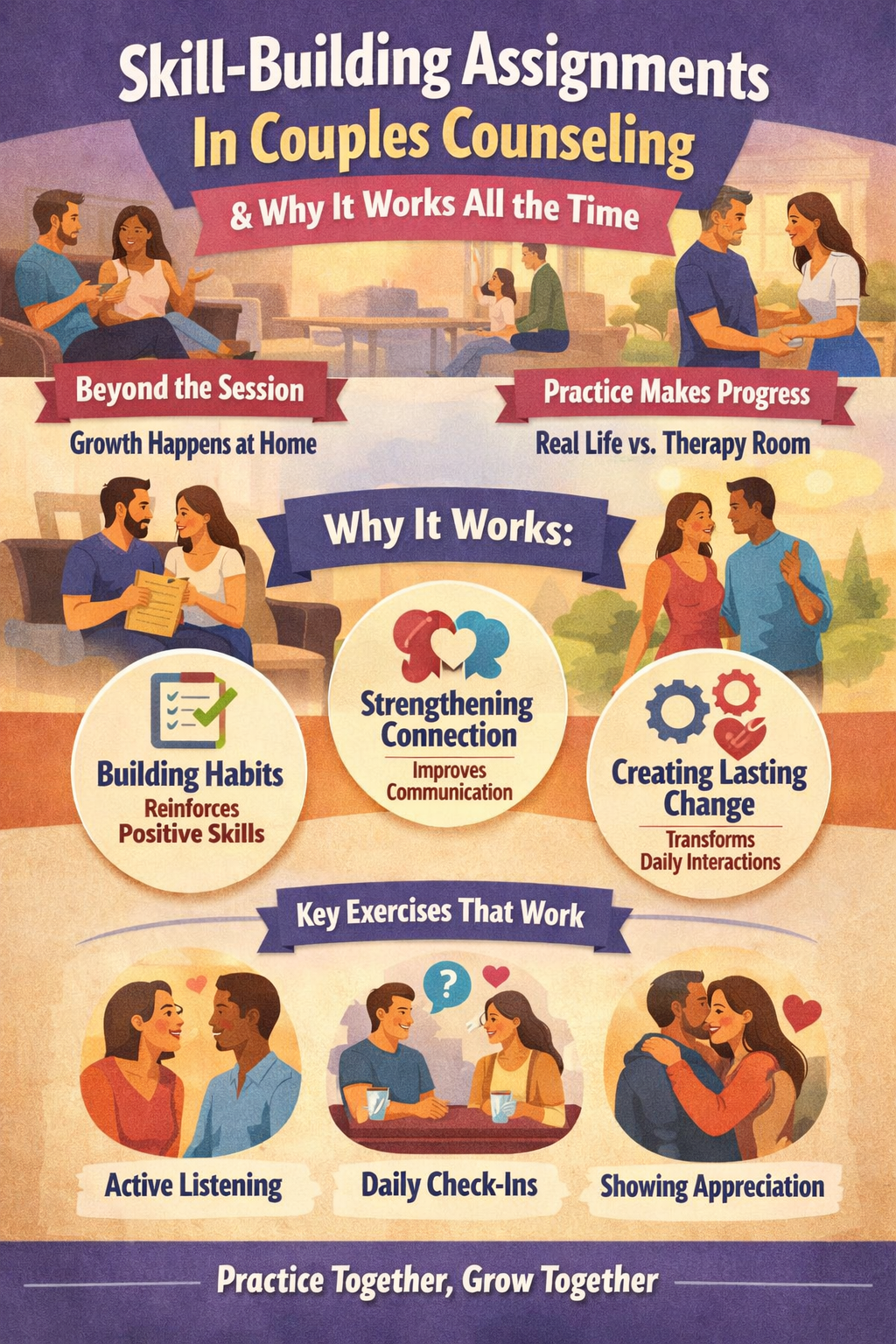
The importance of skill-building assignments in couples therapy: Why collaborative practice outside of therapy sessions has greater impact than in-session work, and universally effective strategies for relationship growth
Couples therapy is often misunderstood as something that happens only inside the therapist’s office, within the boundaries of a weekly session. In reality, the most meaningful change rarely happens in that one hour of guided conversation. Instead, it unfolds in the days and moments between sessions, when couples are living their real lives—navigating stress, miscommunication, emotional triggers, and daily responsibilities. This is where “skill training” assignments become essential. They bridge the gap between insight and transformation, turning awareness into behavior and intention into habit.
Skill training assignments are structured exercises given by the therapist for couples to practice outside of sessions. These assignments are not busy work; they are the core mechanism through which therapy becomes effective. During sessions, couples often gain clarity. They may understand patterns, identify emotional triggers, and even experience moments of connection and resolution. However, understanding something intellectually is very different from applying it under real-life emotional pressure. Skill training assignments create opportunities to practice new behaviors in the exact environments where old patterns used to dominate.
One of the primary reasons work outside the therapy room is more impactful than work inside it is context. In a therapy session, the environment is controlled, calm, and facilitated by a professional whose role is to guide and mediate. Couples are often more regulated emotionally, more reflective, and more intentional in their communication. But real relational difficulty does not occur in controlled environments. It happens in moments of fatigue after a long workday, during financial stress, in parenting disagreements, or when unresolved emotional wounds are triggered unexpectedly. Skill training assignments allow couples to rehearse healthier responses directly within these real-life conditions, where change actually matters.
Another reason external practice is more powerful is repetition. Change in relationships is not created through single insights, but through repeated experiences that reshape emotional memory. When couples practice communication tools, emotional regulation techniques, or conflict resolution strategies only during therapy, the learning remains theoretical. But when they repeatedly apply those same skills at home, in real arguments or emotional conversations, the brain begins to rewire. Over time, new relational habits replace old defensive patterns. This repetition builds confidence and reduces reactivity, which is often one of the biggest barriers in distressed relationships.
Skill training also empowers couples to take ownership of their growth. Therapy sessions can sometimes unintentionally create dependency on the therapist as the “mediator of truth” or the “only safe space” for difficult conversations. While guidance is important, lasting change requires autonomy. When couples are given structured exercises to complete between sessions, they begin to internalize the process of repair and connection. They learn that healing does not depend on the therapist being present, but on their willingness to practice new ways of relating to each other consistently.
One of the most effective strategies in skill training is structured communication practice. This involves setting aside intentional time at home to talk without interruption, defensiveness, or problem-solving pressure. Couples are often guided to use reflective listening, where one partner speaks while the other listens and then repeats back what they heard before responding. This simple structure slows down emotional escalation and creates a sense of being understood, which is often the foundation of conflict resolution.
Another powerful approach is emotional check-ins. Instead of only discussing problems when conflict arises, couples are encouraged to regularly share their emotional state, stress levels, and needs. This reduces emotional buildup, which often leads to explosive arguments. When partners become more attuned to each other’s emotional world in small, consistent ways, the relationship becomes more stable and less reactive over time.
Behavioral assignments that focus on appreciation and positive reinforcement are also highly effective. Many struggling couples fall into patterns where most communication becomes problem-focused or critical. Structured exercises that require partners to intentionally acknowledge what they appreciate about each other help rebalance emotional perception. This does not ignore problems, but it creates a healthier emotional foundation from which problems can be addressed.
Another important element is repair practice. Every couple will experience misunderstandings or emotional missteps even during healing. Skill training assignments often include learning how to pause, revisit a disagreement, and repair emotional ruptures without escalating into blame or withdrawal. This teaches couples that conflict does not have to end in distance; it can end in reconnection.
Ultimately, the power of skill training assignments lies in their ability to transform therapy from an intellectual experience into a lived one. The therapist’s office becomes a place of learning, while real life becomes the practice field. Without this bridge, couples may leave sessions with insight but little change. With it, they begin to build new relational habits that gradually replace the patterns that once created disconnection.
True relationship growth does not come from perfect conversations in therapy. It comes from imperfect conversations at home that are handled differently than before. It is in those repeated moments of choosing patience over reaction, understanding over defensiveness, and connection over withdrawal that real transformation takes place.

dr.dan
Related Posts

When something becomes damaged, repair it instead of opting for a replacement. The same principle applies to relationships and marriages. Continue reading to find guidance on preserving your partnership if you’re genuinely dedicated to its success
In modern society, there's a prevailing tendency to replace things when they...

Is it possible to forgive and move on after infidelity? Some effective strategies in repairing relationships after betrayal, despite popular belief of” Once a cheater, ALWAYS a cheater”!
Infidelity has long been regarded as one of the most painful betrayals in a...

When Routine Replaces Connection: How Couples Can Break the Cycle and Bring Back the Spark
There is something comforting about routine in a relationship. Knowing what your...

Dating Terminologies of the 21st century: Roller coaster of uncertainties and disappointments.
Dating in the 21st century can be daunting, to say the least. With the instant...