

Why depression can make it difficult to recognize and celebrate your achievements—and how to begin acknowledging your efforts, embracing your progress, and taking empowering steps toward a healthier, more positive, and depression-free life.
Depression has a way of changing the way we see ourselves, our accomplishments, and even the meaning of success. You can accomplish something you once worked incredibly hard to achieve, receive recognition from others, reach an important milestone, or overcome an obstacle that once seemed impossible—and still feel little or nothing inside. Instead of excitement, you may feel emptiness. Instead of pride, you may hear an inner voice telling you that what you accomplished was not important, not good enough, or simply what you were “supposed” to do. This can be one of the most frustrating and misunderstood experiences of depression.
One of the most important things to understand is that difficulty celebrating an achievement does not necessarily mean that you are ungrateful, lazy, negative, or incapable of appreciating the good things in your life. Depression can affect motivation, emotional responsiveness, self-esteem, concentration, and the ability to experience pleasure. As a result, something that objectively deserves celebration may not emotionally register as something worth celebrating. Your circumstances may have changed, but your internal experience may still be telling you that nothing has really changed.
Depression can also create a powerful tendency to minimize accomplishments. You might complete a difficult project and immediately think, “Anyone could have done that.” You might reach a personal goal and respond with, “It wasn’t that difficult.” You might receive a compliment and immediately dismiss it. You may compare yourself to someone who appears to be further ahead and conclude that your achievement is insignificant. Over time, this pattern can make you feel as though you are constantly moving forward without ever allowing yourself to recognize how far you have traveled.
Another challenge is that many people unintentionally make achievement the condition for self-worth. They tell themselves, “I’ll be proud of myself when I succeed,” or “I’ll finally feel good about myself when I accomplish this.” The problem is that when success becomes the requirement for feeling worthy, there is always another mountain to climb. Even after reaching the goal, the mind may quickly create a new standard. What was once a dream becomes an expectation, and what should have been a moment of satisfaction becomes another reason to feel inadequate.
Depression can intensify this cycle because the mind often becomes more focused on perceived failures than genuine progress. You may remember the one thing that went wrong while forgetting the ten things that went right. You may focus on what you still need to accomplish instead of acknowledging what you have already overcome. This does not mean that you are choosing to think negatively. Depression can influence attention and interpretation, making negative information feel more convincing and positive information easier to dismiss.
This is why learning to acknowledge your effort is so important. Your achievement is not only the final outcome. It is also the courage, persistence, sacrifices, lessons, disappointments, and small decisions that allowed you to get there. Sometimes the greatest accomplishment is not reaching the destination but continuing to move forward when you were emotionally exhausted and uncertain about whether you could continue.
You deserve to recognize the effort behind your progress.
Perhaps you got out of bed on a difficult morning. Perhaps you made an important phone call that you had been avoiding. Perhaps you went to work despite feeling emotionally drained. Perhaps you asked for help instead of pretending everything was fine. Perhaps you established a healthier boundary, returned to therapy, reconnected with someone you trust, or simply decided that you would give yourself another day to try. These moments may not look impressive from the outside, but they can represent enormous victories for someone struggling with depression.
One powerful shift is learning to replace “Is this accomplishment big enough to celebrate?” with “What did this accomplishment require from me?” This question moves your attention away from comparing your achievement to someone else’s and toward understanding your own journey. Maybe what you accomplished required courage. Maybe it required patience. Maybe it required you to overcome fear. Maybe it required you to keep going when giving up felt easier. Your progress becomes meaningful when you understand what it took to create it.
You also do not have to wait until you feel proud before acknowledging yourself. Sometimes the action comes before the emotion. You can say, “I am proud of myself for making this effort,” even if you do not emotionally feel proud yet. You can recognize your progress even when your mind tells you that it does not matter. Over time, repeatedly practicing this form of self-recognition can help create a different relationship with your accomplishments.
Start with small victories rather than waiting for major milestones. Depression often encourages an all-or-nothing mentality: either you completely succeed or you have failed. A healthier perspective recognizes progress in degrees. Getting through a difficult day can be progress. Completing one task can be progress. Taking care of yourself can be progress. Having an honest conversation can be progress. Trying again after disappointment can be progress. Small steps become significant when they are repeated consistently.
It is also important to separate your identity from your productivity. You are not valuable because of how much you accomplish. You are not more deserving of love because you earn more money, achieve more professionally, maintain a perfect relationship, or constantly perform at your highest level. Achievement can be meaningful, but it should not be the foundation of your worth.
You are a human being before you are a performer, employee, parent, partner, entrepreneur, student, caregiver, or professional.
This distinction can be particularly important for people who have spent years being “the strong one.” When everyone expects you to be capable, independent, successful, and resilient, you may begin believing that you are only worthy when you are functioning at full capacity. Depression can then feel like a personal failure because it challenges the identity you have built around being strong.
But strength is not the absence of struggle.
Strength can also mean admitting that you are struggling. Strength can mean asking for support. Strength can mean slowing down. Strength can mean recognizing that you cannot solve everything by yourself. And sometimes strength means allowing yourself to be human without turning every difficult moment into evidence that something is wrong with you.
Another important step is becoming aware of your internal dialogue. Listen to how you speak to yourself after an accomplishment. Would you speak to a close friend the same way? If your friend completed something difficult and told you, “It wasn’t a big deal,” would you agree with them? Or would you remind them of everything they had overcome to get there?
Try offering yourself the same compassion.
Instead of saying, “I should have done more,” try saying, “I did what I could with what I had at that time.” Instead of “Anyone could have done this,” try “This mattered to me, and I worked for it.” Instead of “I’m still not where I want to be,” try “I may not be where I want to be yet, but I am not where I started.” This does not mean pretending everything is wonderful. It means developing a more balanced and compassionate perspective.
There is also tremendous value in allowing other people to celebrate you. Depression can make compliments uncomfortable. You may instinctively reject praise or explain away your accomplishments. Someone tells you, “You did an amazing job,” and you respond, “It wasn’t anything.” The next time someone genuinely acknowledges something you have accomplished, try simply saying, “Thank you.” You do not have to convince yourself that their praise is completely true. Just allow yourself to receive it.
Celebration does not have to mean throwing a party or feeling overwhelming happiness. Celebration can be quiet. It can be taking a moment to breathe and recognize what you accomplished. It can be treating yourself with kindness. It can be sharing your success with someone who genuinely cares about you. It can be writing down what you accomplished and allowing yourself to acknowledge it without immediately moving on to the next goal.Creating a daily practice of recognizing effort can also be helpful. At the end of the day, ask yourself: “What did I do today that required effort?” The answer does not need to be extraordinary. You are training your mind to notice progress rather than automatically searching for shortcomings.
Another powerful question is, “What would the version of me from five years ago think about where I am today?” We often become so focused on our current destination that we forget to look backward. The person you are today may possess skills, wisdom, resilience, relationships, experiences, and knowledge that your younger self desperately wanted. Your progress may be invisible to you simply because you have become accustomed to it.
Healing also requires patience. There is no single decision that makes depression disappear forever. For many people, recovery involves a combination of professional support, healthy routines, meaningful relationships, self-awareness, and sometimes medication as recommended by a qualified healthcare professional. Seeking professional help is not a sign that you have failed. It is a sign that you are willing to invest in your well-being.
If depression has made it difficult to experience pleasure, motivation, hope, or satisfaction for an extended period, consider speaking with a mental health professional. Depression is treatable, and you do not have to navigate it alone. If you ever experience thoughts of harming yourself or believe you may not be safe, seek immediate professional or emergency support in your area.
Most importantly, remember that the absence of celebration does not erase the achievement. You can accomplish something meaningful and still feel emotionally numb. You can make progress and still feel exhausted. You can be proud of yourself and still have difficult days. Healing is not about forcing yourself to be positive every moment. It is about learning to make room for hope while honestly acknowledging what you are experiencing. Your life does not have to become perfect before you are allowed to appreciate it. Your journey does not have to be finished before you are allowed to acknowledge how far you have come. And you do not have to become someone else before you are worthy of compassion, respect, and love.
Perhaps the first step toward a healthier relationship with yourself is simply recognizing this: you are trying. You are learning. You are growing. You are still here. And even if you cannot celebrate your achievements today, you can begin by acknowledging the effort it took to get this far. Greatness is not always found in extraordinary accomplishments. Sometimes greatness is found in the quiet decision to keep moving forward when life feels extraordinarily difficult. Give yourself permission to notice that.
Give yourself permission to appreciate that. And give yourself permission to believe that your next chapter can be different from your last.
Learn More
Feeling underappreciated in a relationship: The silent threat affecting couples worldwide. Discover effective strategies to strengthen appreciation, deepen connection, and avoid becoming part of this growing statistic.
When people think about the reasons relationships fail, they often imagine dramatic events such as infidelity, financial hardship, constant conflict, or irreconcilable differences. While these issues certainly play a role in many breakups, one of the most damaging relationship threats is often far less visible. It develops quietly over time, frequently unnoticed until emotional distance has already taken hold. That threat is the feeling of being underappreciated.
At the beginning of a relationship, appreciation tends to come naturally. Partners notice and acknowledge even the smallest gestures. A thoughtful text message, a compliment, a surprise gift, or a simple act of kindness can create feelings of gratitude and connection. During this stage, both individuals often feel seen, valued, and important. However, as relationships mature and life becomes increasingly demanding, many couples unintentionally shift their focus away from appreciation and toward responsibility, routine, and obligation.
What was once viewed as a loving gesture gradually becomes expected. The partner who consistently prepares meals, manages household responsibilities, works long hours, provides emotional support, or makes sacrifices for the family may stop receiving acknowledgment for these contributions. Instead of being appreciated, their efforts become part of the background noise of daily life. Over time, this lack of recognition can create feelings of frustration, disappointment, and emotional exhaustion.
The painful reality is that many people do not leave relationships because they have stopped loving their partner. They leave because they no longer feel valued by the person they love. Feeling invisible within a relationship can be one of the loneliest experiences a person can endure. It creates a sense of emotional isolation that often leads individuals to question their worth, their efforts, and sometimes even the future of the relationship itself.
Underappreciation rarely appears overnight. It develops gradually through countless small moments. A thank you that goes unspoken. An effort that goes unnoticed. A sacrifice that is taken for granted. Although each individual incident may seem insignificant, their cumulative effect can be profound. Emotional wounds often result not from a single major event but from a series of small disappointments that accumulate over months or years.
One of the most effective ways to prevent this pattern is through the intentional practice of gratitude. Appreciation is not something that should be assumed; it must be expressed. Many people mistakenly believe that their partner already knows how much they are valued. While this may be partially true, hearing words of appreciation has a powerful psychological impact. A sincere acknowledgment of effort, support, or commitment can strengthen emotional bonds and reinforce feelings of connection. Simple statements such as “I appreciate everything you do” or “Thank you for always being there for me” can have a greater impact than many realize.
Another important strategy involves shifting attention from shortcomings to strengths. Human beings possess a natural tendency to notice problems more readily than positive experiences. In relationships, this often means that mistakes receive more attention than successes. Over time, couples may become experts at identifying what is wrong while overlooking what is right. Healthy relationships thrive when partners actively seek opportunities to recognize each other’s positive qualities, efforts, and contributions.
Communication also plays a critical role in fostering appreciation. Many couples engage in conversations focused primarily on logistics, responsibilities, finances, schedules, and problem-solving. While these discussions are necessary, they should not replace meaningful emotional communication. Taking time to listen attentively, express genuine curiosity, and validate each other’s experiences helps create an environment where both partners feel respected and understood. Feeling heard is one of the most powerful forms of appreciation a person can receive.
Equally important is understanding that people experience appreciation in different ways. Some individuals feel most valued through verbal affirmation, while others experience appreciation through quality time, physical affection, thoughtful gestures, or acts of service. Relationship difficulties often arise when one partner expresses appreciation in a way that feels meaningful to them but not necessarily to the other person. Learning how a partner receives and interprets appreciation can dramatically strengthen emotional intimacy and reduce misunderstandings.
Another common challenge occurs when couples begin keeping score. Relationships can become strained when individuals constantly compare who is giving more, sacrificing more, or contributing more. This transactional mindset often fuels resentment and competition rather than cooperation and connection. Healthy relationships flourish when both partners focus less on measuring contributions and more on supporting one another as members of the same team. Mutual generosity creates a stronger foundation than constant accounting.
Regular relationship check-ins can also help prevent feelings of underappreciation from escalating. Life moves quickly, and many couples become so busy managing responsibilities that they neglect the health of the relationship itself. Setting aside dedicated time to discuss emotional needs, concerns, and positive experiences creates opportunities to address issues before they become deeply rooted. These conversations allow partners to express what makes them feel loved, valued, and appreciated while strengthening trust and understanding.
It is equally important to celebrate progress rather than waiting for major milestones. Many people reserve recognition for significant achievements while overlooking the small victories that occur every day. Acknowledging effort, resilience, growth, and persistence can create a culture of appreciation within the relationship. Whether it is overcoming a challenge, reaching a personal goal, or simply navigating a difficult week together, celebrating these moments reinforces partnership and emotional connection.
The most successful relationships are not those that avoid problems altogether. Rather, they are relationships in which both individuals consistently feel seen, valued, respected, and appreciated. Appreciation acts as an emotional buffer during difficult times, helping couples navigate stress, disagreements, and life’s inevitable challenges. When people feel valued, they become more patient, more forgiving, and more willing to invest in the relationship.
Ultimately, appreciation is one of the simplest yet most powerful tools available to couples. It costs nothing, requires little time, and has the potential to transform the emotional climate of a relationship. In a world where many individuals feel disconnected despite being surrounded by others, taking the time to genuinely acknowledge a partner’s efforts can make all the difference.
The silent threat of underappreciation continues to affect couples across the globe, but it is far from inevitable. By practicing gratitude, communicating openly, recognizing effort, and intentionally making appreciation a daily habit, couples can deepen their connection, strengthen their bond, and avoid becoming part of a growing statistic. In the end, people flourish where they feel valued, and relationships thrive when appreciation is not assumed but consistently expressed.
Learn More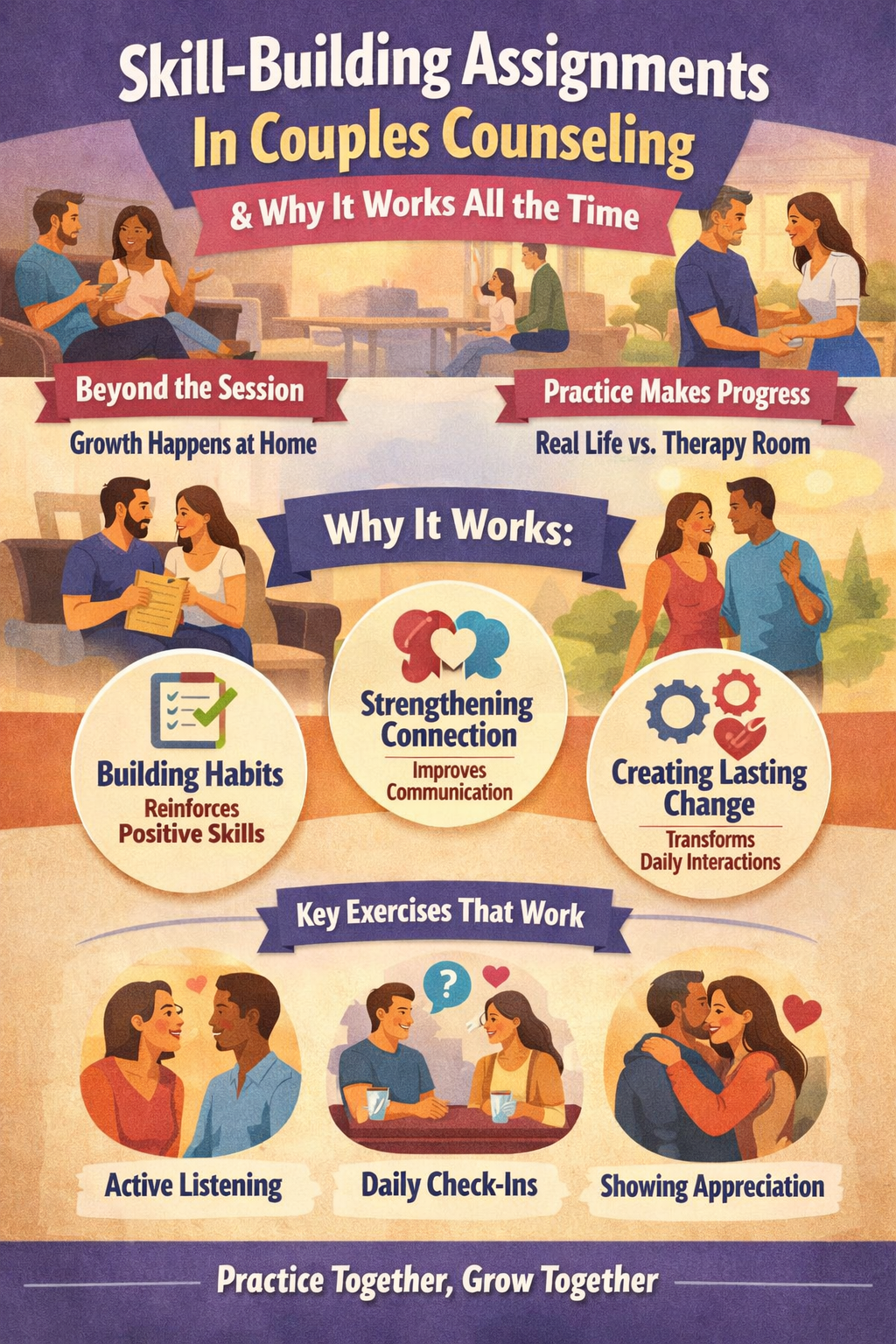
The importance of skill-building assignments in couples therapy: Why collaborative practice outside of therapy sessions has greater impact than in-session work, and universally effective strategies for relationship growth
Couples therapy is often misunderstood as something that happens only inside the therapist’s office, within the boundaries of a weekly session. In reality, the most meaningful change rarely happens in that one hour of guided conversation. Instead, it unfolds in the days and moments between sessions, when couples are living their real lives—navigating stress, miscommunication, emotional triggers, and daily responsibilities. This is where “skill training” assignments become essential. They bridge the gap between insight and transformation, turning awareness into behavior and intention into habit.
Skill training assignments are structured exercises given by the therapist for couples to practice outside of sessions. These assignments are not busy work; they are the core mechanism through which therapy becomes effective. During sessions, couples often gain clarity. They may understand patterns, identify emotional triggers, and even experience moments of connection and resolution. However, understanding something intellectually is very different from applying it under real-life emotional pressure. Skill training assignments create opportunities to practice new behaviors in the exact environments where old patterns used to dominate.
One of the primary reasons work outside the therapy room is more impactful than work inside it is context. In a therapy session, the environment is controlled, calm, and facilitated by a professional whose role is to guide and mediate. Couples are often more regulated emotionally, more reflective, and more intentional in their communication. But real relational difficulty does not occur in controlled environments. It happens in moments of fatigue after a long workday, during financial stress, in parenting disagreements, or when unresolved emotional wounds are triggered unexpectedly. Skill training assignments allow couples to rehearse healthier responses directly within these real-life conditions, where change actually matters.
Another reason external practice is more powerful is repetition. Change in relationships is not created through single insights, but through repeated experiences that reshape emotional memory. When couples practice communication tools, emotional regulation techniques, or conflict resolution strategies only during therapy, the learning remains theoretical. But when they repeatedly apply those same skills at home, in real arguments or emotional conversations, the brain begins to rewire. Over time, new relational habits replace old defensive patterns. This repetition builds confidence and reduces reactivity, which is often one of the biggest barriers in distressed relationships.
Skill training also empowers couples to take ownership of their growth. Therapy sessions can sometimes unintentionally create dependency on the therapist as the “mediator of truth” or the “only safe space” for difficult conversations. While guidance is important, lasting change requires autonomy. When couples are given structured exercises to complete between sessions, they begin to internalize the process of repair and connection. They learn that healing does not depend on the therapist being present, but on their willingness to practice new ways of relating to each other consistently.
One of the most effective strategies in skill training is structured communication practice. This involves setting aside intentional time at home to talk without interruption, defensiveness, or problem-solving pressure. Couples are often guided to use reflective listening, where one partner speaks while the other listens and then repeats back what they heard before responding. This simple structure slows down emotional escalation and creates a sense of being understood, which is often the foundation of conflict resolution.
Another powerful approach is emotional check-ins. Instead of only discussing problems when conflict arises, couples are encouraged to regularly share their emotional state, stress levels, and needs. This reduces emotional buildup, which often leads to explosive arguments. When partners become more attuned to each other’s emotional world in small, consistent ways, the relationship becomes more stable and less reactive over time.
Behavioral assignments that focus on appreciation and positive reinforcement are also highly effective. Many struggling couples fall into patterns where most communication becomes problem-focused or critical. Structured exercises that require partners to intentionally acknowledge what they appreciate about each other help rebalance emotional perception. This does not ignore problems, but it creates a healthier emotional foundation from which problems can be addressed.
Another important element is repair practice. Every couple will experience misunderstandings or emotional missteps even during healing. Skill training assignments often include learning how to pause, revisit a disagreement, and repair emotional ruptures without escalating into blame or withdrawal. This teaches couples that conflict does not have to end in distance; it can end in reconnection.
Ultimately, the power of skill training assignments lies in their ability to transform therapy from an intellectual experience into a lived one. The therapist’s office becomes a place of learning, while real life becomes the practice field. Without this bridge, couples may leave sessions with insight but little change. With it, they begin to build new relational habits that gradually replace the patterns that once created disconnection.
True relationship growth does not come from perfect conversations in therapy. It comes from imperfect conversations at home that are handled differently than before. It is in those repeated moments of choosing patience over reaction, understanding over defensiveness, and connection over withdrawal that real transformation takes place.
Learn More
Small acts of cheating: The rise of “micro-cheating” and its impact on trust in relationship. What really constitute cheating and understand the nuances between all that is involved and at what level does micro-cheating actually happens ?
In an era where communication is instant and constant, relationships are being tested in ways that didn’t exist a generation ago. With smartphones, social media, and endless opportunities for connection, the definition of cheating has become less clear-cut. No longer confined to physical intimacy, betrayal can now occur in subtle, almost invisible ways. This is where the concept of “micro-cheating” has emerged—small, often ambiguous behaviors that may not seem significant on the surface, yet can have a profound impact on trust and emotional security within a relationship.
Micro-cheating is not about a single, obvious act of infidelity. It’s about patterns of behavior that suggest attention, energy, or emotional investment is being directed outside the relationship in ways that feel inappropriate or secretive. These behaviors can include consistently engaging with a specific person online in a flirtatious manner, maintaining private conversations that are intentionally hidden, seeking validation or emotional support from someone else instead of a partner, or presenting oneself differently to attract outside attention. On their own, these actions may appear harmless or even dismissible. But over time, they can create a subtle shift in loyalty and connection.
What makes micro-cheating particularly complex is its ambiguity. Unlike traditional cheating, which is widely recognized and often universally condemned, micro-cheating lives in a gray area. One partner may view certain behaviors as innocent or insignificant, while the other may experience them as a breach of trust. This disconnect can lead to confusion, defensiveness, and emotional distance. The issue is not always the behavior itself, but the lack of shared understanding around what is acceptable within the relationship.
At the core of this issue lies a fundamental question: what truly constitutes cheating? The answer is not universal. For some, cheating begins the moment physical boundaries are crossed. For others, emotional intimacy with someone outside the relationship can feel equally, if not more, damaging. In many cases, the defining factor is not the specific act, but the presence of secrecy. When someone feels the need to hide interactions, delete messages, or downplay connections, it often signals that a boundary—spoken or unspoken—has already been crossed.
Intent also plays a crucial role in understanding micro-cheating. There is a significant difference between casual, transparent interaction and behavior driven by a desire for validation, attention, or emotional escape. When someone begins to seek fulfillment outside of their relationship—whether through flirtation, emotional connection, or external approval—it can indicate that something within the relationship is either lacking or being avoided. This doesn’t always mean the relationship is failing, but it does highlight areas that require attention and honest conversation.
The impact of micro-cheating on trust is often gradual rather than immediate. Unlike a single act of betrayal that creates a clear rupture, micro-cheating erodes trust over time. It introduces doubt, fuels insecurity, and creates a sense of emotional distance. A partner may begin to question not only specific behaviors, but the overall integrity of the relationship. Even if no physical boundaries are crossed, the emotional consequences can be significant. Trust, once shaken, becomes harder to rebuild when the lines of betrayal are unclear or continuously shifting.
Another layer to consider is the role of modern technology. Social media platforms encourage constant interaction, comparison, and validation. The line between public and private life has blurred, making it easier for individuals to engage in behaviors that may feel harmless but carry deeper implications. A message that might have once been a passing conversation can now turn into an ongoing connection. A simple “like” can evolve into consistent attention. Over time, these small interactions can form patterns that resemble emotional investment.
However, it is important to recognize that not all external interactions are inherently harmful. Healthy relationships allow for individuality, friendships, and social engagement outside the partnership. The difference lies in transparency, intention, and boundaries. When interactions are open, respectful, and do not detract from the primary relationship, they are less likely to cause harm. It is when these interactions become secretive, prioritized, or emotionally charged that they begin to cross into problematic territory.
Understanding the nuances of micro-cheating requires couples to move away from assumptions and toward clear communication. Many conflicts arise not because of intentional betrayal, but because expectations were never clearly defined. What one person considers harmless, another may find deeply hurtful. Without open dialogue, both partners operate within their own definitions, increasing the likelihood of misunderstanding and emotional disconnect.
Cheating, in its truest sense, begins when trust is compromised. This can happen through physical actions, but it can also occur through emotional withdrawal, secrecy, or the gradual redirection of attention and energy away from the relationship. It is not always a dramatic event, but often a series of small choices that collectively weaken the foundation of connection.
The rise of micro-cheating reflects a broader shift in how relationships function in the modern world. It challenges individuals to be more intentional, more self-aware, and more communicative about their needs and boundaries. It also invites a deeper reflection on what loyalty and commitment truly mean—not just in action, but in attention, intention, and emotional presence.
Ultimately, the health of a relationship is not determined by the absence of temptation or external interaction, but by the presence of trust, respect, and clarity. Micro-cheating serves as a reminder that it is often the smallest actions, repeated over time, that have the greatest impact. Whether those actions build trust or slowly erode it depends on the awareness and choices of both individuals involved.
In a world where connection is constant, protecting the integrity of a relationship requires more than avoiding obvious betrayal. It requires mindfulness in the subtle moments—the conversations, the intentions, and the decisions that shape where your energy truly goes.
Learn More
How cognitive distortions drive anxiety and how therapy can address them: the various ways we interpret everyday challenges and their impact on our emotions
Anxiety is more than just occasional worry—it’s a persistent, often invisible burden that can shape how we view ourselves, others, and the world around us. One of the key reasons anxiety takes hold is the way our minds interpret daily experiences. Our thoughts are not always neutral; they are filtered through mental shortcuts and patterns known as cognitive distortions. These distortions are habitual ways of thinking that exaggerate danger, personalize negative events, or twist reality in ways that fuel emotional distress. While everyone experiences them from time to time, when these distorted thoughts become automatic, they can make ordinary challenges feel overwhelming, unmanageable, or even threatening.
Take, for instance, a common scenario: a person receives a brief critique from their manager on a work project. A neutral mind might interpret this as constructive feedback, a chance to improve, or simply a normal part of professional growth. Someone under the influence of cognitive distortions, however, might immediately think, “I’m terrible at my job. I’ll never succeed. Everyone thinks I’m incompetent.” Suddenly, a simple piece of feedback has escalated into a full-blown crisis in the mind, sparking anxiety, sleeplessness, and even avoidance of future projects. This pattern illustrates the distortion of “catastrophizing,” where the mind automatically jumps to the worst-case scenario, ignoring context or evidence.
Another common example can be found in social situations. Imagine receiving a text from a friend that is brief or delayed. A rational interpretation might be, “They’re busy; they’ll reply later.” Cognitive distortions, however, can transform this into spiraling worry: “They must be upset with me. I probably did something wrong. They don’t like me anymore.” This distortion, known as “mind reading,” assumes we know others’ thoughts and intentions, often in a negative and inaccurate way. Anxiety grows because the mind fabricates threats that may not exist, and the body responds as if danger is real.
Cognitive distortions can also distort how we interpret setbacks. Picture missing a workout because of a busy schedule. A balanced perspective might say, “I’ll get back on track tomorrow.” A distorted interpretation could be, “I can never stick to anything. I’m lazy and undisciplined. I’ll never reach my goals.” Suddenly, a single missed day feels like evidence of permanent failure, and anxiety about long-term outcomes intensifies. Over time, these small daily distortions compound, creating a persistent sense of worry and inadequacy.
Therapy offers a structured and effective way to address these distorted thinking patterns. Cognitive Behavioral Therapy (CBT), one of the most researched and widely used approaches, helps individuals identify when their thoughts are inaccurate or exaggerated. It then guides them in examining the evidence for and against these beliefs, teaching them to replace automatic distortions with more balanced, realistic interpretations. For example, in the workplace critique scenario, therapy can help the client reframe their thinking: “One critique doesn’t define my abilities. I’ve successfully completed many projects, and this is a chance to improve.” Over time, this practice rewires thought patterns, reducing the emotional intensity that previously accompanied minor triggers.
Therapy also incorporates tools for regulating the physical and emotional response to anxiety. Mindfulness techniques help people stay present, preventing the mind from spiraling into catastrophic future scenarios. Grounding exercises anchor attention to the present, easing the rush of worry. Breathing techniques calm the nervous system, reducing the physical symptoms that often accompany distorted thinking, such as heart palpitations, rapid breathing, or tense muscles. These strategies create a feedback loop: calmer physical states help the mind interpret situations more realistically, further reducing anxiety.
Relatable examples of cognitive distortions abound in everyday life. Students may interpret a single low grade as proof they are “not smart enough,” ignoring the context of overall performance. Parents may see a child’s tantrum and immediately think, “I’m failing as a parent,” despite evidence of consistent nurturing and care. People navigating relationships may misinterpret neutral expressions or delayed responses as rejection or disinterest, fueling anxiety in ways that undermine connection. In each case, the distortion amplifies emotional reactions, making ordinary life experiences feel fraught with danger or failure.
Over time, the cumulative effect of cognitive distortions is profound. They affect not just mental health but decision-making, relationships, work performance, and overall quality of life. They can lead to avoidance behaviors—skipping social events, postponing tasks, or withdrawing from loved ones—because the mind predicts negative outcomes that may never occur. In essence, cognitive distortions create a self-reinforcing cycle: distorted thoughts trigger anxiety, anxiety confirms distorted thinking, and the cycle continues.
The good news is that therapy can break this cycle. By making the mind’s distortions visible, giving clients tools to challenge them, and teaching practical coping strategies, therapy empowers individuals to take control of their emotional lives. They learn to see challenges as manageable rather than catastrophic, setbacks as temporary rather than permanent, and social cues as neutral rather than threatening. Gradually, this fosters resilience, confidence, and a sense of emotional stability.
In conclusion, cognitive distortions are often silent drivers of anxiety, shaping our interpretations of everyday events in ways that magnify stress, fear, and self-doubt. They turn minor challenges into major crises in the mind and fuel emotional patterns that interfere with life. Therapy, particularly evidence-based approaches like CBT, provides tools to identify, challenge, and reframe these distorted thoughts, restoring balance and perspective. By learning to reinterpret daily experiences more accurately, individuals can reclaim a sense of control over their emotions, navigate life’s challenges with confidence, and experience less anxiety in the moments that matter most.
Learn More
Depression and the Fear of False Improvement: The Hidden Cost of Rapid Self-Growth
Personal growth has become one of the defining pursuits of modern life. From social media feeds filled with inspirational quotes to an endless supply of podcasts, books, and courses promising rapid transformation, the idea of “becoming your best self” is omnipresent. On the surface, this emphasis on self-improvement seems positive—encouraging individuals to reflect, learn, and grow. Yet, beneath the surface lies a subtle, often overlooked danger: the fear of false improvement and the emotional toll it can take, particularly for those already struggling with depression.
Depression is not simply sadness; it is a pervasive sense of emptiness, hopelessness, and self-doubt. When individuals dealing with depression encounter the modern culture of rapid self-improvement, the pressure to “fix themselves” quickly can feel unbearable. They are constantly confronted with the expectation that change should be visible, measurable, and swift. Social media amplifies this effect, showing carefully curated snapshots of other people’s growth—smooth transformations, perfect routines, and seemingly effortless success. The unspoken message is clear: if you are not improving at the same pace, you are failing.
This expectation sets the stage for a phenomenon that could be called the fear of false improvement. Individuals may attempt to follow the self-help advice, adopt new routines, or push themselves toward ambitious goals, but the results rarely appear as quickly as promised. Progress in personal growth, particularly when dealing with mental health challenges, is rarely linear or instantaneous. Yet the constant comparison to idealized timelines can create a sense of inadequacy, triggering self-criticism, frustration, and, paradoxically, deepening depressive symptoms. Instead of feeling empowered by growth, people may feel more stuck, more hopeless, and more like they are failing at life itself.
The problem is compounded by the culture of overachievement that often accompanies personal growth rhetoric. High expectations, when unmet, inevitably bring high disappointment. The more one internalizes the belief that they should be improving rapidly, the more painful every perceived failure becomes. The very tools designed to inspire growth—goal-setting, self-tracking, affirmations, visualization—can transform into instruments of pressure, amplifying feelings of guilt, shame, and inadequacy. Depression, already a condition that feeds on negative self-perception, is uniquely vulnerable to this trap.
Moreover, the notion of “false improvement” introduces another layer of stress. Individuals may fear that even when they make progress, it is only superficial—performative rather than genuine. They may question whether their growth is real or just a temporary mask to appear functional, capable, or happy. This fear can lead to anxiety, self-doubt, and emotional paralysis, creating a vicious cycle where the pressure to improve fuels the very symptoms they are attempting to overcome.
The cultural obsession with rapid results also undermines patience and self-compassion, both essential components of authentic personal growth. Real change—whether in mindset, behavior, or emotional regulation—requires time, consistent effort, and often the willingness to experience setbacks. The promise of instant improvement not only misrepresents reality but can also make slow progress feel like failure. When every small misstep is magnified by the expectation of fast transformation, individuals may retreat from growth altogether, reinforcing feelings of hopelessness and depression.
Addressing this problem requires a shift in how personal growth is approached. Growth should be reframed as a journey rather than a race. Progress, particularly when it involves mental health or deep-seated behavioral change, is rarely linear, and the timeline is unique to each individual. Emphasizing small, sustainable improvements, celebrating incremental successes, and accepting setbacks as part of the process can reduce the emotional toll of high expectations. Equally important is fostering self-compassion, the ability to treat oneself with patience, kindness, and understanding even in moments of perceived failure.
Ultimately, the fear of false improvement highlights a critical paradox of modern self-help culture: the very tools designed to empower can inadvertently exacerbate distress when expectations outpace reality. Personal growth remains a valuable pursuit, but it must be approached with mindfulness, patience, and realistic goals. By embracing the slow, often messy process of genuine transformation, individuals can protect themselves from the hidden dangers of rapid improvement culture and cultivate meaningful, lasting change without the added burden of depression and self-doubt.
Learn More
The space-time continuum. How depression can distort your sense of time and ways to fall back on the right path to feel whole again. Strategies that works!
Have you ever noticed how, when you’re feeling low, time seems to slip through your fingers—or stretch endlessly before you? A single hour can feel like an eternity, while a week can vanish in a blur. For those struggling with depression, this isn’t just a feeling; it’s a profound distortion of reality, a shifting of the very fabric of time and space that makes life feel unmoored, disconnected, and heavy.
Imagine waking up on a Monday, looking at the clock, and feeling as though you’ve been lying in bed for days, even though only hours have passed. You plan your day, hoping to accomplish tasks, reach out to friends, maybe take a walk, but everything feels slow, distant, as if you are moving through a dream. This is one way depression warps the time continuum—it stretches the present, turning simple moments into mountains that seem impossible to climb.
Other times, life feels like it’s rushing past, uncontrollable and relentless. Weeks disappear without leaving any memory, responsibilities pile up, and you feel behind, even though you haven’t moved. You wake up one morning surprised it’s Friday, wondering where the time went. Depression has a strange duality: it can make time drag when your mind is clouded by sadness, yet make it vanish when the weight of disengagement blinds you to the present.
Space can feel just as distorted. Your home, once a place of comfort, might feel like a cage. Simple decisions—what to eat, what to wear, whether to step outside—suddenly feel monumental. Corridors feel longer, rooms feel empty, and even familiar streets seem alien. This altered perception amplifies isolation, as the world feels both oppressive and distant at the same time.
But there is hope. There is a path back to the sense of rhythm, grounding, and wholeness. The first step is awareness—recognizing that the distortions of time and space are not failures on your part, but symptoms of depression. Understanding this can shift the narrative from self-blame to self-compassion.
The next step is grounding routines. Start small. Wake up at roughly the same time each day. Eat meals at regular intervals. Step outside for even a few minutes of fresh air or sunlight. These simple acts anchor you to the world, giving structure to the days that may otherwise feel shapeless. When your body begins to sense routine, your mind slowly starts to catch up, and the distorted flow of time becomes more manageable.
Engaging in focused activities can also restore a sense of temporal coherence. Reading a book, cooking a meal, gardening, or working on a creative project forces your mind to inhabit the present. As you concentrate on tasks, the stretched minutes of depression begin to compress, and the lost days start to feel tangible again. Each small accomplishment, no matter how minor, becomes a marker in the timeline of your life, reminding you that you are moving forward.
Mindfulness and meditation are equally powerful tools. By practicing awareness of your body, your breath, and the world around you, you reconnect with the present moment, gently dissolving the haze of distorted time. A mindful walk, noticing the rhythm of your steps and the feel of the air, can reconnect you with the world and your place in it. Even just five minutes of focused breathing can interrupt the spiral of rumination, helping time regain its natural flow.
Physical activity and exposure to sunlight further reinforce this realignment. Exercise triggers the release of mood-regulating chemicals in the brain, while sunlight helps regulate circadian rhythms, the body’s internal clock. Both interventions subtly recalibrate your perception of time and reinforce your connection to the natural cycles of day and night.
Human connection, too, is a lifeline. Depression isolates, stretching moments of loneliness into unbearable spans, but interactions with others—friends, family, support groups—provide external anchors in time and space. A conversation, a shared laugh, or a simple check-in reminds your brain that life continues, that time has meaning, and that you are not alone in navigating it.
Professional support amplifies these strategies. Therapists can help identify thought patterns that distort perception of time and space and teach coping tools to counteract them. Cognitive-behavioral techniques can train the mind to recognize and reframe moments that feel endless or fleeting. Sometimes, medication is needed to correct chemical imbalances that exacerbate these distortions. Professional guidance does not remove the struggle, but it lights the way toward balance and clarity.
Recovery from these distortions is a gradual journey, not a single leap. It begins with small, intentional steps: noticing the sunrise, making a cup of tea, laughing at a friend’s joke, taking a deep breath and feeling your feet on the ground. Each moment, each choice, rebuilds the bridge between you and the continuity of your life. Time begins to flow more naturally, space feels more navigable, and the world becomes less like a foreign land and more like home again.
Depression may warp your perception of time and space, but it does not define your reality. By practicing awareness, establishing routines, connecting with others, and seeking guidance, you can reclaim the rhythm of life. Moments of stillness, laughter, and achievement accumulate, gradually restoring your sense of presence and wholeness. The continuum of time and space may have felt broken, but it can be rebuilt—moment by moment—until you feel grounded, alive, and fully connected to your world once more.
Learn More
Staying on the Mental Edge: How a “Threat-Focused” brain keeps you wired—stressed, anxious and what to do about it. Some strategies that can work!
Have you ever felt like your mind is always on high alert, scanning for problems, risks, or danger, even when everything seems perfectly fine? If so, you’re not imagining it. What you’re experiencing is what psychologists call a “threat-focused” brain—a mind wired to detect threats, anticipate challenges, and stay vigilant at all times. This hyper-alert state may have been essential for our ancestors, keeping them alive in dangerous environments, but in today’s world, it can leave you feeling exhausted, anxious, and perpetually on edge. Understanding why your brain stays in this mode, and learning how to calm it, is key to maintaining focus, resilience, and mental well-being.
A threat-focused brain is always scanning for what could go wrong. It prioritizes negative stimuli and asks questions like, “Is this safe?” or “What could happen if I fail?” While this heightened awareness can help you plan and avoid mistakes, it also keeps your body’s stress systems—cortisol and adrenaline—constantly activated. Over time, chronic stress wears on your mind and body, affecting sleep, focus, decision-making, and even physical health. Headaches, high blood pressure, muscle tension, and digestive issues are all common byproducts of a brain stuck in survival mode. Recognizing the signs of a threat-focused mind—racing thoughts, irritability, and a constant sense of tension—is the first step toward regaining control.
The good news is that there are proven strategies to calm a threat-focused brain without dulling your awareness. One of the most effective methods is mindfulness. By intentionally bringing your attention to the present moment, you signal to your nervous system that it is safe to relax. Mindfulness can take many forms: focused breathing, guided meditation, or simply observing your surroundings without judgment. Even a few minutes a day can retrain your brain to notice opportunities, gratitude, and positive experiences instead of constantly scanning for danger.
Alongside mindfulness, cognitive reframing offers another powerful approach. This involves noticing fear-driven or negative thoughts and consciously questioning their accuracy. Instead of letting your mind spiral into worst-case scenarios, you can remind yourself of your skills, preparation, and past successes. Over time, reframing changes the way your brain interprets stressors, shifting from seeing every challenge as a threat to viewing them as opportunities for growth and problem-solving.
Physical activity also plays a vital role in managing a threat-focused mind. Exercise reduces the buildup of stress hormones, releases endorphins, and improves overall nervous system regulation. Whether it’s a brisk walk, a yoga session, or a swim, movement provides a tangible outlet for tension and mental fatigue. Consistent activity also supports restorative sleep, which is often disrupted in a hyper-vigilant state.
Equally important is the role of social connection. Humans are hardwired to respond to support and reassurance. Talking through worries with trusted friends, family, or support networks provides perspective, emotional release, and the sense that you’re not facing challenges alone. Feeling connected and understood sends a powerful signal to the brain that it’s safe, reducing the constant fight-or-flight response that a threat-focused mind tends to maintain.
What’s key to remember is that a threat-focused brain doesn’t have to be your enemy. It’s a tool—a highly tuned radar system that can help you stay alert and prepared—but it needs guidance. By practicing mindfulness, reframing negative thoughts, moving your body, and nurturing supportive relationships, you can retrain your mind to stay alert without being anxious. You can reclaim control over your mental state, sharpen your focus, and build resilience without living in constant tension.
Ultimately, living with a threat-focused brain is about balance. It’s about harnessing the benefits of vigilance while learning when to relax, when to trust yourself, and when to let go of imagined dangers. By consistently applying strategies that soothe and recalibrate your nervous system, you can stay mentally sharp, emotionally grounded, and ready to thrive in a world that often demands your attention but doesn’t have to drain your peace of mind. Your mind may be wired to notice threats, but with the right practices, you can teach it to notice possibilities too.
Learn More
The ONE of many challenges in Parenting: The art of active listening with teenage kids and create healthy and engaging conversations within family dynamics. The do’s and don’ts of interactions.
Parenting teenagers is often considered one of the most rewarding yet simultaneously challenging stages in family life. Adolescence is a period of tremendous growth, exploration, and self-discovery, but it is also a time of emotional turbulence, evolving social pressures, and an intensified need for independence. For many parents, these changes can feel overwhelming, leaving them uncertain about how to connect meaningfully with their children. Among the numerous challenges that arise during this stage, one skill stands out as both essential and transformative: the art of active listening. Mastering this skill allows parents to create healthy, engaging conversations, maintain strong family bonds, and navigate the complexities of adolescent life with empathy and understanding.
Active listening is far more than simply hearing words. It involves fully engaging with a child’s thoughts, emotions, and intentions, showing genuine interest, and responding in ways that convey understanding. Teenagers are particularly sensitive to whether they are being truly heard or simply tolerated. When parents practice active listening, they demonstrate that their child’s perspective is valued and respected. This acknowledgment fosters trust, encourages openness, and makes it more likely that a teenager will seek guidance or share difficult experiences rather than withdraw in silence or act out through rebellious behavior. Active listening also helps parents understand the root causes of certain behaviors, enabling more thoughtful and effective responses to challenges such as mood swings, conflicts with peers, or academic pressures.
Creating an environment that encourages active, meaningful communication requires careful attention to family dynamics. Parents must cultivate patience, empathy, and emotional intelligence, recognizing that a teenager’s feelings are valid even if their perspective differs from an adult’s. Engaging in conversations with curiosity rather than judgment can transform ordinary exchanges into opportunities for connection. Asking questions that invite reflection, rather than simply eliciting yes or no responses, encourages adolescents to think critically and express themselves more fully. Statements that reflect understanding and empathy, such as acknowledging frustration or validating disappointment, communicate care far more effectively than immediate advice or criticism.
However, the path to effective communication is fraught with potential pitfalls. One of the most common mistakes parents make is dismissing or minimizing their teenager’s emotions. Phrases like “You’re overreacting” or “It’s not a big deal” can unintentionally communicate that their feelings are unimportant, which may lead to withdrawal or resentment. Interrupting a teen mid-sentence, responding with impatience, or immediately attempting to solve a problem can similarly shut down dialogue. Parents must resist the urge to dominate conversations or impose solutions prematurely. Likewise, sarcasm, judgment, or belittling humor can have lasting negative effects on a child’s willingness to communicate openly. By consciously avoiding these behaviors, parents create a space where teens feel safe, respected, and empowered to express themselves.
Active listening also involves recognizing nonverbal cues and emotional undercurrents. Often, teenagers communicate as much through body language, tone, and facial expressions as through their words. Parents who observe these signals and respond thoughtfully are better equipped to understand the full context of a child’s feelings. This attentiveness demonstrates that the parent is fully present, not merely performing a superficial check-in, and reinforces the message that the teenager’s inner world matters.
Another key aspect of effective communication is modeling healthy dialogue. Parents who actively listen, respond empathetically, and express their own thoughts and emotions constructively teach adolescents the skills they need for future relationships. This modeling includes demonstrating patience, using reflective language, and showing that disagreements can be navigated respectfully without escalating into conflict. By witnessing these interactions firsthand, teenagers learn to communicate with self-awareness, respect, and emotional intelligence—skills that will serve them long after they leave the family home.
Importantly, active listening is not a one-time effort but a consistent practice. Family dynamics thrive when parents make conscious, repeated efforts to engage in meaningful dialogue. This involves not only listening during moments of conflict but also during everyday interactions—talking about school, friendships, hobbies, or current events. Regular, thoughtful conversations help normalize open communication, build trust, and reduce the emotional distance that often grows between parents and teenagers. Over time, these interactions contribute to a more cohesive, resilient family unit, capable of navigating challenges together rather than in isolation.
Finally, the benefits of active listening extend far beyond immediate conflict resolution. Teens who feel heard are more likely to develop strong self-esteem, resilience, and emotional regulation. They are more willing to seek guidance, discuss difficult topics such as mental health or risky behaviors, and collaborate with their parents in problem-solving. For parents, the rewards are equally significant: deeper connections, reduced misunderstandings, and the satisfaction of nurturing a healthy, thriving family dynamic.
While parenting teenagers is undeniably challenging, active listening emerges as one of the most powerful tools in fostering meaningful communication and strong family relationships. By fully engaging with their children, validating emotions, avoiding judgment, and modeling constructive dialogue, parents create an environment where teenagers feel supported, understood, and empowered. The art of active listening transforms everyday conversations into opportunities for connection, growth, and mutual respect, enabling families to navigate the complexities of adolescence together. It is through this intentional practice that parents can turn the challenges of teenage years into meaningful opportunities for lasting bonds and enduring understanding.
Learn More