

Depression and Feeling “Behind” in Life: How Comparison Can Drain Your Joy—and How to Overcome These Emotional Mood Killers
Have you ever looked around at your life and felt as though everyone else is moving forward while you are standing still? Someone gets married, someone buys a home, a former classmate gets promoted, a friend starts a successful business, or someone you know seems to be traveling the world and living the life you wish you had. Meanwhile, you may find yourself asking, “What am I doing with my life?” or “Why am I not where I thought I would be by now?” These questions can become particularly painful when they are repeated often enough that they begin to shape the way you see yourself.
Comparison can be one of the biggest emotional mood killers because it can quietly transform another person’s success into evidence of our own perceived failure. Instead of appreciating our own journey, we become preoccupied with where we believe we should be. For someone experiencing depression, this pattern can become even more intense. Depression can influence the way we interpret ourselves, our circumstances, our accomplishments, and even our future. A temporary setback can begin to feel like proof that we are permanently falling behind. A missed opportunity can feel like a life sentence. A difficult season can begin to look like our entire story.
But there is something important we often forget: there is no universal timeline for a meaningful life.
Society can make it seem as though life comes with a predetermined schedule. We are expected to graduate by a certain age, establish a career, find a partner, get married, have children, purchase a home, build wealth, achieve professional success, and eventually retire comfortably. These may be meaningful goals for some people, but they are not universal deadlines. When we begin treating them as deadlines, we can start measuring our worth against an imaginary timetable. Instead of asking, “What do I want from my life?” we start asking, “Why don’t I have what everyone else has?”
That shift can have a powerful psychological effect. Feeling behind can create shame, frustration, anxiety, envy, hopelessness, and low self-esteem. Those emotions can then influence our behavior. We may withdraw from people, stop pursuing opportunities, avoid social situations, lose motivation, or convince ourselves that trying is pointless. The result can become a self-reinforcing cycle: we compare ourselves to others, feel inadequate, experience emotional distress, withdraw from life, experience fewer positive opportunities, become even more discouraged, and then compare ourselves even more.
Human beings naturally compare themselves with others. Social comparison is a normal part of how we evaluate ourselves and understand where we stand within the world around us. Comparison isn’t always negative. Seeing someone accomplish something we admire can motivate us to pursue our own goals. The problem begins when inspiration turns into self-condemnation.
There is a tremendous psychological difference between saying, “They accomplished something I would like to accomplish,” and saying, “They accomplished something I haven’t accomplished, therefore I must be failing.” The first thought creates possibility. The second creates shame. The event is the same, but the interpretation is completely different.
Social media has made this challenge even more complicated. Every day, we are exposed to carefully selected images of other people’s careers, relationships, vacations, homes, bodies, businesses, accomplishments, and lifestyles. We can scroll through hundreds of examples of people appearing happy, successful, wealthy, loved, healthy, and fulfilled. But we rarely see the complete story behind those images.
We may see the promotion without seeing the years of rejection that preceded it. We may see the wedding without seeing the relationship struggles. We may see the beautiful vacation without seeing the financial stress. We may see the successful business without seeing the failed ventures, sleepless nights, uncertainty, and sacrifices that came before the success. In other words, we often compare our behind-the-scenes with someone else’s highlight reel.
That is an unfair comparison.
Depression can make this pattern even more damaging because it can influence how we process information. A person struggling with depression may naturally focus more heavily on perceived shortcomings while minimizing accomplishments and positive experiences. Thoughts such as “I should be further along,” “Everyone is doing better than me,” “I wasted too much time,” “I missed my opportunity,” or “Maybe I will never get where I want to be” can begin to feel like objective facts. But a thought is not automatically a fact.
One of the most valuable psychological skills we can develop is the ability to examine our thoughts rather than automatically believe them. When you catch yourself thinking, “I’m behind in life,” pause and ask, “According to whose timeline?” That simple question can challenge an assumption that may have been controlling your emotions for years.
People develop at different speeds because people live different lives. Some discover their career direction in their twenties, while others find their calling much later. Some find meaningful relationships early, while others experience love after years of personal growth. Some achieve financial success quickly, while others spend decades building stability. Some know exactly what they want, while others need several wrong turns before discovering what genuinely matters to them.
Different does not automatically mean deficient.
Your circumstances, experiences, opportunities, challenges, values, decisions, relationships, and starting point are different from everyone else’s. Therefore, expecting your life to follow someone else’s timeline is often a recipe for unnecessary disappointment.
Another important psychological trap is allowing achievements to determine our self-worth. Your salary is not your worth. Your relationship status is not your worth. Your job title is not your worth. Your number of followers is not your worth. Your house, car, possessions, business, or bank account do not determine your value as a human being.
Goals matter. Achievement matters. Growth matters. But self-worth and achievement are not the same thing.You can fail at something without being a failure. You can experience rejection without being unworthy. You can be temporarily lost without being permanently lost. You can be struggling financially without being a failure as a person. You can be single without being incomplete. You can be rebuilding your life without being behind.One of the most effective ways to reduce unhealthy comparison is to change the person you are comparing yourself with. Instead of constantly asking, “Am I doing as well as them?” ask, “Am I moving forward compared with where I was?”
That question changes everything.
Your comparison becomes personal rather than competitive. Yesterday becomes the reference point. Last year becomes the reference point. Your previous habits, confidence, knowledge, emotional maturity, financial situation, or level of discipline become the reference point. Maybe you are not where you ultimately want to be, but perhaps you are not where you used to be either. That matters. Progress doesn’t always announce itself dramatically. Sometimes progress looks like getting out of bed when you didn’t feel like it. Sometimes it means setting a boundary you were previously afraid to establish. Sometimes it means making a difficult phone call, applying for a job, returning to school, starting therapy, ending an unhealthy relationship, improving your health, learning something new, or simply refusing to give up. We often underestimate small steps because we are focused on the destination. But meaningful change is frequently built through consistent small actions rather than one enormous breakthrough.
Another emotional mood killer is the word “should.”
“I should be married by now.”
“I should have more money.”
“I should own a house.”
“I should have figured this out already.”
“I should be more successful.”
“I should be happier.”
Every “should” can become another weapon we use against ourselves. Try replacing “should” with “would like.” Instead of saying, “I should own a home,” you might say, “I would like to own a home, and I can begin exploring the steps that could move me toward that goal.” The first statement creates judgment. The second creates possibility. There is also tremendous value in protecting your mental environment. We understand that our physical surroundings can influence our behavior, yet we sometimes forget that our psychological surroundings can influence our emotional state as well. Pay attention to what you repeatedly consume. If certain social-media accounts consistently leave you feeling inadequate, envious, angry, discouraged, or hopeless, it may be time to reconsider how much exposure you give them. This does not mean you need to resent successful people or avoid anyone who is doing well. It simply means you should become intentional about what you allow to occupy your mental space.
Ask yourself, “After consuming this content, do I feel inspired or inadequate?”
That answer can tell you a lot. Another important shift is learning to celebrate other people’s success without using it as evidence against yourself. Someone else’s success does not subtract from your potential. Their promotion does not prevent you from growing. Their relationship does not mean you are incapable of finding love. Their financial success does not determine your financial future. Their accomplishment can simply be their accomplishment. You can admire someone without competing with them. You can celebrate someone without diminishing yourself. You can learn from someone without believing that you are inferior to them. This is a healthier form of comparison—inspiration without self-condemnation. We should also consider the way we speak to ourselves. Imagine that someone you deeply care about tells you, “I feel like I’ve wasted my life. Everyone is ahead of me. I’m not good enough.” Would you respond by telling them that they’re a failure? Most likely, you would offer compassion, perspective, encouragement, and hope. So why do we sometimes speak to ourselves in ways we would never speak to someone we love?
Self-compassion does not mean making excuses or avoiding responsibility. It means recognizing that being human includes mistakes, setbacks, uncertainty, disappointment, and imperfect progress. You can hold yourself accountable while still treating yourself with kindness. When you feel behind, don’t simply ask, “What’s wrong with me?” Instead, ask, “What is this feeling trying to tell me?”
Maybe you genuinely are dissatisfied with an area of your life. Perhaps you need a new goal. Maybe you need stronger boundaries, deeper relationships, a career change, better habits, or a new direction. Or perhaps you need to recognize that you are actually making progress but have become so focused on what is missing that you have stopped noticing what you have accomplished. The goal isn’t to eliminate every uncomfortable emotion. The goal is to understand what those emotions may be communicating without allowing them to define your identity. One of the most powerful things you can do is create your own definition of success. What does a meaningful life actually mean to you?
Success might mean financial freedom. It might mean meaningful relationships, health, independence, peace, creativity, family, helping others, building a business, traveling, learning, or simply waking up each morning feeling that your life has purpose. There is no requirement that your definition of success match someone else’s. If you don’t define success for yourself, comparison will define it for you.
It is also important to recognize that depression cannot simply be solved by telling someone to “think positively.” Depression can be a serious mental-health condition that affects mood, motivation, energy, concentration, self-esteem, relationships, and daily functioning. When someone is genuinely struggling, dismissing their experience with simplistic advice can make them feel even more isolated. If persistent sadness, hopelessness, loss of interest, isolation, significant changes in sleep or appetite, difficulty functioning, or thoughts of death or self-harm are interfering with daily life, professional mental-health support may be appropriate. Therapy can provide a structured environment to examine negative thought patterns, develop healthier coping strategies, rebuild motivation, improve self-awareness, and address the underlying factors contributing to emotional distress. Seeking help is not a sign of weakness. Sometimes the strongest decision you can make is recognizing that you don’t have to figure everything out alone.
Perhaps you are not where you imagined you would be. Maybe some opportunities passed you by. Maybe you made mistakes. Maybe you experienced losses that changed your direction. Maybe you spent years simply trying to survive when you wish you had been building. Those experiences matter, but they do not have to become your destiny. Your past can explain where you have been without determining where you are going.
The real question isn’t whether your life looks like someone else’s. The question is hether you are willing to participate in creating a life that is meaningful to you. Stop using someone else’s chapter to judge your entire story. Stop treating someone else’s timeline as your deadline. Stop allowing comparison to convince you that your life has already passed you by.
You are not necessarily behind. You may simply be on a different path, moving at a different pace, toward a destination that is uniquely yours. Sometimes the greatest mood killer isn’t the life we actually have. It is the constant comparison to the life we believe we are supposed to have. Your journey doesn’t have to look like theirs to be valuable. Your progress doesn’t have to look impressive to everyone else to be meaningful. And your timeline doesn’t have to match anyone else’s to be worth celebrating.
Keep moving. Keep growing. Keep becoming. Your story isn’t over.
Learn More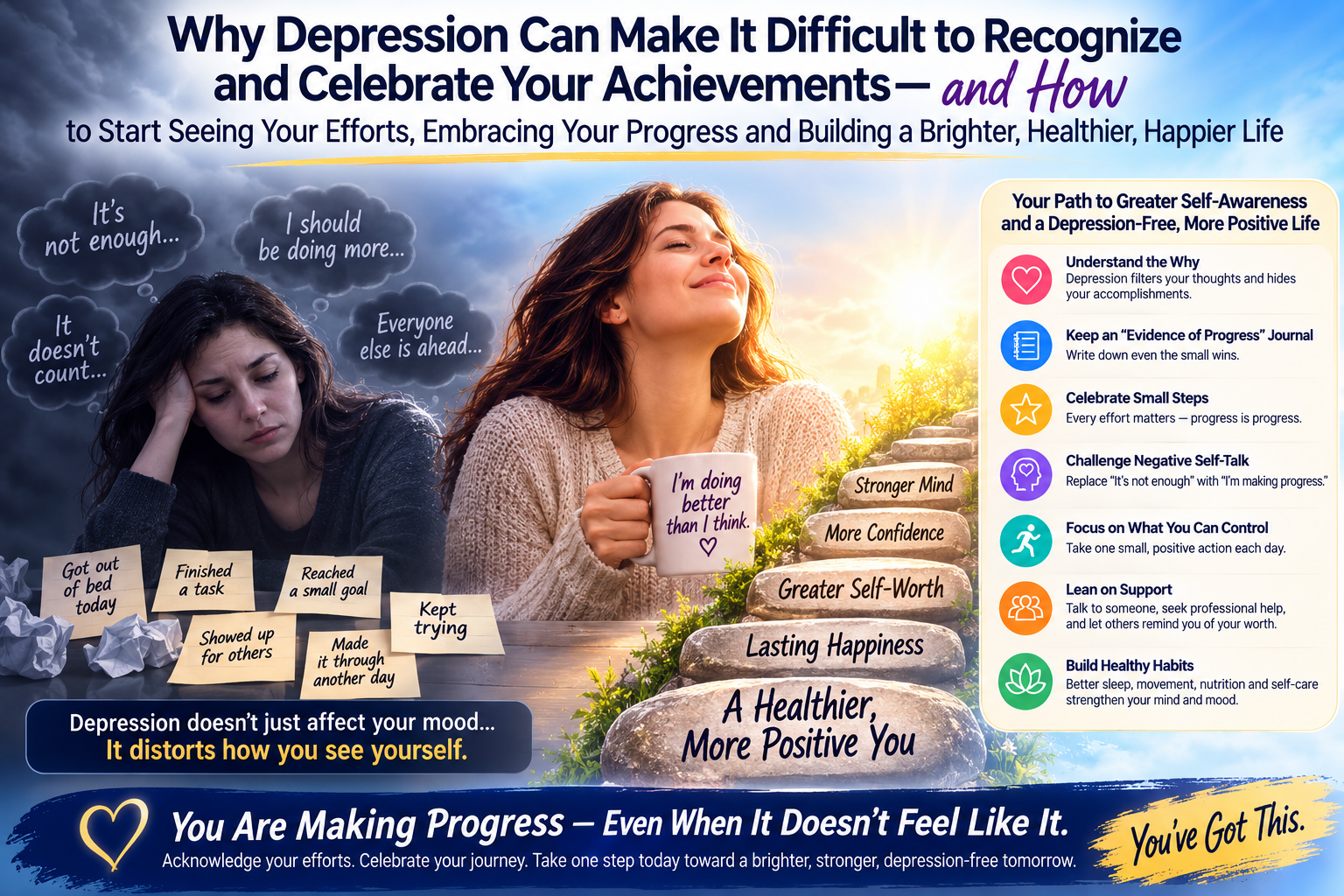
Why depression can make it difficult to recognize and celebrate your achievements—and how to begin acknowledging your efforts, embracing your progress, and taking empowering steps toward a healthier, more positive, and depression-free life.
Depression has a way of changing the way we see ourselves, our accomplishments, and even the meaning of success. You can accomplish something you once worked incredibly hard to achieve, receive recognition from others, reach an important milestone, or overcome an obstacle that once seemed impossible—and still feel little or nothing inside. Instead of excitement, you may feel emptiness. Instead of pride, you may hear an inner voice telling you that what you accomplished was not important, not good enough, or simply what you were “supposed” to do. This can be one of the most frustrating and misunderstood experiences of depression.
One of the most important things to understand is that difficulty celebrating an achievement does not necessarily mean that you are ungrateful, lazy, negative, or incapable of appreciating the good things in your life. Depression can affect motivation, emotional responsiveness, self-esteem, concentration, and the ability to experience pleasure. As a result, something that objectively deserves celebration may not emotionally register as something worth celebrating. Your circumstances may have changed, but your internal experience may still be telling you that nothing has really changed.
Depression can also create a powerful tendency to minimize accomplishments. You might complete a difficult project and immediately think, “Anyone could have done that.” You might reach a personal goal and respond with, “It wasn’t that difficult.” You might receive a compliment and immediately dismiss it. You may compare yourself to someone who appears to be further ahead and conclude that your achievement is insignificant. Over time, this pattern can make you feel as though you are constantly moving forward without ever allowing yourself to recognize how far you have traveled.
Another challenge is that many people unintentionally make achievement the condition for self-worth. They tell themselves, “I’ll be proud of myself when I succeed,” or “I’ll finally feel good about myself when I accomplish this.” The problem is that when success becomes the requirement for feeling worthy, there is always another mountain to climb. Even after reaching the goal, the mind may quickly create a new standard. What was once a dream becomes an expectation, and what should have been a moment of satisfaction becomes another reason to feel inadequate.
Depression can intensify this cycle because the mind often becomes more focused on perceived failures than genuine progress. You may remember the one thing that went wrong while forgetting the ten things that went right. You may focus on what you still need to accomplish instead of acknowledging what you have already overcome. This does not mean that you are choosing to think negatively. Depression can influence attention and interpretation, making negative information feel more convincing and positive information easier to dismiss.
This is why learning to acknowledge your effort is so important. Your achievement is not only the final outcome. It is also the courage, persistence, sacrifices, lessons, disappointments, and small decisions that allowed you to get there. Sometimes the greatest accomplishment is not reaching the destination but continuing to move forward when you were emotionally exhausted and uncertain about whether you could continue.
You deserve to recognize the effort behind your progress.
Perhaps you got out of bed on a difficult morning. Perhaps you made an important phone call that you had been avoiding. Perhaps you went to work despite feeling emotionally drained. Perhaps you asked for help instead of pretending everything was fine. Perhaps you established a healthier boundary, returned to therapy, reconnected with someone you trust, or simply decided that you would give yourself another day to try. These moments may not look impressive from the outside, but they can represent enormous victories for someone struggling with depression.
One powerful shift is learning to replace “Is this accomplishment big enough to celebrate?” with “What did this accomplishment require from me?” This question moves your attention away from comparing your achievement to someone else’s and toward understanding your own journey. Maybe what you accomplished required courage. Maybe it required patience. Maybe it required you to overcome fear. Maybe it required you to keep going when giving up felt easier. Your progress becomes meaningful when you understand what it took to create it.
You also do not have to wait until you feel proud before acknowledging yourself. Sometimes the action comes before the emotion. You can say, “I am proud of myself for making this effort,” even if you do not emotionally feel proud yet. You can recognize your progress even when your mind tells you that it does not matter. Over time, repeatedly practicing this form of self-recognition can help create a different relationship with your accomplishments.
Start with small victories rather than waiting for major milestones. Depression often encourages an all-or-nothing mentality: either you completely succeed or you have failed. A healthier perspective recognizes progress in degrees. Getting through a difficult day can be progress. Completing one task can be progress. Taking care of yourself can be progress. Having an honest conversation can be progress. Trying again after disappointment can be progress. Small steps become significant when they are repeated consistently.
It is also important to separate your identity from your productivity. You are not valuable because of how much you accomplish. You are not more deserving of love because you earn more money, achieve more professionally, maintain a perfect relationship, or constantly perform at your highest level. Achievement can be meaningful, but it should not be the foundation of your worth.
You are a human being before you are a performer, employee, parent, partner, entrepreneur, student, caregiver, or professional.
This distinction can be particularly important for people who have spent years being “the strong one.” When everyone expects you to be capable, independent, successful, and resilient, you may begin believing that you are only worthy when you are functioning at full capacity. Depression can then feel like a personal failure because it challenges the identity you have built around being strong.
But strength is not the absence of struggle.
Strength can also mean admitting that you are struggling. Strength can mean asking for support. Strength can mean slowing down. Strength can mean recognizing that you cannot solve everything by yourself. And sometimes strength means allowing yourself to be human without turning every difficult moment into evidence that something is wrong with you.
Another important step is becoming aware of your internal dialogue. Listen to how you speak to yourself after an accomplishment. Would you speak to a close friend the same way? If your friend completed something difficult and told you, “It wasn’t a big deal,” would you agree with them? Or would you remind them of everything they had overcome to get there?
Try offering yourself the same compassion.
Instead of saying, “I should have done more,” try saying, “I did what I could with what I had at that time.” Instead of “Anyone could have done this,” try “This mattered to me, and I worked for it.” Instead of “I’m still not where I want to be,” try “I may not be where I want to be yet, but I am not where I started.” This does not mean pretending everything is wonderful. It means developing a more balanced and compassionate perspective.
There is also tremendous value in allowing other people to celebrate you. Depression can make compliments uncomfortable. You may instinctively reject praise or explain away your accomplishments. Someone tells you, “You did an amazing job,” and you respond, “It wasn’t anything.” The next time someone genuinely acknowledges something you have accomplished, try simply saying, “Thank you.” You do not have to convince yourself that their praise is completely true. Just allow yourself to receive it.
Celebration does not have to mean throwing a party or feeling overwhelming happiness. Celebration can be quiet. It can be taking a moment to breathe and recognize what you accomplished. It can be treating yourself with kindness. It can be sharing your success with someone who genuinely cares about you. It can be writing down what you accomplished and allowing yourself to acknowledge it without immediately moving on to the next goal.Creating a daily practice of recognizing effort can also be helpful. At the end of the day, ask yourself: “What did I do today that required effort?” The answer does not need to be extraordinary. You are training your mind to notice progress rather than automatically searching for shortcomings.
Another powerful question is, “What would the version of me from five years ago think about where I am today?” We often become so focused on our current destination that we forget to look backward. The person you are today may possess skills, wisdom, resilience, relationships, experiences, and knowledge that your younger self desperately wanted. Your progress may be invisible to you simply because you have become accustomed to it.
Healing also requires patience. There is no single decision that makes depression disappear forever. For many people, recovery involves a combination of professional support, healthy routines, meaningful relationships, self-awareness, and sometimes medication as recommended by a qualified healthcare professional. Seeking professional help is not a sign that you have failed. It is a sign that you are willing to invest in your well-being.
If depression has made it difficult to experience pleasure, motivation, hope, or satisfaction for an extended period, consider speaking with a mental health professional. Depression is treatable, and you do not have to navigate it alone. If you ever experience thoughts of harming yourself or believe you may not be safe, seek immediate professional or emergency support in your area.
Most importantly, remember that the absence of celebration does not erase the achievement. You can accomplish something meaningful and still feel emotionally numb. You can make progress and still feel exhausted. You can be proud of yourself and still have difficult days. Healing is not about forcing yourself to be positive every moment. It is about learning to make room for hope while honestly acknowledging what you are experiencing. Your life does not have to become perfect before you are allowed to appreciate it. Your journey does not have to be finished before you are allowed to acknowledge how far you have come. And you do not have to become someone else before you are worthy of compassion, respect, and love.
Perhaps the first step toward a healthier relationship with yourself is simply recognizing this: you are trying. You are learning. You are growing. You are still here. And even if you cannot celebrate your achievements today, you can begin by acknowledging the effort it took to get this far. Greatness is not always found in extraordinary accomplishments. Sometimes greatness is found in the quiet decision to keep moving forward when life feels extraordinarily difficult. Give yourself permission to notice that.
Give yourself permission to appreciate that. And give yourself permission to believe that your next chapter can be different from your last.
Learn More
Depression and the Fear of False Improvement: The Hidden Cost of Rapid Self-Growth
Personal growth has become one of the defining pursuits of modern life. From social media feeds filled with inspirational quotes to an endless supply of podcasts, books, and courses promising rapid transformation, the idea of “becoming your best self” is omnipresent. On the surface, this emphasis on self-improvement seems positive—encouraging individuals to reflect, learn, and grow. Yet, beneath the surface lies a subtle, often overlooked danger: the fear of false improvement and the emotional toll it can take, particularly for those already struggling with depression.
Depression is not simply sadness; it is a pervasive sense of emptiness, hopelessness, and self-doubt. When individuals dealing with depression encounter the modern culture of rapid self-improvement, the pressure to “fix themselves” quickly can feel unbearable. They are constantly confronted with the expectation that change should be visible, measurable, and swift. Social media amplifies this effect, showing carefully curated snapshots of other people’s growth—smooth transformations, perfect routines, and seemingly effortless success. The unspoken message is clear: if you are not improving at the same pace, you are failing.
This expectation sets the stage for a phenomenon that could be called the fear of false improvement. Individuals may attempt to follow the self-help advice, adopt new routines, or push themselves toward ambitious goals, but the results rarely appear as quickly as promised. Progress in personal growth, particularly when dealing with mental health challenges, is rarely linear or instantaneous. Yet the constant comparison to idealized timelines can create a sense of inadequacy, triggering self-criticism, frustration, and, paradoxically, deepening depressive symptoms. Instead of feeling empowered by growth, people may feel more stuck, more hopeless, and more like they are failing at life itself.
The problem is compounded by the culture of overachievement that often accompanies personal growth rhetoric. High expectations, when unmet, inevitably bring high disappointment. The more one internalizes the belief that they should be improving rapidly, the more painful every perceived failure becomes. The very tools designed to inspire growth—goal-setting, self-tracking, affirmations, visualization—can transform into instruments of pressure, amplifying feelings of guilt, shame, and inadequacy. Depression, already a condition that feeds on negative self-perception, is uniquely vulnerable to this trap.
Moreover, the notion of “false improvement” introduces another layer of stress. Individuals may fear that even when they make progress, it is only superficial—performative rather than genuine. They may question whether their growth is real or just a temporary mask to appear functional, capable, or happy. This fear can lead to anxiety, self-doubt, and emotional paralysis, creating a vicious cycle where the pressure to improve fuels the very symptoms they are attempting to overcome.
The cultural obsession with rapid results also undermines patience and self-compassion, both essential components of authentic personal growth. Real change—whether in mindset, behavior, or emotional regulation—requires time, consistent effort, and often the willingness to experience setbacks. The promise of instant improvement not only misrepresents reality but can also make slow progress feel like failure. When every small misstep is magnified by the expectation of fast transformation, individuals may retreat from growth altogether, reinforcing feelings of hopelessness and depression.
Addressing this problem requires a shift in how personal growth is approached. Growth should be reframed as a journey rather than a race. Progress, particularly when it involves mental health or deep-seated behavioral change, is rarely linear, and the timeline is unique to each individual. Emphasizing small, sustainable improvements, celebrating incremental successes, and accepting setbacks as part of the process can reduce the emotional toll of high expectations. Equally important is fostering self-compassion, the ability to treat oneself with patience, kindness, and understanding even in moments of perceived failure.
Ultimately, the fear of false improvement highlights a critical paradox of modern self-help culture: the very tools designed to empower can inadvertently exacerbate distress when expectations outpace reality. Personal growth remains a valuable pursuit, but it must be approached with mindfulness, patience, and realistic goals. By embracing the slow, often messy process of genuine transformation, individuals can protect themselves from the hidden dangers of rapid improvement culture and cultivate meaningful, lasting change without the added burden of depression and self-doubt.
Learn More
The space-time continuum. How depression can distort your sense of time and ways to fall back on the right path to feel whole again. Strategies that works!
Have you ever noticed how, when you’re feeling low, time seems to slip through your fingers—or stretch endlessly before you? A single hour can feel like an eternity, while a week can vanish in a blur. For those struggling with depression, this isn’t just a feeling; it’s a profound distortion of reality, a shifting of the very fabric of time and space that makes life feel unmoored, disconnected, and heavy.
Imagine waking up on a Monday, looking at the clock, and feeling as though you’ve been lying in bed for days, even though only hours have passed. You plan your day, hoping to accomplish tasks, reach out to friends, maybe take a walk, but everything feels slow, distant, as if you are moving through a dream. This is one way depression warps the time continuum—it stretches the present, turning simple moments into mountains that seem impossible to climb.
Other times, life feels like it’s rushing past, uncontrollable and relentless. Weeks disappear without leaving any memory, responsibilities pile up, and you feel behind, even though you haven’t moved. You wake up one morning surprised it’s Friday, wondering where the time went. Depression has a strange duality: it can make time drag when your mind is clouded by sadness, yet make it vanish when the weight of disengagement blinds you to the present.
Space can feel just as distorted. Your home, once a place of comfort, might feel like a cage. Simple decisions—what to eat, what to wear, whether to step outside—suddenly feel monumental. Corridors feel longer, rooms feel empty, and even familiar streets seem alien. This altered perception amplifies isolation, as the world feels both oppressive and distant at the same time.
But there is hope. There is a path back to the sense of rhythm, grounding, and wholeness. The first step is awareness—recognizing that the distortions of time and space are not failures on your part, but symptoms of depression. Understanding this can shift the narrative from self-blame to self-compassion.
The next step is grounding routines. Start small. Wake up at roughly the same time each day. Eat meals at regular intervals. Step outside for even a few minutes of fresh air or sunlight. These simple acts anchor you to the world, giving structure to the days that may otherwise feel shapeless. When your body begins to sense routine, your mind slowly starts to catch up, and the distorted flow of time becomes more manageable.
Engaging in focused activities can also restore a sense of temporal coherence. Reading a book, cooking a meal, gardening, or working on a creative project forces your mind to inhabit the present. As you concentrate on tasks, the stretched minutes of depression begin to compress, and the lost days start to feel tangible again. Each small accomplishment, no matter how minor, becomes a marker in the timeline of your life, reminding you that you are moving forward.
Mindfulness and meditation are equally powerful tools. By practicing awareness of your body, your breath, and the world around you, you reconnect with the present moment, gently dissolving the haze of distorted time. A mindful walk, noticing the rhythm of your steps and the feel of the air, can reconnect you with the world and your place in it. Even just five minutes of focused breathing can interrupt the spiral of rumination, helping time regain its natural flow.
Physical activity and exposure to sunlight further reinforce this realignment. Exercise triggers the release of mood-regulating chemicals in the brain, while sunlight helps regulate circadian rhythms, the body’s internal clock. Both interventions subtly recalibrate your perception of time and reinforce your connection to the natural cycles of day and night.
Human connection, too, is a lifeline. Depression isolates, stretching moments of loneliness into unbearable spans, but interactions with others—friends, family, support groups—provide external anchors in time and space. A conversation, a shared laugh, or a simple check-in reminds your brain that life continues, that time has meaning, and that you are not alone in navigating it.
Professional support amplifies these strategies. Therapists can help identify thought patterns that distort perception of time and space and teach coping tools to counteract them. Cognitive-behavioral techniques can train the mind to recognize and reframe moments that feel endless or fleeting. Sometimes, medication is needed to correct chemical imbalances that exacerbate these distortions. Professional guidance does not remove the struggle, but it lights the way toward balance and clarity.
Recovery from these distortions is a gradual journey, not a single leap. It begins with small, intentional steps: noticing the sunrise, making a cup of tea, laughing at a friend’s joke, taking a deep breath and feeling your feet on the ground. Each moment, each choice, rebuilds the bridge between you and the continuity of your life. Time begins to flow more naturally, space feels more navigable, and the world becomes less like a foreign land and more like home again.
Depression may warp your perception of time and space, but it does not define your reality. By practicing awareness, establishing routines, connecting with others, and seeking guidance, you can reclaim the rhythm of life. Moments of stillness, laughter, and achievement accumulate, gradually restoring your sense of presence and wholeness. The continuum of time and space may have felt broken, but it can be rebuilt—moment by moment—until you feel grounded, alive, and fully connected to your world once more.
Learn More
The many negative outcomes of untreated chronic depression: How can it affect your emotional memory and ways to recover them when it does happen: Strategies that can work!
Chronic depression is not simply a prolonged period of sadness; it is a complex condition that, when left untreated, can quietly reshape how a person thinks, feels, remembers, and experiences life. Over time, untreated depression affects emotional memory, distorts self-perception, and alters the brain’s natural ability to process emotions in a balanced way. The longer it persists, the more deeply it can influence behavior, relationships, and overall quality of life.
One of the most significant negative outcomes of untreated chronic depression is its impact on emotional memory. Emotional memory is the way the brain stores and retrieves experiences that carry emotional weight. In depression, the brain develops a strong bias toward negative emotional memories. Painful experiences, failures, losses, and moments of rejection are recalled more easily and with greater intensity than positive or neutral events. Meanwhile, memories associated with joy, success, or connection often fade, feel distant, or seem less meaningful. This imbalance reinforces the belief that life has always been painful and will remain that way, even when evidence suggests otherwise.
Over time, this negative filtering reshapes identity. Individuals may begin to define themselves through their lowest moments, believing that past struggles are proof of personal inadequacy rather than circumstances they survived. This distorted emotional memory can fuel hopelessness, making it difficult to imagine a future that feels different from the past. As a result, motivation declines, decision-making becomes impaired, and avoidance behaviors increase. People may withdraw socially, abandon goals, or stop engaging in activities that once brought fulfillment, further reinforcing depressive patterns.
Untreated chronic depression also affects emotional regulation. The brain becomes less flexible in responding to stress, leading to heightened emotional reactivity or emotional numbness. Small setbacks may feel overwhelming, while positive events fail to register fully. This emotional blunting is particularly damaging because it robs individuals of reinforcement that could otherwise support healing. Relationships often suffer as well, as depression can distort perceptions of others’ intentions, increase sensitivity to criticism, and reduce emotional availability.
Physiologically, prolonged depression is associated with changes in brain chemistry and neural pathways, particularly in areas involved in memory, mood regulation, and stress response. Elevated stress hormones over long periods can impair the brain’s ability to form new positive emotional memories, trapping individuals in a loop where the past feels heavier than the present. Sleep disturbances, fatigue, and cognitive fog further weaken resilience, making recovery feel even more out of reach.
Despite these challenges, emotional memory is not fixed. The brain remains capable of change, even after years of depression. Reversing the effects begins with recognizing that the depressive lens is not an accurate reflection of reality but a learned pattern shaped by untreated illness. Awareness alone can create distance between the individual and the negative narrative depression promotes.
One effective strategy involves intentionally rebuilding emotional memory through repeated positive experiences paired with conscious attention. Depression often prevents positive moments from being fully encoded in memory, so slowing down and deliberately acknowledging moments of safety, connection, or accomplishment helps the brain register them more deeply. Over time, this practice weakens the dominance of negative recall and strengthens emotional balance.
Therapeutic interventions play a critical role in reversing these patterns. Cognitive-based therapies help individuals identify distorted thinking linked to emotional memory and challenge beliefs rooted in past pain rather than present truth. Trauma-informed approaches can help process unresolved emotional experiences that continue to influence current reactions. Mindfulness-based practices train the brain to stay anchored in the present, reducing the tendency to relive emotionally charged memories that no longer serve a purpose.
Behavioral activation is another powerful tool. Even when motivation is low, engaging in meaningful or values-based activities can gradually reintroduce positive emotional input into the brain. These actions create new experiences that, with repetition, begin to reshape memory networks and emotional responses. Over time, the brain learns that effort can lead to reward, even if that reward initially feels muted.
Addressing chronic depression also requires attention to lifestyle factors that support brain health. Consistent sleep, physical movement, proper nutrition, and social connection all influence emotional regulation and memory processing. While these changes may seem simple, they directly support the brain’s ability to heal and adapt.
Most importantly, reversing the effects of untreated chronic depression requires compassion. Many individuals blame themselves for how long they have struggled, unaware that depression itself interferes with the ability to seek help or recognize alternatives. Healing does not mean erasing painful memories; it means integrating them without allowing them to dominate identity or future expectations.
When chronic depression is treated, emotional memory becomes more balanced. The past no longer defines the present, and the future feels open rather than predetermined by pain. With the right strategies, support, and persistence, the brain can relearn hope, restore emotional flexibility, and reconnect individuals with a sense of meaning and possibility that depression once obscured.
Learn More
Clinical Variability in Depressive Disorders: Why Individuals May Experience Different Symptom Patterns Across Time. Understanding them is key to mental health.
Depressive disorders are often misunderstood as a single, static emotional state, when in reality they are dynamic and deeply individualized conditions that can shift in form, intensity, and presentation over time. Clinicians and researchers increasingly recognize that depression does not always follow a predictable pattern. Instead, it may evolve as a result of biological changes, psychological adaptation, life circumstances, and underlying vulnerabilities. Understanding this clinical variability is essential not only for accurate diagnosis and treatment, but also for reducing stigma and improving patient self-awareness.
Depression is influenced by a complex interaction between genetics, neurobiology, personality traits, environmental stressors, and learned coping responses. At one point in a person’s life, depression may appear as profound sadness, loss of interest, and withdrawal from daily functioning. Years later, however, it may emerge as irritability, emotional numbness, or chronic fatigue rather than overt sadness. These shifts do not indicate inconsistency or exaggeration on the part of the individual; rather, they reflect how the brain and body respond to stress, trauma, hormonal changes, and evolving life demands.
Early depressive episodes are often triggered by identifiable stressors such as academic pressure, relationship changes, or grief. During this stage, symptoms may be more recognizable and easier for others to validate. Over time, however, repeated exposure to depression can alter both neural pathways and cognitive patterns. Some individuals develop patterns of emotional suppression or become highly functional while remaining internally distressed. As a result, later presentations of depression may appear more subtle, internalized, or masked by productivity, perfectionism, or chronic overwork. What was once clearly experienced as sadness may instead manifest as burnout, hopelessness, or an inability to feel pleasure.
Physiological changes across the lifespan also contribute to the shifting nature of depressive symptoms. Hormonal fluctuations, medical conditions, sleep disturbances, and aging-related brain changes can deepen or reshape how depression is expressed. For example, depression in adolescents may present as irritability or behavioral changes, while in older adults it may appear as memory difficulties, apathy, or somatic complaints such as chronic pain and fatigue. The same person may even experience depression differently across developmental stages, which can complicate diagnosis and lead to misinterpretation by family members, healthcare providers, or the individual themselves.
Another important factor in this variability is how people psychologically adapt to ongoing emotional distress. Over time, individuals often develop coping strategies that mask their symptoms, such as maintaining a busy schedule, intellectualizing emotions, or focusing intensely on caregiving or professional success. These adaptations may protect functioning in the short term but can also obscure the presence of depression, delaying help-seeking and treatment. A person may appear outwardly successful while internally experiencing significant distress, emotional emptiness, or loss of meaning, illustrating how depression can coexist with competence and achievement.
Trauma history and life experiences further shape the evolution of depressive symptoms. Unresolved trauma can shift depression toward dissociation, hypervigilance, or shame-based thinking patterns, while prolonged adversity may contribute to chronic dysthymia — a persistent, low-grade depressive state that becomes woven into one’s sense of identity. Periods of major life transition, such as career changes, parenting demands, retirement, or loss, may reactivate depressive symptoms or alter their form. The person may feel as though depression has resurfaced “in a new way,” when in reality it is responding to a new psychological context.
Recognizing the variability of depressive presentations is essential for effective clinical care. When symptoms evolve, some individuals mistakenly believe they are “no longer depressed” or that their struggles are simply personal weaknesses, character flaws, or signs of failure. Others may feel confused when therapy or medication that once worked becomes less effective over time. Understanding that depression is dynamic — and often requires periodic reassessment — encourages individuals to remain engaged in ongoing care rather than assuming that treatment has failed or that they must simply endure their symptoms.
From a therapeutic standpoint, acknowledging variability allows clinicians to tailor interventions to the current expression of the disorder. Treatment may shift between cognitive restructuring, trauma-focused approaches, behavioral activation, lifestyle intervention, or medication adjustments depending on how depression manifests at a given time. Long-term mental health outcomes improve when care is flexible rather than standardized, and when patients are encouraged to openly discuss changes in how their symptoms feel or function in their lives.
Ultimately, understanding the evolving nature of depressive disorders fosters compassion, insight, and empowerment. It reminds us that depression is not a weakness or a single emotional state, but a multifaceted condition shaped by biology, experience, and context. When individuals recognize that symptom patterns may change — and that these changes are valid and clinically meaningful — they are more likely to seek timely support, advocate for themselves in treatment settings, and develop a deeper awareness of their emotional landscape. This awareness is not only key to effective mental health care, but also to fostering resilience and self-acceptance across the many phases of life.
Learn More
The Side Effect of Depression: How Isolation Exacerbates the Pain—And How Therapy Can Guide You Out of the Vortex
Depression is not just a mood—it’s a powerful force that can alter how we see ourselves, our future, and the world around us. While its symptoms can vary, one common thread binds most experiences of depression: the tendency to isolate.
But here’s the hard truth—isolation is not relief. It’s reinforcement. And while pulling away may feel like a way to survive, it can quietly drag you deeper into the very thing you’re trying to escape.
Let’s dive into how isolation worsens depression—and more importantly, how psychotherapy can help you break free.
🧠 The Link Between Depression and Isolation
When you’re depressed, even the simplest social interaction can feel exhausting. You may tell yourself:
- “They won’t understand.”
- “I don’t want to be a burden.”
- “It’s better if I’m alone.”
These thoughts are not signs of weakness; they’re symptoms of the illness itself. But isolation is like turning down the lights in an already dark room. It deepens loneliness, reduces stimulation, and cuts off opportunities for connection and hope.
Studies show that social withdrawal can intensify feelings of worthlessness, sadness, and despair. It also removes the external feedback we often need to challenge the lies depression tells us about ourselves.
💬 The Vortex of Misery—Why It Feels Impossible to Climb Out
Depression isn’t just sadness. It’s a fog of fatigue, self-doubt, and emotional numbness. Over time, isolation can create a feedback loop:
- You feel low, so you withdraw.
- The lack of connection deepens the low mood.
- You interpret the growing distance as proof you’re unworthy.
- Repeat.
This cycle can feel like a vortex—spinning faster the longer it’s left unaddressed. But here’s where hope begins: therapy.
💡 How Therapy Can Help You Step Out of Isolation
Therapy isn’t just about talking—it’s about transforming. With the right approach, it helps you reconnect with yourself, others, and your sense of purpose.
Here are some modalities proven to help treat depression and the isolation it often brings:
1. Cognitive Behavioral Therapy (CBT)
CBT helps identify and challenge the negative thought patterns that fuel both depression and isolation. You learn how to:
- Recognize distorted thinking (“No one cares about me.”)
- Replace it with more balanced thoughts (“Some people do care, even if I don’t feel it right now.”)
- Practice behaviors that build connection, even in small steps
Why it works: CBT is solution-focused and teaches practical tools to fight the urge to withdraw.
2. Interpersonal Therapy (IPT)
Since isolation directly impacts relationships, IPT focuses on improving communication and resolving social conflicts. It addresses:
- Grief or loss
- Role transitions (divorce, job loss)
- Interpersonal disputes
- Social skill deficits
Why it works: It targets the very area depression tends to destroy—your human connections.
3. Mindfulness-Based Cognitive Therapy (MBCT)
This approach blends cognitive therapy with mindfulness practices to help you stay present and prevent relapse.
You learn how to:
- Observe your thoughts without judgment
- Ground yourself when the mind spirals
- Break the autopilot mode of depressive thinking
Why it works: MBCT gives you space between your emotions and your reactions.
4. Psychodynamic Therapy
For those who want to explore the deeper roots of their depression—such as childhood wounds or repressed feelings—psychodynamic therapy offers profound insight.
Why it works: It allows healing at the source, not just the surface.
✨ Your Journey Starts With One Step
Here’s what depression doesn’t want you to know: You are not alone. You never were.
There’s always a bridge out of the vortex—but sometimes, it takes the steady hand of a therapist to guide you toward it.
Isolation may whisper that hiding is safer. But connection is where healing begins.
You don’t have to climb out all at once. You only need the courage to start.
And therapy? It’s not the end of the road.
It’s the beginning of your return to life.
🗣 Words of wisdom: From Isolation to Illumination
If you’ve been battling depression in silence, now is the time to break that silence—with strength, not shame. Reach out. Invest in your healing. Let therapy be your light out of the dark.
You are worth the effort.
You are worthy of connection.
And yes—you are absolutely capable of climbing out of that vortex.

How to Cope Between Therapy Sessions When Depression Strikes: Mental Illness Never Takes a Break
Therapy can be a powerful lifeline in managing depression, but what happens in the spaces between sessions? Mental illness doesn’t operate on a schedule. Depression doesn’t pause to respect your calendar. It can creep in during quiet moments, overwhelm you at work, or hit hardest when you’re alone. That’s why learning how to cope between therapy appointments is essential for long-term healing and emotional resilience.
Below are practical and compassionate strategies to help you stay grounded, manage difficult emotions, and support yourself in the times when professional help isn’t immediately available.
1. Create a Personalized Coping Toolbox
Everyone’s experience with depression is unique, so your coping tools should be too. Start by identifying activities and strategies that have helped you in the past or that you’d like to try. Your toolbox might include:
- Breathing or grounding exercises
- Journaling thoughts and feelings
- Listening to calming or uplifting music
- Going for a walk or gentle movement
- Calling a trusted friend or support person
- Reading affirmations or past therapy notes
Keep your toolbox accessible—write it down or save it on your phone—so it’s easy to reference when you’re feeling low.
2. Stick to a Routine, Even a Simple One
Depression can make even the smallest tasks feel overwhelming, but having a loose daily routine can give your day structure and purpose. This doesn’t mean being rigid or overly ambitious. Focus on small, manageable habits such as:
- Getting out of bed around the same time each day
- Drinking a glass of water first thing in the morning
- Taking a shower or brushing your teeth
- Eating at regular intervals
- Going outside for at least five minutes
A routine offers a sense of normalcy and achievement, even during hard times.
3. Track Your Mood and Thoughts
Use a journal or an app to record how you’re feeling throughout the day. Note any triggers, patterns, or thoughts that stand out. This helps in two ways:
- It gives you insight into your emotional cycles
- It provides useful information to share in your next therapy session
By becoming more aware of your mental state, you can start to recognize early warning signs and act before things escalate.
4. Practice Self-Compassion, Not Perfection
It’s easy to become your harshest critic when you’re struggling. You might feel guilt for not being “productive” or shame for needing help. But healing isn’t linear, and there are no perfect days in recovery.
Treat yourself the way you would treat a dear friend—with kindness, patience, and understanding. Replace harsh inner dialogue with more supportive thoughts like:
- “I’m doing the best I can with what I have today.”
- “It’s okay to feel this way. These feelings won’t last forever.”
- “Needing rest doesn’t make me weak—it makes me human.”
5. Reach Out for Connection
Isolation can deepen the grip of depression, making it feel harder to reach out. But human connection, even in small doses, can provide relief and reassurance. Don’t wait for a crisis to call someone. Reach out when you:
- Need to vent
- Want distraction or company
- Feel yourself slipping into a dark mental space
You don’t have to explain everything. A simple, “Can we talk?” or “I could really use a friendly voice right now,” is enough.
6. Use Technology Wisely
There are several mental health apps designed to support people between therapy sessions. These can offer guided meditations, mood tracking, thought reframing, or even AI-based journaling. Some helpful ones include:
- Headspace (mindfulness and meditation)
- Moodpath (mood tracking and mental health screening)
- Woebot (a chatbot based on Cognitive Behavioral Therapy)
- Sanvello (coping tools, goal setting, and community support)
Use tech to your advantage—but be mindful of doom-scrolling or consuming triggering content on social media.
7. Know When to Seek Extra Help
Sometimes, depression intensifies between sessions. If you’re feeling overwhelmed or having thoughts of self-harm, don’t wait until your next appointment. Reach out to:
- A crisis hotline or mental health support line
- A trusted friend or family member
- Your therapist, if they offer emergency contact options
- A walk-in clinic or local mental health service
There is no shame in asking for more support when you need it. Your safety and well-being always come first.
Final Thoughts: You Are Stronger Than You Think
Between therapy sessions, you are still healing. Every effort you make to care for yourself—no matter how small—is a victory. Depression may not take a break, but neither does your resilience. With the right tools, support, and mindset, you can navigate the hard days and come out stronger on the other side.
Remember: You are not alone. Your story is still unfolding, and brighter chapters are ahead. Keep showing up for yourself. That’s courage. That’s strength. That’s hope in motion.


Carrying the weight of depression symptoms due to loneliness. How to break the isolation cycle post pandemic. Effective strategies that can help you get back into society and mingle with other human beings.
The COVID-19 pandemic reshaped social interactions, forcing many into prolonged isolation. As a result, countless individuals found themselves struggling with loneliness, which has contributed to depression symptoms such as persistent sadness, fatigue, loss of interest, and anxiety. The absence of regular human connection can deepen feelings of despair, making it even harder to reintegrate into society. However, breaking the cycle of isolation is essential for improving mental well-being. Here are effective strategies to help you reconnect with others and reclaim a fulfilling social life.
Understanding the Link Between Loneliness and Depression
Loneliness and depression are intricately connected, forming a cycle that can be difficult to break. While loneliness is the emotional distress caused by a lack of meaningful social connections, depression is a more pervasive mental health condition that affects mood, energy levels, and overall well-being. When left unaddressed, loneliness can contribute to the onset of depression, and in turn, depression can cause individuals to further isolate themselves, deepening feelings of loneliness.
How Loneliness Contributes to Depression
- Lack of Social Support – Human beings are inherently social creatures, and strong relationships play a crucial role in mental health. When someone lacks companionship, they may feel unimportant or disconnected, which can lead to feelings of sadness and hopelessness.
- Increased Negative Thinking – Without external perspectives from friends or family, lonely individuals may develop negative thought patterns. They may believe they are unworthy of companionship or assume others do not care about them, reinforcing depressive thoughts.
- Reduced Dopamine and Serotonin Levels – Social interaction stimulates neurotransmitters like dopamine and serotonin, which regulate mood and emotions. A lack of connection can disrupt this balance, making loneliness a biological trigger for depression.
- Loss of Purpose and Motivation – Many social activities provide a sense of purpose. When someone withdraws from social engagement, they may experience a decline in motivation, leading to further isolation and worsening depressive symptoms.
- Chronic Stress and Anxiety – Loneliness can increase cortisol levels, the stress hormone, which negatively impacts both mental and physical health. Persistent stress contributes to anxiety, making social situations even more intimidating for those already struggling.
How Depression Reinforces Loneliness
- Social Withdrawal – A key symptom of depression is the tendency to withdraw from social interactions. The more someone avoids socializing, the more disconnected they become, deepening their loneliness.
- Loss of Interest in Activities – Depression often causes people to lose interest in hobbies or events they once enjoyed, making it difficult to engage with others. This leads to fewer social opportunities and increased isolation.
- Feelings of Shame or Unworthiness – Those with depression may feel like a burden to others, leading them to avoid seeking help or initiating social interactions. They may believe that others won’t understand or that they don’t deserve companionship.
- Fatigue and Low Energy – The mental and physical exhaustion caused by depression can make even simple social activities feel overwhelming. As a result, individuals may avoid contact with friends and family, further exacerbating loneliness.
Strategies on breaking that vicious cycle: Steps Toward Healing
Reentering society after a long period of isolation can be daunting, but taking small, intentional steps can help ease the transition. Here are some practical ways to reconnect with the world and find happiness from within:
1. Start Small and Gradual
Reintegrating into social settings doesn’t mean jumping into large crowds immediately. Begin by engaging in low-pressure interactions, such as short conversations with neighbors, cashiers, or acquaintances. Small social interactions can help build confidence and make the idea of larger gatherings less intimidating.
2. Join Community Groups or Clubs
Finding a shared interest is a great way to make new connections. Consider joining a book club, art class, or fitness group. Many communities offer support groups for those struggling with loneliness and mental health challenges, providing a safe space to interact with others who understand your experience.
3. Reconnect with Old Friends and Family
Sometimes, loneliness persists because we have lost touch with those we once cared about. Reaching out to an old friend or a family member can rekindle relationships that provide comfort and support. A simple text or phone call can be the first step toward rebuilding social ties.
4. Volunteer Your Time
Volunteering provides a sense of purpose and a structured way to interact with others. Helping out at a local charity, animal shelter, or community center can create new connections while also giving you a reason to engage with the world in a meaningful way.
5. Seek Professional Support
If loneliness has contributed to severe depression, seeking help from a therapist or counselor is crucial. Cognitive-behavioral therapy (CBT) and other therapeutic approaches can help you navigate feelings of isolation, identify negative thought patterns, and develop coping mechanisms for social anxiety.
6. Use Technology to Your Advantage
While excessive screen time can contribute to isolation, technology can also be a useful tool for reconnecting with others. Virtual meetups, online support groups, and social media platforms can help bridge the gap until you feel comfortable engaging in face-to-face interactions.
7. Set Small, Achievable Social Goals
Instead of pressuring yourself to make drastic changes overnight, set small, realistic goals. This could be as simple as having one conversation per day, attending a local event, or inviting a friend for coffee. Celebrate each step as a victory to build momentum and confidence.
8. Engage in Physical Activity
Exercise has been shown to improve mood and reduce symptoms of depression. Activities such as yoga, group fitness classes, or even a daily walk in a public space can provide opportunities to be around others without the pressure of direct interaction.
Loneliness doesn’t have to lead to permanent depression—unless you let it. We have the power to control how external challenges affect us, both in the short and long term. We can either confront and overcome them or allow them to break us. Life presents us with choices, and it’s up to us to face the obstacles ahead.
Escaping the cycle of isolation takes time and effort, but the rewards are life-changing. Human connection is essential for emotional well-being, and by taking small, intentional steps, you can rediscover the fulfillment of meaningful relationships. You’re not alone—many are navigating post-pandemic loneliness alongside you. Be patient, seek support when needed, and move forward at your own pace.
With persistence and the right approach, you can rebuild your social life and experience the joy of true connection once again.

Breaking the Silence: Depression in Men and the Role of Cognitive Behavioral Psychotherapy to assist them into better mental health
Depression is often perceived as a condition that affects women more than men. However, this misconception is rooted in societal expectations and gender norms that discourage men from expressing vulnerability. The reality is that depression in men is widespread yet underreported due to stigma, fear, and a reluctance to seek help. Many men suffer in silence, leading to severe consequences such as substance abuse, relationship breakdowns, and even suicide. Cognitive Behavioral Psychotherapy (CBT) provides a structured and effective approach to addressing male depression, challenging negative thought patterns, and fostering openness to mental health support.
Understanding Male Depression and long term impact on their mental health.
Men experience depression differently than women. While women are more likely to exhibit sadness, tearfulness, and verbal expression of distress, men often display anger, irritability, risk-taking behaviors, and withdrawal from social connections. This difference in symptom expression can make depression in men harder to diagnose and easier to dismiss as mere stress or mood swings.
Common signs of depression in men include:
- Increased irritability and aggression
- Difficulty sleeping or excessive sleep
- Loss of interest in work, hobbies, and relationships
- Chronic fatigue or low energy levels
- Increased use of alcohol or drugs as coping mechanisms
- Feelings of hopelessness, worthlessness, or persistent sadness
- Suicidal thoughts or self-harming behaviors
Despite these symptoms, many men resist seeking help due to cultural and psychological barriers. Societal expectations condition men to suppress emotions, viewing the acknowledgment of mental distress as a sign of weakness. This reluctance to seek professional assistance often leads to prolonged suffering and worsened outcomes.
The Role of Cognitive Behavioral Psychotherapy (CBT)
Cognitive Behavioral Psychotherapy (CBT) is one of the most effective and widely used therapeutic approaches for treating depression. It focuses on identifying and modifying negative thought patterns and behaviors that contribute to emotional distress. For men struggling with depression, CBT offers several key benefits:
1. Breaking Down the Mental Barriers
CBT helps men recognize the connection between their thoughts, emotions, and behaviors. Many men with depression engage in cognitive distortions, such as black-and-white thinking (“I’m a failure at everything”) or catastrophizing (“Things will never get better”). Through CBT, they learn to challenge these distortions and replace them with more balanced, realistic thoughts.
2. Encouraging Emotional Expression
One of the major obstacles to treating male depression is the difficulty in articulating emotions. CBT provides a structured environment where men can explore their feelings without judgment. Therapists help them develop a vocabulary for their emotions, making it easier to express distress in healthy ways rather than through anger or avoidance.
3. Developing Healthier Coping Mechanisms
Men often resort to unhealthy coping mechanisms such as alcohol consumption, overworking, or engaging in reckless behavior. CBT teaches alternative strategies such as mindfulness, relaxation techniques, and constructive problem-solving, helping them replace self-destructive habits with healthier approaches.
4. Improving Problem-Solving Skills
Men with depression often feel overwhelmed by life’s challenges and perceive problems as insurmountable. CBT equips them with problem-solving skills that allow them to break down issues into manageable steps, reducing feelings of helplessness and increasing self-efficacy.
5. Building Stronger Relationships
Depression often strains personal and professional relationships. CBT helps men develop better communication skills, fostering stronger connections with loved ones. Learning to express emotions and needs effectively can improve relationships and create a support system that is crucial for recovery.
Why Men Need to Break the Silence
The stigma surrounding male depression can have devastating consequences. Statistics show that men are significantly more likely to die by suicide than women, with undiagnosed and untreated depression being a major contributing factor. By raising awareness and encouraging open discussions, society can create an environment where men feel safe to seek help without fear of judgment.
Additionally, workplaces, schools, and healthcare providers must play a role in normalizing mental health conversations. Employee assistance programs, mental health workshops, and routine mental health screenings can make a difference in identifying and addressing depression early.
Depression in men is a critical yet often overlooked issue. The societal expectation for men to be emotionally resilient and self-sufficient contributes to their reluctance to seek help. Cognitive Behavioral Psychotherapy offers a practical and effective solution, equipping men with the tools to recognize, challenge, and modify depressive thought patterns. By breaking the silence and fostering an environment of acceptance and understanding, we can encourage more men to embrace therapy and embark on the path to recovery. The key to healing lies in acknowledging that seeking help is not a sign of weakness, but a courageous step toward a healthier, more fulfilling life.
