
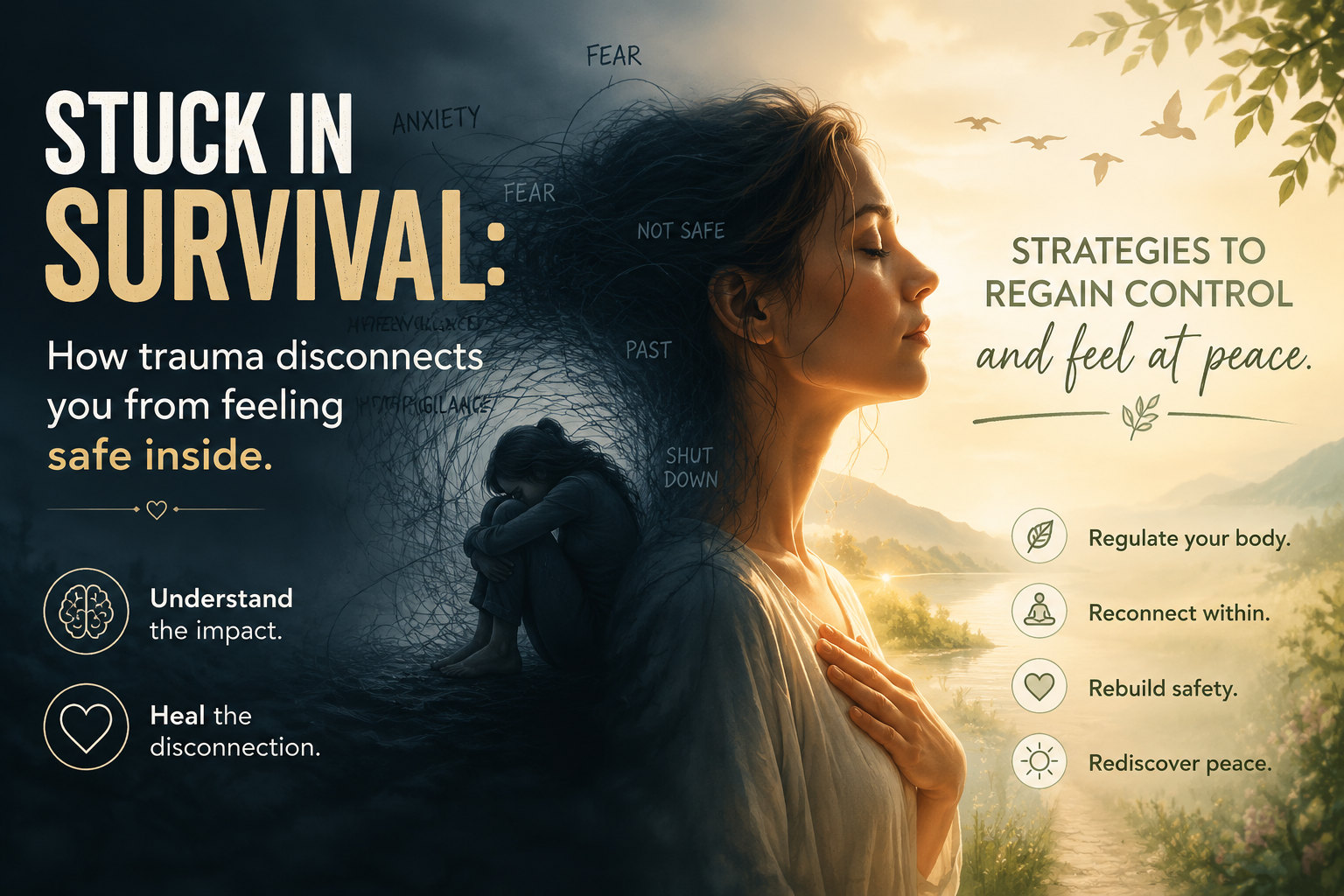
Stuck in survival: How trauma disconnects you from feeling safe inside. Strategies to regain control and feel at peace.
When a person experiences trauma, the mind does not simply remember the event as a story from the past. The nervous system often continues to respond as if the threat is still present. This is why many people describe feeling “stuck in survival,” even long after the danger is gone. Instead of returning to a baseline of safety and calm, the body remains alert, scanning for signs of danger, even in ordinary or safe environments. This internal state can be confusing and exhausting because the outside world may appear normal, yet the inner world feels tense, reactive, or unsettled.
Trauma is not only a psychological experience; it is also a physiological one. The brain’s alarm system, primarily involving the amygdala, becomes highly sensitized after overwhelming experiences. When this system is activated, the body shifts into survival responses such as fight, flight, freeze, or fawn. These responses are not choices—they are automatic survival mechanisms designed to protect the individual. However, when they become overactive or chronic, they can disconnect a person from their sense of safety, even in situations that are no longer dangerous.
One of the most significant impacts of trauma is the disruption of internal safety cues. The body’s ability to interpret calm signals becomes impaired. For some, relaxation may even feel uncomfortable or unfamiliar, because their nervous system has adapted to constant vigilance. Silence might feel unsafe. Stillness might feel threatening. Even positive experiences can feel destabilizing if the body has learned to associate predictability with danger and unpredictability with survival.
This disconnect often shows up in daily life through anxiety, emotional reactivity, hypervigilance, difficulty trusting others, or feeling emotionally numb. Some individuals may feel detached from their bodies altogether, as if they are observing life rather than fully inhabiting it. Others may feel constantly “on edge,” reacting strongly to minor triggers that resemble past experiences. These patterns are not signs of weakness; they are signs of an overworked nervous system trying to protect itself.
The process of healing begins with understanding that the body is not broken—it is protective. The goal is not to eliminate the survival response, but to gently retrain the nervous system to recognize safety again. This requires consistency, patience, and experiences that gradually reintroduce the body to calm without overwhelming it.
One of the foundational steps in regaining internal safety is developing awareness of the body’s signals. Many trauma survivors learn to disconnect from physical sensations because they feel overwhelming or unpredictable. Rebuilding this connection begins with noticing small, non-threatening sensations such as breathing patterns, posture, or points of contact with the ground. Over time, this awareness helps re-establish communication between the mind and body.
Another important aspect of healing involves creating experiences of safety in real time. This is not about convincing oneself intellectually that everything is fine, but about allowing the nervous system to experience safety through repetition. Safe relationships, predictable routines, and environments that feel emotionally stable all contribute to this recalibration. The body learns through experience, not just insight.
Emotional regulation also plays a central role. Trauma often reduces the window of tolerance, meaning individuals may swing quickly between emotional overwhelm and emotional shutdown. Expanding this window involves practicing grounding techniques that bring attention back to the present moment. These can include noticing sensory details in the environment, engaging in slow breathing, or orienting the body to physical stability. These practices help signal to the nervous system that the present moment is not the past.
A key part of recovery is also learning to work with thoughts differently. Trauma often produces internal narratives shaped by fear, mistrust, or self-protection. Instead of engaging these thoughts as absolute truths, healing involves learning to observe them as mental patterns shaped by past experiences. This creates space between what is remembered and what is currently real.
As the nervous system gradually learns that not all moments are dangerous, the body begins to soften its defensive posture. This does not happen all at once, and it is not linear. There may be progress followed by setbacks, especially when new stressors appear. However, over time, repeated experiences of safety begin to rewire the internal system.
Ultimately, healing from trauma is not about returning to who you were before the experience, but about building a new relationship with yourself where safety is no longer rare or uncertain. It is about teaching the body that it no longer has to stay locked in survival mode to protect you. With time, patience, and consistent support, the nervous system can learn that peace is not only possible—it is sustainable.

dr.dan
Related Posts
The many faces of Trauma: The many strategies in building coping skills for trauma triggers. Not ONE solution fits all!
Trauma can have a profound and lasting impact on an individual’s mental,...

Why is self-awareness the stepping stone to your life’s success?
In our constantly changing world, the path to success can seem intricate and...

Discover yourself through various opportunities to attain professional success by managing episodes of anxiety through positive rituals and healthy long term habits.
In the journey toward your professional aspirations, it's important to...

How cognitive distortions drive anxiety and how therapy can address them: the various ways we interpret everyday challenges and their impact on our emotions
Anxiety is more than just occasional worry—it’s a persistent, often...