
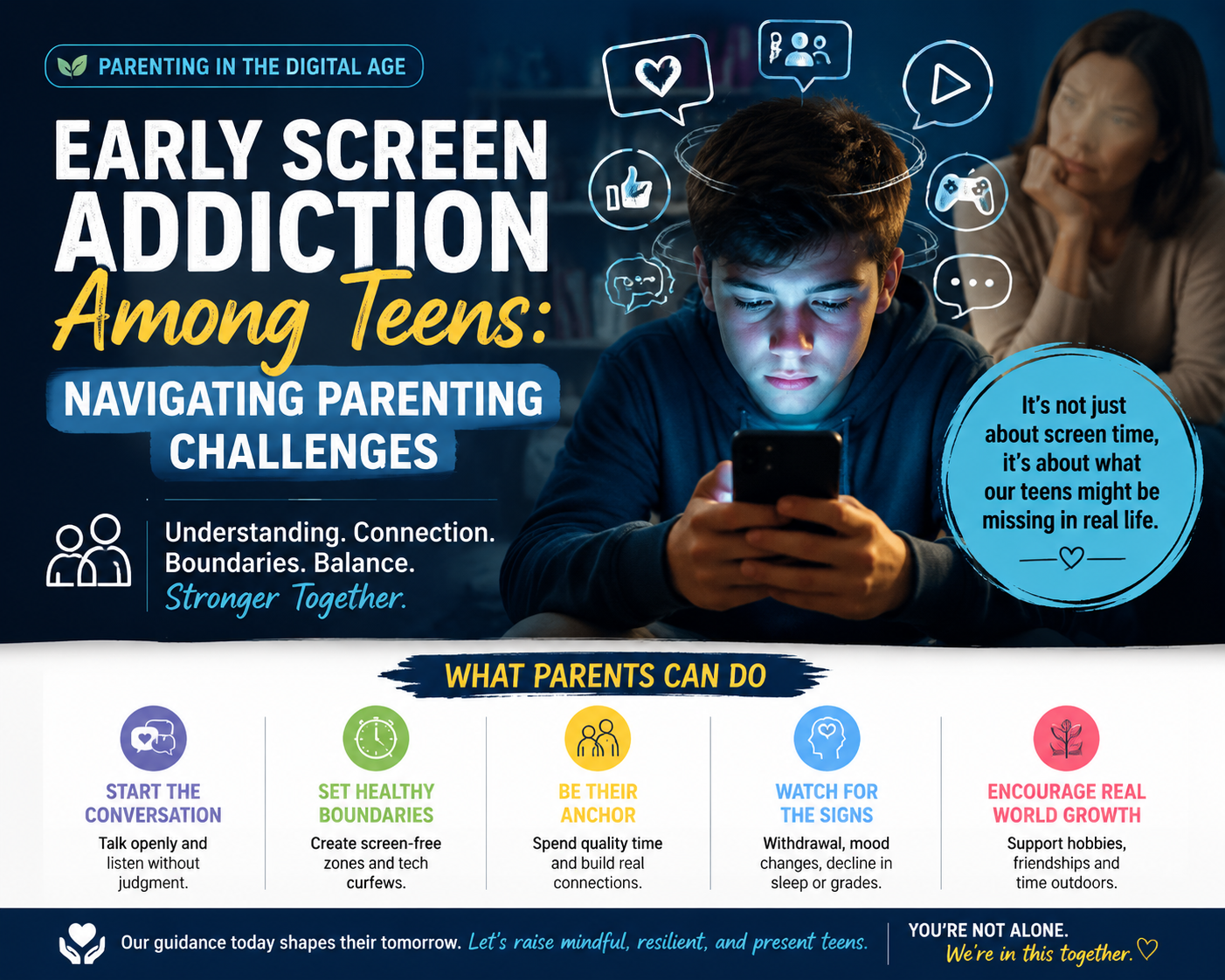
Early Screen Addiction Among Teens: Navigating Parenting Challenges in the Digital Age
Parenting has always come with its share of challenges, but raising teenagers in today’s digital world presents a unique set of obstacles unlike anything previous generations have experienced. Smartphones, social media, online gaming, streaming platforms, and constant connectivity have transformed not only how young people spend their time but also how they communicate, learn, socialize, and develop emotionally. For many parents, it can feel as though they are competing with an entire digital universe for their teenager’s attention.
Conversations that once came naturally often become brief exchanges, misunderstandings, or heated arguments. Parents wonder why their children seem emotionally distant, while teenagers often feel misunderstood and judged. The result is frustration on both sides, leaving families searching for ways to reconnect in an increasingly disconnected world.
Although researchers continue to debate the term “screen addiction,” there is little disagreement that excessive screen use can negatively affect emotional well-being, attention, sleep quality, academic performance, and family relationships. Digital platforms are intentionally designed to capture and maintain attention through endless scrolling, notifications, rewards, and personalized content. Every message, “like,” achievement in a game, or new video triggers small releases of dopamine, the brain’s reward chemical, encouraging repeated engagement.
For adolescents, whose brains are still developing, this constant stimulation is particularly powerful. Teenagers naturally seek novelty, excitement, social acceptance, and immediate rewards. Technology provides all of these almost instantly, making it increasingly difficult to disengage. Over time, many young people begin turning to screens not only for entertainment but also as a way to manage stress, loneliness, boredom, anxiety, or uncomfortable emotions.
Parents frequently interpret this behavior as laziness, disrespect, or defiance. In reality, many teenagers are using technology as an emotional coping mechanism. Rather than expressing feelings such as, “I’m anxious,” “I feel left out,” or “I’m overwhelmed,” they retreat into social media, gaming, or streaming services where they can temporarily escape life’s pressures. Unfortunately, while screens may provide short-term comfort, they rarely address the emotional needs underneath.
This emotional disconnect often fuels the arguments so many families experience. Parents typically value responsibility, delayed gratification, face-to-face communication, and self-discipline. Teenagers, however, are growing up in an environment that prioritizes instant communication, digital identities, online friendships, and immediate access to information and entertainment. When a parent says, “Put your phone away,” the teenager may hear, “You don’t understand my world.” Conversely, when a teen ignores repeated requests, parents often hear, “You don’t respect me.” Neither interpretation is entirely accurate, but both individuals leave the conversation feeling unheard.
One of the most common parenting mistakes is assuming that providing more information will change behavior. Most teenagers already know that excessive screen time can interfere with sleep, concentration, mental health, and relationships. Knowledge alone, however, rarely changes habits. The adolescent brain is naturally inclined toward immediate gratification rather than long-term consequences, making self-regulation especially difficult during these formative years. As a result, lengthy lectures often produce resistance rather than reflection.
A more effective approach begins with curiosity instead of criticism. Rather than asking, “Why are you always on your phone?” parents might ask, “What do you enjoy most about this game?” or “What makes this app so important to you?” These questions invite conversation instead of conflict. When teenagers feel understood rather than judged, they become far more receptive to guidance. Listening does not mean agreeing with every choice; it simply communicates respect and opens the door for meaningful dialogue.
Healthy boundaries remain essential, but they are most successful when they are collaborative rather than authoritarian. Families benefit from creating clear expectations together, such as keeping phones away during meals, charging devices outside bedrooms at night, completing responsibilities before recreational screen time, or setting aside regular screen-free family activities. Teenagers who participate in establishing these guidelines are significantly more likely to follow them because they experience a sense of ownership rather than punishment.
Equally important is the example parents set. Young people pay far more attention to behavior than to words. A parent who constantly checks emails during dinner or scrolls through social media while expecting undivided attention from their child unintentionally sends conflicting messages. Demonstrating healthy digital habits, including putting phones away during conversations and being fully present, reinforces the values parents hope to instill.
Reducing unhealthy screen dependence also requires offering meaningful alternatives. Simply taking away devices often creates resentment unless teenagers have opportunities to experience fulfillment elsewhere. Sports, music, creative arts, volunteering, outdoor activities, cooking together, reading, family game nights, and shared hobbies provide opportunities for genuine connection while strengthening emotional resilience. These experiences help young people discover that enjoyment, confidence, and belonging exist beyond the digital world.
Communication also changes dramatically when parents focus first on understanding emotions before attempting to solve problems. A teenager who says, “Nobody likes me,” may not be asking for advice. They may simply need someone to acknowledge their pain. Responding with, “That sounds incredibly difficult,” often creates more trust than immediately offering solutions. Feeling heard reduces defensiveness and encourages continued conversation, while feeling dismissed frequently shuts communication down altogether.
There are times, however, when excessive screen use may signal deeper emotional concerns. Persistent social withdrawal, severe anxiety, depression, declining academic performance, chronic sleep disruption, self-harm, or intense emotional reactions whenever devices are removed may indicate that professional support is needed. Early intervention can help identify underlying issues before they become more serious and provide families with practical strategies for rebuilding healthier patterns.
Ultimately, parenting success has never been measured by raising children who never argue or make mistakes. Healthy families experience disagreements, misunderstandings, and moments of frustration. What distinguishes resilient families is their willingness to repair relationships, maintain trust, and continue showing up for one another with compassion and consistency.
Technology will continue evolving, bringing new opportunities and new challenges that no previous generation has faced. Parents cannot eliminate these influences, nor should they attempt to isolate their children from the modern world. Instead, they can provide something far more valuable: emotional security, consistent guidance, unconditional love, and genuine human connection. These qualities cannot be downloaded, streamed, or replaced by an app.
The strongest protection against unhealthy screen dependence is not stricter rules alone, but stronger relationships. When teenagers know they are valued, respected, and understood, they become more resilient, more emotionally secure, and better equipped to navigate the digital age. In the end, the goal is not to raise children who merely spend less time looking at screens, but young adults who know how to balance technology with meaningful relationships, purposeful living, and a deep understanding of themselves and the people around them.

dr.dan
Related Posts

How can proper therapy help children of couples going through separation or divorce. The short and long term impact of broken families on children and their present behaviors inside and outside of school.
Separation and divorce are emotionally challenging experiences for families,...

Navigating back-to-school anxiety amid changing school policies. Imminent changes that can bring stress to kids and parents and knowing what to do to reduce the levels of cortisol in your body. Efficient strategies that can help you for school year 2026-2027.
The return to school can be an exciting time filled with new opportunities,...

How parenting trends affect our mental health? IF all family dynamics are different in nature, no magic formula can work to alleviate the stress of parenting. What other alternative solutions are available?
Parenting is a complex and ever-evolving journey, influenced by a myriad of...

Effective strategies in managing conflicts when one partner avoids arguments: Subtle ways to compromising to ensure a healthy relationship long term.
Managing conflicts in a relationship where one partner avoids arguments can...