

Behind the Mask: Understanding a Child’s Struggle at School When Pretending Everything Is Fine at Home Is No Longer Possible—and How Parents Can Recognize the Warning Signs and Take Meaningful Action to Help.
For many parents, discovering that their child is struggling at school can come as a painful surprise. A child may come home, eat dinner, laugh with the family, complete their usual routine, and appear perfectly fine, while internally carrying anxiety, loneliness, academic pressure, bullying, social rejection, learning difficulties, or the growing feeling that they simply cannot keep up. Children do not always have the emotional vocabulary to explain what they are experiencing, so instead, they may become remarkably good at hiding it. They may say, “School was fine,” when it wasn’t. They may smile when they feel overwhelmed, insist that they are not worried when they are, or act as though nothing bothers them because they do not want to disappoint their parents.
Sometimes, this façade is not intentional deception. It can be a child’s way of protecting themselves. A child may believe that admitting they are struggling will make their parents disappointed, angry, worried, or frustrated. They may fear being judged by teachers or classmates, or they may simply lack the ability to explain what they are feeling. Over time, they can learn to separate their outside behavior from their internal experience. At school, they may try to appear confident, funny, independent, or unaffected. At home, they may continue maintaining the same image because they do not know how to admit that something is wrong.
The psychological burden of maintaining that façade can become enormous. Imagine carrying a heavy backpack throughout the school day while pretending that it weighs nothing. At first, a child may be able to manage it. But eventually, another difficult assignment, disappointing grade, conflict with a friend, critical comment from a teacher, or stressful interaction can become the extra weight that pushes them toward emotional exhaustion. The child may begin showing changes that parents initially interpret as attitude or defiance. They may become unusually quiet, irritable, emotional, distracted, withdrawn, or resistant to school. Homework may suddenly become a nightly battle. A child who once enjoyed talking about school may stop mentioning it altogether. They may complain about headaches or stomachaches, struggle to sleep, lose interest in activities they once enjoyed, or become increasingly anxious the night before school.
These behaviors should not automatically be interpreted as laziness, defiance, attention-seeking, or a lack of discipline. Sometimes behavior is communication. A child who cannot say, “I am overwhelmed and I don’t know how to handle this,” may communicate through avoidance. A child who cannot say, “I am afraid other students will make fun of me,” may suddenly refuse to go to school. A child who feels academically incapable may stop trying because failing after making an effort can feel more painful than appearing not to care. In some cases, a child may unconsciously protect their self-esteem by convincing themselves that they did not really try. If they fail, they can tell themselves, “I could have done it if I had tried,” rather than confronting the more frightening belief that they tried their hardest and still could not succeed.
This can create a damaging psychological cycle. The child avoids an assignment because it creates anxiety, and the avoidance provides temporary relief. But the assignment remains unfinished, which creates additional academic pressure. Falling behind can then reinforce feelings of inadequacy, and those feelings make the next assignment even more intimidating. Eventually, the child can become trapped in a cycle of stress, avoidance, falling behind, shame, and even greater stress. Parents may understandably respond by pushing harder, saying things such as, “Why aren’t you doing your homework?” “You need to try harder,” or “You’re capable of doing better.” These statements usually come from love and concern, but when a child is already experiencing anxiety or shame, additional pressure can sometimes reinforce the belief that something is wrong with them. Instead of thinking, “I am having difficulty with this,” the child may begin thinking, “I am the problem.”
That distinction is extremely important. A child who understands that they are struggling with a specific problem can learn strategies to address it. A child who believes that they themselves are the problem may begin developing shame, low self-esteem, helplessness, and resistance to asking for help. This is why parents should try to become curious before becoming corrective. Rather than immediately asking, “Why aren’t you doing better?” parents can ask, “What has been feeling difficult lately?” Instead of assuming that their child is not trying, they can explore whether the child understands the material, feels comfortable in the classroom, is experiencing problems with peers, is being bullied, feels overwhelmed by expectations, has difficulty concentrating, or is afraid of disappointing someone.
Sometimes one of the most powerful messages a parent can give a struggling child is simply, “You don’t have to pretend everything is okay with me.” That statement creates emotional permission for the child to remove the mask. Children need to know that telling the truth about their struggles will not automatically result in punishment, disappointment, or judgment. They need to understand that their parents want to understand the problem rather than simply correct the behavior. This does not mean eliminating expectations or accountability. A child can still be responsible for completing schoolwork while receiving emotional support. They can be expected to treat others respectfully while being given the opportunity to explain when they feel excluded, bullied, or overwhelmed. They can be encouraged to improve academically without being made to believe that their grades determine their worth.
Parents should also pay close attention to changes from their child’s normal personality and behavior. A naturally quiet child and a child who has suddenly become withdrawn may be experiencing very different things. A child who has always struggled academically is different from a child whose grades suddenly begin declining. A child who occasionally complains about school is different from one who repeatedly develops physical complaints before school or becomes intensely distressed on Sunday evenings. Changes in sleep, appetite, concentration, energy, social interaction, emotional regulation, school attendance, and interest in activities can all provide important clues that something deserves closer attention.
Parents should also listen to the difference between what their child says and what their child does. A child may insist that everything is fine while their behavior communicates otherwise. Sometimes the body reveals what words cannot. Anxiety may appear through stomachaches, headaches, restlessness, difficulty sleeping, irritability, or avoidance. Sadness may appear through withdrawal, loss of motivation, or changes in behavior. Social difficulties may appear through a sudden reluctance to attend school or participate in activities. These signs do not automatically mean that a child has a mental-health disorder, but they can be signals that deserve compassionate attention rather than immediate judgment.
Creating an environment where children feel emotionally safe is one of the most important things parents can do. The goal is not to interrogate a child until they reveal what is wrong. The goal is to create enough trust that the child eventually feels comfortable talking. Some children open up during a direct conversation, while others may communicate more easily while riding in the car, eating dinner, walking, playing a game, or doing another activity. Some may find it easier to write their feelings down or talk to another trusted adult. There is no single correct doorway into a child’s emotional world.
Parents can also help children develop a stronger emotional vocabulary. A child may know that they feel terrible without understanding whether what they are experiencing is anxiety, embarrassment, loneliness, sadness, anger, fear, or frustration. Instead of asking only, “What’s wrong?” a parent might ask, “Do you feel worried, embarrassed, frustrated, lonely, angry, or overwhelmed?” Giving children language for their emotions can help them recognize what is happening internally and communicate their needs more effectively.
It is also important to consider what is happening within the school environment. A child’s struggle may have little to do with effort and much more to do with the circumstances surrounding them. Academic expectations, relationships with teachers, peer dynamics, bullying, social pressure, learning differences, classroom structure, and a child’s sense of belonging can all influence how they experience school. A child who feels accepted and supported is psychologically positioned very differently from one who spends every school day anticipating embarrassment, rejection, criticism, or failure.
Communication between parents and educators can therefore become an important part of understanding the bigger picture. Teachers may observe behaviors that parents never see, while parents may recognize emotional changes that teachers are unaware of. When these perspectives are shared respectfully, adults can develop a clearer understanding of what the child may be experiencing. The objective should not be to immediately blame the child, teacher, school, or parent. The objective should be to understand the circumstances and determine what kind of support the child needs.
Professional support may also be appropriate when a child’s difficulties persist, intensify, or significantly interfere with school, relationships, sleep, family life, or everyday functioning. A qualified mental-health professional can help explore whether the child’s difficulties may be associated with anxiety, depression, trauma, adjustment challenges, social difficulties, learning concerns, or other factors. Seeking support does not mean labeling a child as broken or incapable. It means taking the child’s emotional experience seriously and providing another layer of support when the family needs it.
Perhaps the most important message parents can communicate is that struggling does not make a child a failure. A difficult semester does not define intelligence. A poor grade does not determine potential. Being rejected by peers does not mean someone is unlikeable. Needing additional academic or emotional support does not mean a child is weak. Children are still developing their identities, and the messages they receive during difficult periods can become part of the story they eventually tell themselves about who they are.
If the message a child repeatedly receives is, “You are disappointing us,” they may internalize shame. But if the message is, “We know you’re capable, and we also want to understand what you’re going through,” the child may begin developing resilience, self-awareness, and the confidence to seek help. The difference is not simply in the words. It is in the emotional environment created around those words.
Parents cannot remove every challenge their children will encounter. They cannot prevent every difficult friendship, disappointing grade, embarrassing moment, stressful assignment, or challenging experience. What they can provide is a secure place where their child does not have to pretend. Because sometimes the most meaningful intervention is not immediately solving the problem. Sometimes it is recognizing that something has changed, sitting beside the child without judgment, listening carefully, and saying, “You don’t have to carry this alone. Let’s figure it out together.”
Behind every child’s behavior is a story that may not yet have been told. When parents become curious about that story instead of simply reacting to the behavior, they create an opportunity to understand what their child is truly experiencing. And when the mask finally comes off, what a struggling child often needs most is not criticism, pressure, or another lecture about doing better. They need someone willing to see them, listen to them, believe them, and remind them that struggling today does not determine who they can become tomorrow.
Learn More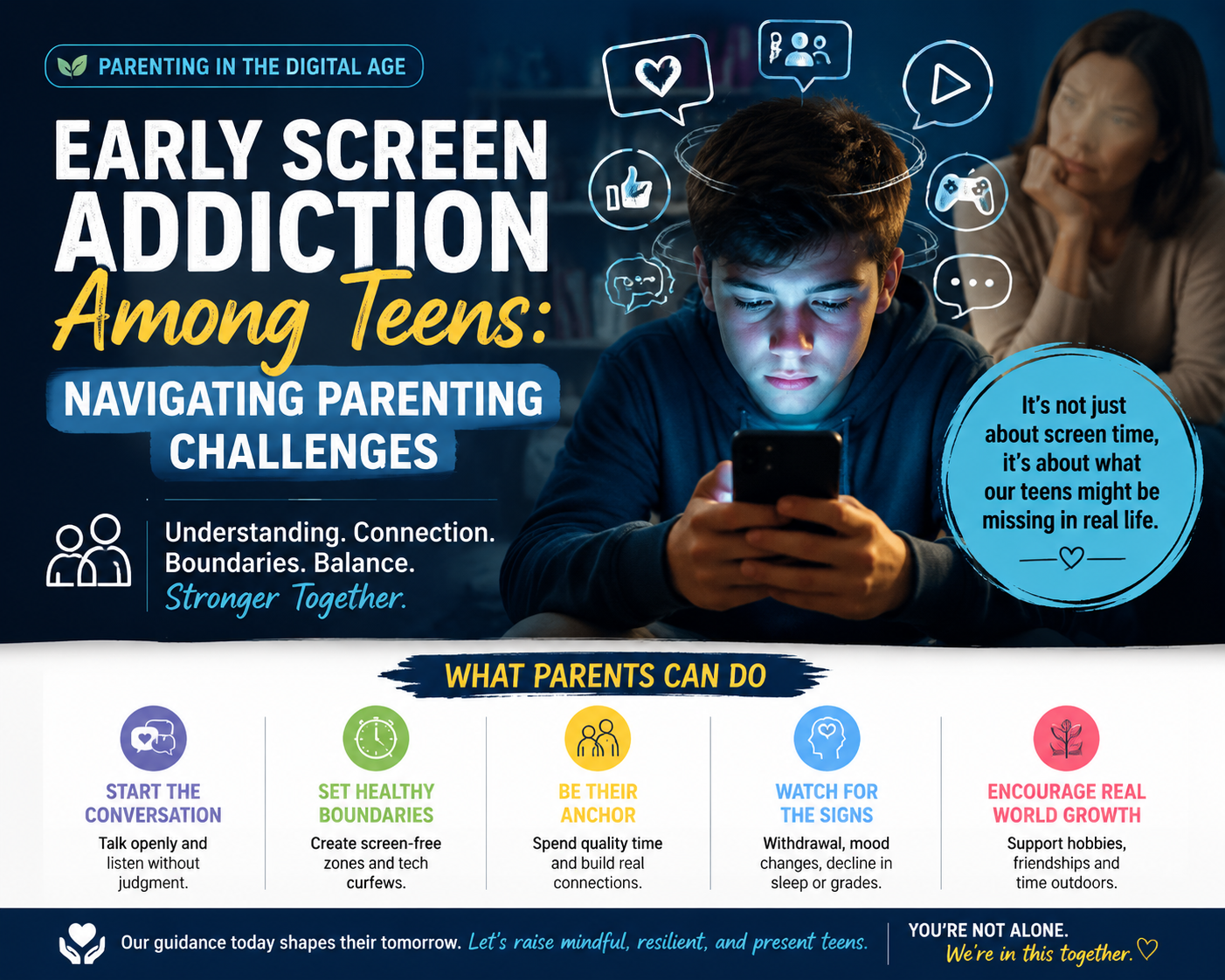
Early Screen Addiction Among Teens: Navigating Parenting Challenges in the Digital Age
Parenting has always come with its share of challenges, but raising teenagers in today’s digital world presents a unique set of obstacles unlike anything previous generations have experienced. Smartphones, social media, online gaming, streaming platforms, and constant connectivity have transformed not only how young people spend their time but also how they communicate, learn, socialize, and develop emotionally. For many parents, it can feel as though they are competing with an entire digital universe for their teenager’s attention.
Conversations that once came naturally often become brief exchanges, misunderstandings, or heated arguments. Parents wonder why their children seem emotionally distant, while teenagers often feel misunderstood and judged. The result is frustration on both sides, leaving families searching for ways to reconnect in an increasingly disconnected world.
Although researchers continue to debate the term “screen addiction,” there is little disagreement that excessive screen use can negatively affect emotional well-being, attention, sleep quality, academic performance, and family relationships. Digital platforms are intentionally designed to capture and maintain attention through endless scrolling, notifications, rewards, and personalized content. Every message, “like,” achievement in a game, or new video triggers small releases of dopamine, the brain’s reward chemical, encouraging repeated engagement.
For adolescents, whose brains are still developing, this constant stimulation is particularly powerful. Teenagers naturally seek novelty, excitement, social acceptance, and immediate rewards. Technology provides all of these almost instantly, making it increasingly difficult to disengage. Over time, many young people begin turning to screens not only for entertainment but also as a way to manage stress, loneliness, boredom, anxiety, or uncomfortable emotions.
Parents frequently interpret this behavior as laziness, disrespect, or defiance. In reality, many teenagers are using technology as an emotional coping mechanism. Rather than expressing feelings such as, “I’m anxious,” “I feel left out,” or “I’m overwhelmed,” they retreat into social media, gaming, or streaming services where they can temporarily escape life’s pressures. Unfortunately, while screens may provide short-term comfort, they rarely address the emotional needs underneath.
This emotional disconnect often fuels the arguments so many families experience. Parents typically value responsibility, delayed gratification, face-to-face communication, and self-discipline. Teenagers, however, are growing up in an environment that prioritizes instant communication, digital identities, online friendships, and immediate access to information and entertainment. When a parent says, “Put your phone away,” the teenager may hear, “You don’t understand my world.” Conversely, when a teen ignores repeated requests, parents often hear, “You don’t respect me.” Neither interpretation is entirely accurate, but both individuals leave the conversation feeling unheard.
One of the most common parenting mistakes is assuming that providing more information will change behavior. Most teenagers already know that excessive screen time can interfere with sleep, concentration, mental health, and relationships. Knowledge alone, however, rarely changes habits. The adolescent brain is naturally inclined toward immediate gratification rather than long-term consequences, making self-regulation especially difficult during these formative years. As a result, lengthy lectures often produce resistance rather than reflection.
A more effective approach begins with curiosity instead of criticism. Rather than asking, “Why are you always on your phone?” parents might ask, “What do you enjoy most about this game?” or “What makes this app so important to you?” These questions invite conversation instead of conflict. When teenagers feel understood rather than judged, they become far more receptive to guidance. Listening does not mean agreeing with every choice; it simply communicates respect and opens the door for meaningful dialogue.
Healthy boundaries remain essential, but they are most successful when they are collaborative rather than authoritarian. Families benefit from creating clear expectations together, such as keeping phones away during meals, charging devices outside bedrooms at night, completing responsibilities before recreational screen time, or setting aside regular screen-free family activities. Teenagers who participate in establishing these guidelines are significantly more likely to follow them because they experience a sense of ownership rather than punishment.
Equally important is the example parents set. Young people pay far more attention to behavior than to words. A parent who constantly checks emails during dinner or scrolls through social media while expecting undivided attention from their child unintentionally sends conflicting messages. Demonstrating healthy digital habits, including putting phones away during conversations and being fully present, reinforces the values parents hope to instill.
Reducing unhealthy screen dependence also requires offering meaningful alternatives. Simply taking away devices often creates resentment unless teenagers have opportunities to experience fulfillment elsewhere. Sports, music, creative arts, volunteering, outdoor activities, cooking together, reading, family game nights, and shared hobbies provide opportunities for genuine connection while strengthening emotional resilience. These experiences help young people discover that enjoyment, confidence, and belonging exist beyond the digital world.
Communication also changes dramatically when parents focus first on understanding emotions before attempting to solve problems. A teenager who says, “Nobody likes me,” may not be asking for advice. They may simply need someone to acknowledge their pain. Responding with, “That sounds incredibly difficult,” often creates more trust than immediately offering solutions. Feeling heard reduces defensiveness and encourages continued conversation, while feeling dismissed frequently shuts communication down altogether.
There are times, however, when excessive screen use may signal deeper emotional concerns. Persistent social withdrawal, severe anxiety, depression, declining academic performance, chronic sleep disruption, self-harm, or intense emotional reactions whenever devices are removed may indicate that professional support is needed. Early intervention can help identify underlying issues before they become more serious and provide families with practical strategies for rebuilding healthier patterns.
Ultimately, parenting success has never been measured by raising children who never argue or make mistakes. Healthy families experience disagreements, misunderstandings, and moments of frustration. What distinguishes resilient families is their willingness to repair relationships, maintain trust, and continue showing up for one another with compassion and consistency.
Technology will continue evolving, bringing new opportunities and new challenges that no previous generation has faced. Parents cannot eliminate these influences, nor should they attempt to isolate their children from the modern world. Instead, they can provide something far more valuable: emotional security, consistent guidance, unconditional love, and genuine human connection. These qualities cannot be downloaded, streamed, or replaced by an app.
The strongest protection against unhealthy screen dependence is not stricter rules alone, but stronger relationships. When teenagers know they are valued, respected, and understood, they become more resilient, more emotionally secure, and better equipped to navigate the digital age. In the end, the goal is not to raise children who merely spend less time looking at screens, but young adults who know how to balance technology with meaningful relationships, purposeful living, and a deep understanding of themselves and the people around them.
Learn More