
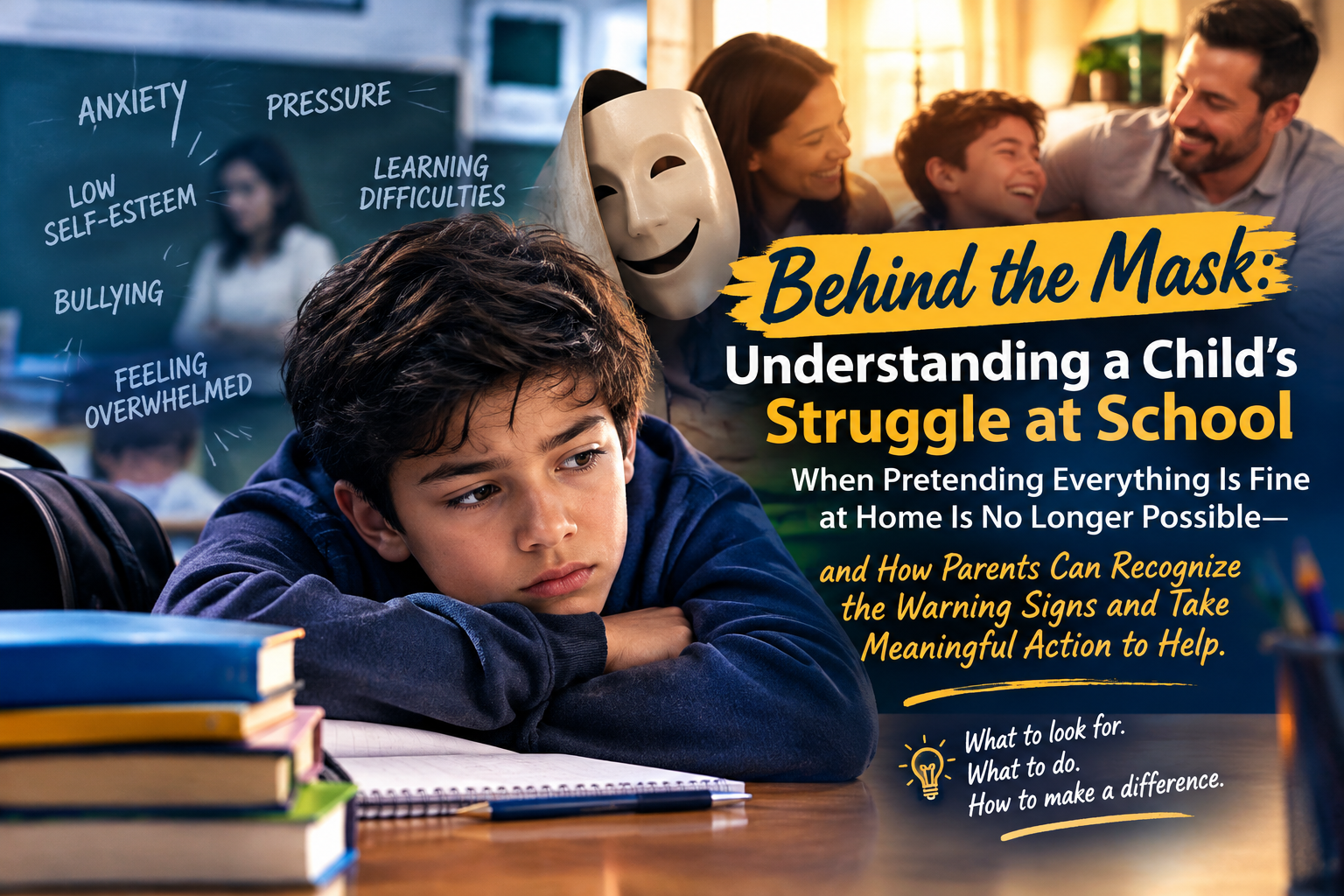
Behind the Mask: Understanding a Child’s Struggle at School When Pretending Everything Is Fine at Home Is No Longer Possible—and How Parents Can Recognize the Warning Signs and Take Meaningful Action to Help.
For many parents, discovering that their child is struggling at school can come as a painful surprise. A child may come home, eat dinner, laugh with the family, complete their usual routine, and appear perfectly fine, while internally carrying anxiety, loneliness, academic pressure, bullying, social rejection, learning difficulties, or the growing feeling that they simply cannot keep up. Children do not always have the emotional vocabulary to explain what they are experiencing, so instead, they may become remarkably good at hiding it. They may say, “School was fine,” when it wasn’t. They may smile when they feel overwhelmed, insist that they are not worried when they are, or act as though nothing bothers them because they do not want to disappoint their parents.
Sometimes, this façade is not intentional deception. It can be a child’s way of protecting themselves. A child may believe that admitting they are struggling will make their parents disappointed, angry, worried, or frustrated. They may fear being judged by teachers or classmates, or they may simply lack the ability to explain what they are feeling. Over time, they can learn to separate their outside behavior from their internal experience. At school, they may try to appear confident, funny, independent, or unaffected. At home, they may continue maintaining the same image because they do not know how to admit that something is wrong.
The psychological burden of maintaining that façade can become enormous. Imagine carrying a heavy backpack throughout the school day while pretending that it weighs nothing. At first, a child may be able to manage it. But eventually, another difficult assignment, disappointing grade, conflict with a friend, critical comment from a teacher, or stressful interaction can become the extra weight that pushes them toward emotional exhaustion. The child may begin showing changes that parents initially interpret as attitude or defiance. They may become unusually quiet, irritable, emotional, distracted, withdrawn, or resistant to school. Homework may suddenly become a nightly battle. A child who once enjoyed talking about school may stop mentioning it altogether. They may complain about headaches or stomachaches, struggle to sleep, lose interest in activities they once enjoyed, or become increasingly anxious the night before school.
These behaviors should not automatically be interpreted as laziness, defiance, attention-seeking, or a lack of discipline. Sometimes behavior is communication. A child who cannot say, “I am overwhelmed and I don’t know how to handle this,” may communicate through avoidance. A child who cannot say, “I am afraid other students will make fun of me,” may suddenly refuse to go to school. A child who feels academically incapable may stop trying because failing after making an effort can feel more painful than appearing not to care. In some cases, a child may unconsciously protect their self-esteem by convincing themselves that they did not really try. If they fail, they can tell themselves, “I could have done it if I had tried,” rather than confronting the more frightening belief that they tried their hardest and still could not succeed.
This can create a damaging psychological cycle. The child avoids an assignment because it creates anxiety, and the avoidance provides temporary relief. But the assignment remains unfinished, which creates additional academic pressure. Falling behind can then reinforce feelings of inadequacy, and those feelings make the next assignment even more intimidating. Eventually, the child can become trapped in a cycle of stress, avoidance, falling behind, shame, and even greater stress. Parents may understandably respond by pushing harder, saying things such as, “Why aren’t you doing your homework?” “You need to try harder,” or “You’re capable of doing better.” These statements usually come from love and concern, but when a child is already experiencing anxiety or shame, additional pressure can sometimes reinforce the belief that something is wrong with them. Instead of thinking, “I am having difficulty with this,” the child may begin thinking, “I am the problem.”
That distinction is extremely important. A child who understands that they are struggling with a specific problem can learn strategies to address it. A child who believes that they themselves are the problem may begin developing shame, low self-esteem, helplessness, and resistance to asking for help. This is why parents should try to become curious before becoming corrective. Rather than immediately asking, “Why aren’t you doing better?” parents can ask, “What has been feeling difficult lately?” Instead of assuming that their child is not trying, they can explore whether the child understands the material, feels comfortable in the classroom, is experiencing problems with peers, is being bullied, feels overwhelmed by expectations, has difficulty concentrating, or is afraid of disappointing someone.
Sometimes one of the most powerful messages a parent can give a struggling child is simply, “You don’t have to pretend everything is okay with me.” That statement creates emotional permission for the child to remove the mask. Children need to know that telling the truth about their struggles will not automatically result in punishment, disappointment, or judgment. They need to understand that their parents want to understand the problem rather than simply correct the behavior. This does not mean eliminating expectations or accountability. A child can still be responsible for completing schoolwork while receiving emotional support. They can be expected to treat others respectfully while being given the opportunity to explain when they feel excluded, bullied, or overwhelmed. They can be encouraged to improve academically without being made to believe that their grades determine their worth.
Parents should also pay close attention to changes from their child’s normal personality and behavior. A naturally quiet child and a child who has suddenly become withdrawn may be experiencing very different things. A child who has always struggled academically is different from a child whose grades suddenly begin declining. A child who occasionally complains about school is different from one who repeatedly develops physical complaints before school or becomes intensely distressed on Sunday evenings. Changes in sleep, appetite, concentration, energy, social interaction, emotional regulation, school attendance, and interest in activities can all provide important clues that something deserves closer attention.
Parents should also listen to the difference between what their child says and what their child does. A child may insist that everything is fine while their behavior communicates otherwise. Sometimes the body reveals what words cannot. Anxiety may appear through stomachaches, headaches, restlessness, difficulty sleeping, irritability, or avoidance. Sadness may appear through withdrawal, loss of motivation, or changes in behavior. Social difficulties may appear through a sudden reluctance to attend school or participate in activities. These signs do not automatically mean that a child has a mental-health disorder, but they can be signals that deserve compassionate attention rather than immediate judgment.
Creating an environment where children feel emotionally safe is one of the most important things parents can do. The goal is not to interrogate a child until they reveal what is wrong. The goal is to create enough trust that the child eventually feels comfortable talking. Some children open up during a direct conversation, while others may communicate more easily while riding in the car, eating dinner, walking, playing a game, or doing another activity. Some may find it easier to write their feelings down or talk to another trusted adult. There is no single correct doorway into a child’s emotional world.
Parents can also help children develop a stronger emotional vocabulary. A child may know that they feel terrible without understanding whether what they are experiencing is anxiety, embarrassment, loneliness, sadness, anger, fear, or frustration. Instead of asking only, “What’s wrong?” a parent might ask, “Do you feel worried, embarrassed, frustrated, lonely, angry, or overwhelmed?” Giving children language for their emotions can help them recognize what is happening internally and communicate their needs more effectively.
It is also important to consider what is happening within the school environment. A child’s struggle may have little to do with effort and much more to do with the circumstances surrounding them. Academic expectations, relationships with teachers, peer dynamics, bullying, social pressure, learning differences, classroom structure, and a child’s sense of belonging can all influence how they experience school. A child who feels accepted and supported is psychologically positioned very differently from one who spends every school day anticipating embarrassment, rejection, criticism, or failure.
Communication between parents and educators can therefore become an important part of understanding the bigger picture. Teachers may observe behaviors that parents never see, while parents may recognize emotional changes that teachers are unaware of. When these perspectives are shared respectfully, adults can develop a clearer understanding of what the child may be experiencing. The objective should not be to immediately blame the child, teacher, school, or parent. The objective should be to understand the circumstances and determine what kind of support the child needs.
Professional support may also be appropriate when a child’s difficulties persist, intensify, or significantly interfere with school, relationships, sleep, family life, or everyday functioning. A qualified mental-health professional can help explore whether the child’s difficulties may be associated with anxiety, depression, trauma, adjustment challenges, social difficulties, learning concerns, or other factors. Seeking support does not mean labeling a child as broken or incapable. It means taking the child’s emotional experience seriously and providing another layer of support when the family needs it.
Perhaps the most important message parents can communicate is that struggling does not make a child a failure. A difficult semester does not define intelligence. A poor grade does not determine potential. Being rejected by peers does not mean someone is unlikeable. Needing additional academic or emotional support does not mean a child is weak. Children are still developing their identities, and the messages they receive during difficult periods can become part of the story they eventually tell themselves about who they are.
If the message a child repeatedly receives is, “You are disappointing us,” they may internalize shame. But if the message is, “We know you’re capable, and we also want to understand what you’re going through,” the child may begin developing resilience, self-awareness, and the confidence to seek help. The difference is not simply in the words. It is in the emotional environment created around those words.
Parents cannot remove every challenge their children will encounter. They cannot prevent every difficult friendship, disappointing grade, embarrassing moment, stressful assignment, or challenging experience. What they can provide is a secure place where their child does not have to pretend. Because sometimes the most meaningful intervention is not immediately solving the problem. Sometimes it is recognizing that something has changed, sitting beside the child without judgment, listening carefully, and saying, “You don’t have to carry this alone. Let’s figure it out together.”
Behind every child’s behavior is a story that may not yet have been told. When parents become curious about that story instead of simply reacting to the behavior, they create an opportunity to understand what their child is truly experiencing. And when the mask finally comes off, what a struggling child often needs most is not criticism, pressure, or another lecture about doing better. They need someone willing to see them, listen to them, believe them, and remind them that struggling today does not determine who they can become tomorrow.
Learn More
Lingering childhood trauma: How can it affect your career success if left untreated and ignored. Figuring out the most productive way to address the past.
Childhood trauma doesn’t stay in a box marked “past.” When left untreated or ignored, early wounds can quietly shape the way you work, lead, take risks, relate to colleagues, and tolerate stress — sometimes sabotaging career potential long before you realize it. The good news: with targeted strategies, professional help, and workplace adjustments, you can interrupt those patterns and redirect your energy toward growth and sustained success. This article explains how trauma shows up in a career, why it matters, and a practical, productive roadmap to address the past.
How childhood trauma can influence career development (the mechanisms)
- Threat-driven physiology. Trauma sensitizes the nervous system. In work settings this looks like hyper-vigilance, quick stress reactions, or freeze responses under pressure — which can limit creativity and problem-solving in high-stakes moments.
- Attachment and trust patterns. Early relational wounds shape how you relate to bosses, mentors, and teammates. You may avoid closeness (keeping colleagues at arm’s length), or you may overly depend on approval, both of which hamper authentic leadership and collaboration.
- Self-concept and belief systems. Trauma often produces internalized messages — “I’m not enough,” “I don’t deserve success,” or “If I show weakness I’ll be rejected.” These feed imposter syndrome, risk aversion, and missed opportunities.
- Emotion regulation and decision-making. Difficulty tolerating uncomfortable emotions can prompt escape behaviors (avoidance, procrastination, overwork, substance use), impulsive decisions, or chronic indecision — all costly for career trajectory.
- Performance under feedback. Trauma can make critical feedback feel like personal attack, leading to defensiveness, withdrawal, or persistent anxiety around evaluations and promotions.
- Burnout and avoidance. Unresolved trauma increases vulnerability to burnout, absenteeism, and disengagement — sometimes interpreted by employers as “poor fit” rather than a treatable health issue.
Typical workplace signs that trauma may be influencing performance
- Chronic second-guessing and perfectionism that slow projects down.
- Extreme reactions to routine feedback (catastrophizing or stonewalling).
- Difficulty maintaining boundaries (saying yes to everything) or, conversely, isolating to avoid conflict.
- Frequent job-hopping or self-sabotage near promotions.
- Physical symptoms in high-pressure situations: panic, dissociation, memory blanks.
- Recurrent interpersonal conflicts with coworkers that feel out-of-proportion.
If several of these describe you regularly, trauma-informed support may be helpful.
Why ignoring it is costly (short- and long-term)
- Short-term: missed promotions, strained relationships, reduced productivity, poor decision-making in critical moments.
- Long-term: a career path shaped by avoidance (settling for less), chronic health effects, and cumulative missed opportunities that compound over decades.
Treating trauma isn’t only about wellbeing — it’s an investment in career capital.
The most productive, evidence-aligned ways to address the past
Note: the right path depends on your needs. If you’re in crisis or having thoughts of self-harm, seek immediate professional help.
1. Start with targeted professional help
- Therapy modalities that commonly help with childhood trauma: trauma-informed cognitive-behavioral therapy (CBT), Eye Movement Desensitization and Reprocessing (EMDR), somatic therapies (which work with body sensations), and attachment-focused therapies. A trauma-informed clinician assesses safety and builds gradual exposure and regulation skills.
- Coaching + therapy combo: career coach for actionable workplace strategies together with therapy for deeper healing can accelerate progress.
2. Build emotion regulation skills first
- Learning to calm your nervous system (breathing, grounding, paced activity, simple movement) gives you more choice in stressful moments and prevents reactive behaviors that derail meetings or negotiations.
3. Reframe beliefs with evidence-based practices
- Use cognitive techniques to test “automatic thoughts” (e.g., “If I make a mistake they’ll fire me”) and replace them with realistic alternatives. Small experiments at work can disconfirm catastrophic beliefs.
4. Practice interpersonal skill-building
- Role-play difficult conversations, rehearse receiving feedback, and script boundary language. These practice runs reduce threat responses when the real moment arrives.
5. Use gradual exposure to feared career moves
- If promotions or public speaking trigger trauma-based fear, take incremental steps (present small parts of a talk, accept low-stakes leadership tasks) to build mastery.
6. Create pragmatic workplace supports
- Confidential mentoring, flexible schedules during therapy phases, or limiting meetings when you’re overloaded can make healing compatible with job demands. If disclosure is considered, plan it carefully — a brief script, clear ask (e.g., temporary flexibility), and identifying a trusted HR or manager ally.
7. Cultivate restorative routines
- Sleep hygiene, consistent movement, nutrition, and micro-recovery (short breaks, nature exposure) stabilize mood and cognition, amplifying therapeutic gains.
8. Track measurable progress
- Set small, observable goals: attend X feedback meetings without leaving early, apply for one stretch role, or reduce sick days by Y. Objective wins reinforce new identity narratives.
Tips for managers and teammates (if you’re supporting someone)
- Validate the person’s experience and focus on behaviors at work rather than assumptions about cause.
- Offer flexible support (mentorship, temporary workload adjustments) without stigmatizing language.
- Encourage use of employee assistance programs and confidential mental health resources.
- Promote a psychologically safe culture where learning from mistakes is rewarded.
Measuring success: what progress looks like
- Less reactivity to feedback, better sleep, clearer decision-making, sustained attendance, and willingness to pursue stretch assignments.
- Internal indicators: a reduced sense of shame, increased agency, and a stronger narrative of “I can grow.”
- Career indicators: completed projects, promotions pursued, improved peer relationships.
Few concluding words of effective reasoning: Healing is strategic work, not a detour
Addressing childhood trauma is not an indulgence or a career sidetrack — it is strategic professional development. When you reduce threat-based responses, correct limiting beliefs, and build interpersonal courage, you free cognitive and emotional energy to learn, lead, and take the kinds of risks that create long-term success. Start with small steps, pair therapy with practical workplace strategies, and track concrete wins. Over time, what once felt like an invisible brake can become the foundation of more honest, resilient, and fulfilling professional life.
Learn More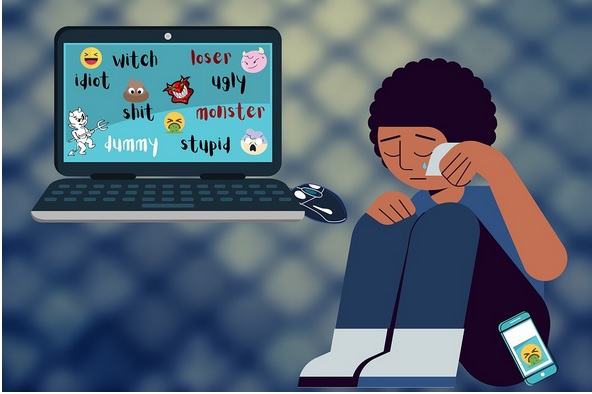
Effective strategies on how to discuss cyberbullying with your child/children to help keep them safe online. Psychological impact it can have on them if conversation is ignored or avoided.
The rapid rise of digital communication has led to an increase in cyberbullying, making it crucial for parents to discuss online safety with their children. According to a 2022 Pew Research Center study, 59% of U.S. teens report experiencing some form of cyberbullying. This article explores how to effectively communicate with children about cyberbullying, provide them with the necessary tools to stay safe online, and mitigate potential risks.
Understanding Cyberbullying
Cyberbullying is the use of digital platforms such as social media, messaging apps, and gaming forums to harass, threaten, or humiliate others. Common forms of cyberbullying include:
- Harassment: Sending repeated, offensive, or threatening messages.
- Doxxing: Publishing private information without consent.
- Exclusion: Intentionally leaving someone out of online groups or conversations.
- Impersonation: Creating fake accounts to mock or defame someone.
- Rumor Spreading: Sharing false or misleading information to damage a person’s reputation.
Cyberbullying differs from traditional bullying because it can occur anonymously and reach a wider audience, making it more challenging to combat.
Why Conversations About Cyberbullying Matter
Research indicates that open conversations between parents and children about online safety can reduce the likelihood of cyberbullying involvement. A study published in JAMA Pediatrics found that children who frequently discuss online behavior with their parents are less likely to engage in or become victims of cyberbullying. Effective communication helps:
- Build trust, ensuring children feel safe discussing online issues.
- Educate children about the consequences of cyberbullying.
- Encourage proactive steps in handling online harassment.
- Foster emotional resilience and critical thinking.
How to Approach the Conversation
1. Create a Safe and Open Environment
- Initiate discussions in a non-judgmental, supportive manner.
- Assure your child that they can share concerns without fear of punishment.
- Listen actively and validate their feelings.
2. Explain What Cyberbullying Is
- Use age-appropriate language and real-life examples.
- Discuss different types of cyberbullying and their consequences.
- Encourage children to reflect on how their online actions impact others.
3. Encourage Responsible Online Behavior
- Teach the importance of respectful communication and empathy.
- Reinforce the value of privacy settings and strong passwords.
- Guide them on identifying suspicious behavior online.
4. Recognizing the Signs of Cyberbullying
- Look for behavioral changes such as withdrawal, anxiety, or reluctance to use digital devices.
- Encourage children to speak up if they or their friends experience cyberbullying.
5. Equip Them with Coping Strategies
- Teach them to block, report, and disengage from bullies.
- Emphasize the importance of not retaliating, as it can escalate the situation.
- Encourage seeking support from trusted adults or school counselors.
6. Set Boundaries and Monitor Activity
- Establish clear guidelines for internet and social media use.
- Use parental controls while balancing trust and privacy.
- Regularly check in on their online experiences.
The Role of Schools and Law Enforcement
Schools play a crucial role in preventing and addressing cyberbullying. The National Center for Education Statistics (NCES) reports that 46% of public schools have policies in place to handle cyberbullying cases. Parents should:
- Familiarize themselves with school policies on digital harassment.
- Encourage children to report cyberbullying incidents to school officials.
- Collaborate with teachers and administrators to ensure a safe learning environment.
- Contact law enforcement if threats or harassment become severe.
Psychological Impact of Cyberbullying
Cyberbullying can lead to serious psychological effects, including:
- Anxiety and Depression: A 2021 study in Child and Adolescent Psychiatry and Mental Health found that victims of cyberbullying are more likely to develop anxiety and depressive symptoms.
- Low Self-Esteem: Persistent online harassment can lead to feelings of worthlessness.
- Academic Decline: Victims may struggle with concentration and school performance due to emotional distress.
- Suicidal Thoughts: Extreme cases of cyberbullying have been linked to increased suicidal ideation, as documented by research in the Journal of Adolescent Health.
Preventative Measures for Parents
To proactively prevent cyberbullying, parents should:
- Model positive online behavior: Demonstrate responsible internet use.
- Encourage digital literacy: Teach children how to verify information and recognize online risks.
- Create a family media plan: Set guidelines for appropriate screen time and online interactions.
- Stay informed: Keep up with the latest social media trends and potential online threats.
When to Seek Professional Help
If a child experiences severe emotional distress due to cyberbullying, professional intervention may be necessary. Signs that indicate the need for therapy or counseling include:
- Withdrawal from social activities and friendships.
- Sudden drop in academic performance.
- Drastic mood swings or increased irritability.
- Self-harm behaviors or suicidal thoughts.
Challenges ahead
Discussing cyberbullying with your child should be an ongoing conversation rather than a one-time discussion. By fostering open communication, teaching digital responsibility, and staying actively involved in their online lives, parents can create a safer digital environment for their children. With the right guidance and support, children can navigate the digital world confidently and securely.


Avoiding these narcissistic parenting styles or your children may follow similar narcissistic behaviors. Some hope in sight.

To prevent your children from adopting narcissistic behaviors, it is crucial to avoid two distinct parenting approaches. These parenting styles can have similar detrimental effects, resembling the parallel between narcissism and obesity when raising children in a toxic mental and physical environment. The end result may be different in expression, with one involving manipulative behaviors towards others and the other leading to morbid obesity, but the underlying dangers persist, yielding undesirable outcomes.
When parents have a tendency to overeat, their children are more likely to follow suit due to limited choices, as parents are the ones responsible for grocery shopping. If an abundance of unhealthy food is readily available at home, children are more likely to consume what is accessible.
Conversely, when parents exhibit narcissistic behaviors, their offspring tend to view such behavior as normal, as they witness it in their daily lives. Unlike the consistent nature of overeating leading to obesity, the narcissistic environment parents create can manifest in opposite ways while ultimately resulting in the same outcome.

Allow me to elaborate: There are two distinct parenting styles that can lead a child to develop narcissistic tendencies, and interestingly, these styles are polar opposites. One style involves neglectful parenting, which traumatizes children and impairs their self-esteem and ability to form healthy attachments with others in adulthood. The opposite style path involves overindulgent parenting, fostering a sense of entitlement and narcissism in the child’s future.
Children learn through observation. Growing up in a household where their feelings were ignored teaches them that acknowledging and respecting others’ feelings and needs is unnecessary. Conversely, children who are spoiled and told that everything they do and feel is valid develop an inflated sense of self-worth. Both environments reinforce self-centeredness, where the child learns that others’ feelings are less important than their own, leading to poor emotional regulation skills.
The good news is that children can unlearn toxic behaviors more easily than adults. If you notice your child developing antagonistic traits, you can help by demonstrating good emotional regulation and mirroring their emotions. By validating their feelings, you can reduce shame, fear, and insecurity, which can drive narcissistic behaviors. Additionally, if your child throws a tantrum, you can guide them by asking three questions: “What happened?” “How are you feeling?” and “How do you think your reaction is affecting others?” This approach helps them develop empathy, social awareness, and emotional regulation skills.
All challenging children from narcissistic parents had one thing in common, which most will acknowledge their behavior.

Just as with fitness and health, there are specific habits that need to be modified in order to ensure long-lasting desired results. Consistently maintaining a healthy diet and regular exercise routines are vital components for achieving positive outcomes in the life of your offsprings. When it comes to narcissistic parenting styles, it is crucial to reflect on your own approach and make necessary adjustments before the situation deteriorates. Given that changing old habits or adopting new ones may take longer than the typical 45 to 60 days, the urgency of proactive solutions becomes apparent.
It’s essential to concentrate on identifying and addressing any harmful behaviors from the past that could negatively influence your children, such as neglect and lack of attention. However, it’s also important to be aware that excessive attention and an overbearing presence can have adverse effects on children. These changes need to originate from within, so it’s imperative to start taking action now before it gets too late.
Learn More