
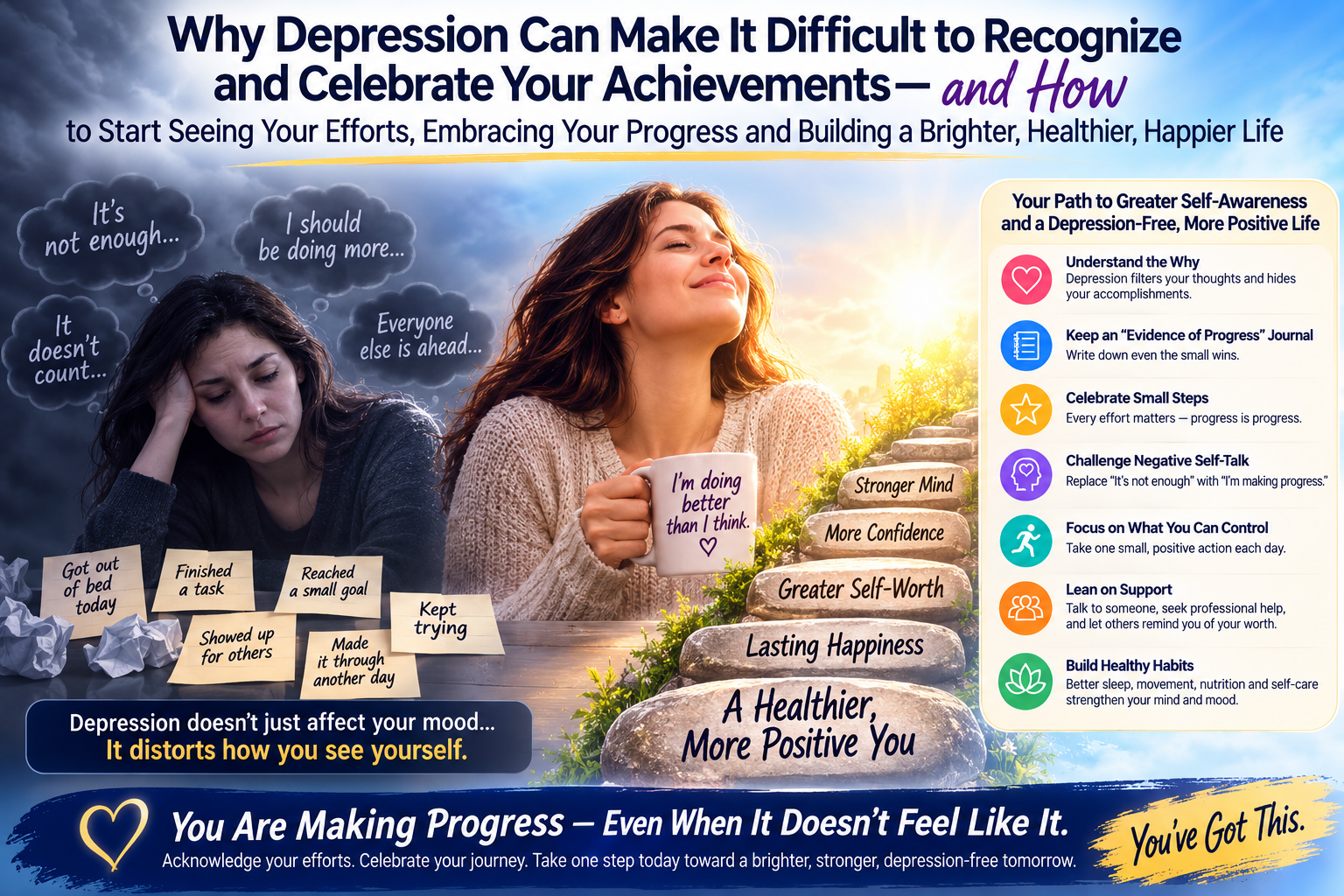
Why depression can make it difficult to recognize and celebrate your achievements—and how to begin acknowledging your efforts, embracing your progress, and taking empowering steps toward a healthier, more positive, and depression-free life.
Depression has a way of changing the way we see ourselves, our accomplishments, and even the meaning of success. You can accomplish something you once worked incredibly hard to achieve, receive recognition from others, reach an important milestone, or overcome an obstacle that once seemed impossible—and still feel little or nothing inside. Instead of excitement, you may feel emptiness. Instead of pride, you may hear an inner voice telling you that what you accomplished was not important, not good enough, or simply what you were “supposed” to do. This can be one of the most frustrating and misunderstood experiences of depression.
One of the most important things to understand is that difficulty celebrating an achievement does not necessarily mean that you are ungrateful, lazy, negative, or incapable of appreciating the good things in your life. Depression can affect motivation, emotional responsiveness, self-esteem, concentration, and the ability to experience pleasure. As a result, something that objectively deserves celebration may not emotionally register as something worth celebrating. Your circumstances may have changed, but your internal experience may still be telling you that nothing has really changed.
Depression can also create a powerful tendency to minimize accomplishments. You might complete a difficult project and immediately think, “Anyone could have done that.” You might reach a personal goal and respond with, “It wasn’t that difficult.” You might receive a compliment and immediately dismiss it. You may compare yourself to someone who appears to be further ahead and conclude that your achievement is insignificant. Over time, this pattern can make you feel as though you are constantly moving forward without ever allowing yourself to recognize how far you have traveled.
Another challenge is that many people unintentionally make achievement the condition for self-worth. They tell themselves, “I’ll be proud of myself when I succeed,” or “I’ll finally feel good about myself when I accomplish this.” The problem is that when success becomes the requirement for feeling worthy, there is always another mountain to climb. Even after reaching the goal, the mind may quickly create a new standard. What was once a dream becomes an expectation, and what should have been a moment of satisfaction becomes another reason to feel inadequate.
Depression can intensify this cycle because the mind often becomes more focused on perceived failures than genuine progress. You may remember the one thing that went wrong while forgetting the ten things that went right. You may focus on what you still need to accomplish instead of acknowledging what you have already overcome. This does not mean that you are choosing to think negatively. Depression can influence attention and interpretation, making negative information feel more convincing and positive information easier to dismiss.
This is why learning to acknowledge your effort is so important. Your achievement is not only the final outcome. It is also the courage, persistence, sacrifices, lessons, disappointments, and small decisions that allowed you to get there. Sometimes the greatest accomplishment is not reaching the destination but continuing to move forward when you were emotionally exhausted and uncertain about whether you could continue.
You deserve to recognize the effort behind your progress.
Perhaps you got out of bed on a difficult morning. Perhaps you made an important phone call that you had been avoiding. Perhaps you went to work despite feeling emotionally drained. Perhaps you asked for help instead of pretending everything was fine. Perhaps you established a healthier boundary, returned to therapy, reconnected with someone you trust, or simply decided that you would give yourself another day to try. These moments may not look impressive from the outside, but they can represent enormous victories for someone struggling with depression.
One powerful shift is learning to replace “Is this accomplishment big enough to celebrate?” with “What did this accomplishment require from me?” This question moves your attention away from comparing your achievement to someone else’s and toward understanding your own journey. Maybe what you accomplished required courage. Maybe it required patience. Maybe it required you to overcome fear. Maybe it required you to keep going when giving up felt easier. Your progress becomes meaningful when you understand what it took to create it.
You also do not have to wait until you feel proud before acknowledging yourself. Sometimes the action comes before the emotion. You can say, “I am proud of myself for making this effort,” even if you do not emotionally feel proud yet. You can recognize your progress even when your mind tells you that it does not matter. Over time, repeatedly practicing this form of self-recognition can help create a different relationship with your accomplishments.
Start with small victories rather than waiting for major milestones. Depression often encourages an all-or-nothing mentality: either you completely succeed or you have failed. A healthier perspective recognizes progress in degrees. Getting through a difficult day can be progress. Completing one task can be progress. Taking care of yourself can be progress. Having an honest conversation can be progress. Trying again after disappointment can be progress. Small steps become significant when they are repeated consistently.
It is also important to separate your identity from your productivity. You are not valuable because of how much you accomplish. You are not more deserving of love because you earn more money, achieve more professionally, maintain a perfect relationship, or constantly perform at your highest level. Achievement can be meaningful, but it should not be the foundation of your worth.
You are a human being before you are a performer, employee, parent, partner, entrepreneur, student, caregiver, or professional.
This distinction can be particularly important for people who have spent years being “the strong one.” When everyone expects you to be capable, independent, successful, and resilient, you may begin believing that you are only worthy when you are functioning at full capacity. Depression can then feel like a personal failure because it challenges the identity you have built around being strong.
But strength is not the absence of struggle.
Strength can also mean admitting that you are struggling. Strength can mean asking for support. Strength can mean slowing down. Strength can mean recognizing that you cannot solve everything by yourself. And sometimes strength means allowing yourself to be human without turning every difficult moment into evidence that something is wrong with you.
Another important step is becoming aware of your internal dialogue. Listen to how you speak to yourself after an accomplishment. Would you speak to a close friend the same way? If your friend completed something difficult and told you, “It wasn’t a big deal,” would you agree with them? Or would you remind them of everything they had overcome to get there?
Try offering yourself the same compassion.
Instead of saying, “I should have done more,” try saying, “I did what I could with what I had at that time.” Instead of “Anyone could have done this,” try “This mattered to me, and I worked for it.” Instead of “I’m still not where I want to be,” try “I may not be where I want to be yet, but I am not where I started.” This does not mean pretending everything is wonderful. It means developing a more balanced and compassionate perspective.
There is also tremendous value in allowing other people to celebrate you. Depression can make compliments uncomfortable. You may instinctively reject praise or explain away your accomplishments. Someone tells you, “You did an amazing job,” and you respond, “It wasn’t anything.” The next time someone genuinely acknowledges something you have accomplished, try simply saying, “Thank you.” You do not have to convince yourself that their praise is completely true. Just allow yourself to receive it.
Celebration does not have to mean throwing a party or feeling overwhelming happiness. Celebration can be quiet. It can be taking a moment to breathe and recognize what you accomplished. It can be treating yourself with kindness. It can be sharing your success with someone who genuinely cares about you. It can be writing down what you accomplished and allowing yourself to acknowledge it without immediately moving on to the next goal.Creating a daily practice of recognizing effort can also be helpful. At the end of the day, ask yourself: “What did I do today that required effort?” The answer does not need to be extraordinary. You are training your mind to notice progress rather than automatically searching for shortcomings.
Another powerful question is, “What would the version of me from five years ago think about where I am today?” We often become so focused on our current destination that we forget to look backward. The person you are today may possess skills, wisdom, resilience, relationships, experiences, and knowledge that your younger self desperately wanted. Your progress may be invisible to you simply because you have become accustomed to it.
Healing also requires patience. There is no single decision that makes depression disappear forever. For many people, recovery involves a combination of professional support, healthy routines, meaningful relationships, self-awareness, and sometimes medication as recommended by a qualified healthcare professional. Seeking professional help is not a sign that you have failed. It is a sign that you are willing to invest in your well-being.
If depression has made it difficult to experience pleasure, motivation, hope, or satisfaction for an extended period, consider speaking with a mental health professional. Depression is treatable, and you do not have to navigate it alone. If you ever experience thoughts of harming yourself or believe you may not be safe, seek immediate professional or emergency support in your area.
Most importantly, remember that the absence of celebration does not erase the achievement. You can accomplish something meaningful and still feel emotionally numb. You can make progress and still feel exhausted. You can be proud of yourself and still have difficult days. Healing is not about forcing yourself to be positive every moment. It is about learning to make room for hope while honestly acknowledging what you are experiencing. Your life does not have to become perfect before you are allowed to appreciate it. Your journey does not have to be finished before you are allowed to acknowledge how far you have come. And you do not have to become someone else before you are worthy of compassion, respect, and love.
Perhaps the first step toward a healthier relationship with yourself is simply recognizing this: you are trying. You are learning. You are growing. You are still here. And even if you cannot celebrate your achievements today, you can begin by acknowledging the effort it took to get this far. Greatness is not always found in extraordinary accomplishments. Sometimes greatness is found in the quiet decision to keep moving forward when life feels extraordinarily difficult. Give yourself permission to notice that.
Give yourself permission to appreciate that. And give yourself permission to believe that your next chapter can be different from your last.
Learn More
Early Screen Addiction Among Teens: Navigating Parenting Challenges in the Digital Age
Parenting has always come with its share of challenges, but raising teenagers in today’s digital world presents a unique set of obstacles unlike anything previous generations have experienced. Smartphones, social media, online gaming, streaming platforms, and constant connectivity have transformed not only how young people spend their time but also how they communicate, learn, socialize, and develop emotionally. For many parents, it can feel as though they are competing with an entire digital universe for their teenager’s attention.
Conversations that once came naturally often become brief exchanges, misunderstandings, or heated arguments. Parents wonder why their children seem emotionally distant, while teenagers often feel misunderstood and judged. The result is frustration on both sides, leaving families searching for ways to reconnect in an increasingly disconnected world.
Although researchers continue to debate the term “screen addiction,” there is little disagreement that excessive screen use can negatively affect emotional well-being, attention, sleep quality, academic performance, and family relationships. Digital platforms are intentionally designed to capture and maintain attention through endless scrolling, notifications, rewards, and personalized content. Every message, “like,” achievement in a game, or new video triggers small releases of dopamine, the brain’s reward chemical, encouraging repeated engagement.
For adolescents, whose brains are still developing, this constant stimulation is particularly powerful. Teenagers naturally seek novelty, excitement, social acceptance, and immediate rewards. Technology provides all of these almost instantly, making it increasingly difficult to disengage. Over time, many young people begin turning to screens not only for entertainment but also as a way to manage stress, loneliness, boredom, anxiety, or uncomfortable emotions.
Parents frequently interpret this behavior as laziness, disrespect, or defiance. In reality, many teenagers are using technology as an emotional coping mechanism. Rather than expressing feelings such as, “I’m anxious,” “I feel left out,” or “I’m overwhelmed,” they retreat into social media, gaming, or streaming services where they can temporarily escape life’s pressures. Unfortunately, while screens may provide short-term comfort, they rarely address the emotional needs underneath.
This emotional disconnect often fuels the arguments so many families experience. Parents typically value responsibility, delayed gratification, face-to-face communication, and self-discipline. Teenagers, however, are growing up in an environment that prioritizes instant communication, digital identities, online friendships, and immediate access to information and entertainment. When a parent says, “Put your phone away,” the teenager may hear, “You don’t understand my world.” Conversely, when a teen ignores repeated requests, parents often hear, “You don’t respect me.” Neither interpretation is entirely accurate, but both individuals leave the conversation feeling unheard.
One of the most common parenting mistakes is assuming that providing more information will change behavior. Most teenagers already know that excessive screen time can interfere with sleep, concentration, mental health, and relationships. Knowledge alone, however, rarely changes habits. The adolescent brain is naturally inclined toward immediate gratification rather than long-term consequences, making self-regulation especially difficult during these formative years. As a result, lengthy lectures often produce resistance rather than reflection.
A more effective approach begins with curiosity instead of criticism. Rather than asking, “Why are you always on your phone?” parents might ask, “What do you enjoy most about this game?” or “What makes this app so important to you?” These questions invite conversation instead of conflict. When teenagers feel understood rather than judged, they become far more receptive to guidance. Listening does not mean agreeing with every choice; it simply communicates respect and opens the door for meaningful dialogue.
Healthy boundaries remain essential, but they are most successful when they are collaborative rather than authoritarian. Families benefit from creating clear expectations together, such as keeping phones away during meals, charging devices outside bedrooms at night, completing responsibilities before recreational screen time, or setting aside regular screen-free family activities. Teenagers who participate in establishing these guidelines are significantly more likely to follow them because they experience a sense of ownership rather than punishment.
Equally important is the example parents set. Young people pay far more attention to behavior than to words. A parent who constantly checks emails during dinner or scrolls through social media while expecting undivided attention from their child unintentionally sends conflicting messages. Demonstrating healthy digital habits, including putting phones away during conversations and being fully present, reinforces the values parents hope to instill.
Reducing unhealthy screen dependence also requires offering meaningful alternatives. Simply taking away devices often creates resentment unless teenagers have opportunities to experience fulfillment elsewhere. Sports, music, creative arts, volunteering, outdoor activities, cooking together, reading, family game nights, and shared hobbies provide opportunities for genuine connection while strengthening emotional resilience. These experiences help young people discover that enjoyment, confidence, and belonging exist beyond the digital world.
Communication also changes dramatically when parents focus first on understanding emotions before attempting to solve problems. A teenager who says, “Nobody likes me,” may not be asking for advice. They may simply need someone to acknowledge their pain. Responding with, “That sounds incredibly difficult,” often creates more trust than immediately offering solutions. Feeling heard reduces defensiveness and encourages continued conversation, while feeling dismissed frequently shuts communication down altogether.
There are times, however, when excessive screen use may signal deeper emotional concerns. Persistent social withdrawal, severe anxiety, depression, declining academic performance, chronic sleep disruption, self-harm, or intense emotional reactions whenever devices are removed may indicate that professional support is needed. Early intervention can help identify underlying issues before they become more serious and provide families with practical strategies for rebuilding healthier patterns.
Ultimately, parenting success has never been measured by raising children who never argue or make mistakes. Healthy families experience disagreements, misunderstandings, and moments of frustration. What distinguishes resilient families is their willingness to repair relationships, maintain trust, and continue showing up for one another with compassion and consistency.
Technology will continue evolving, bringing new opportunities and new challenges that no previous generation has faced. Parents cannot eliminate these influences, nor should they attempt to isolate their children from the modern world. Instead, they can provide something far more valuable: emotional security, consistent guidance, unconditional love, and genuine human connection. These qualities cannot be downloaded, streamed, or replaced by an app.
The strongest protection against unhealthy screen dependence is not stricter rules alone, but stronger relationships. When teenagers know they are valued, respected, and understood, they become more resilient, more emotionally secure, and better equipped to navigate the digital age. In the end, the goal is not to raise children who merely spend less time looking at screens, but young adults who know how to balance technology with meaningful relationships, purposeful living, and a deep understanding of themselves and the people around them.
Learn More
Why anxiety can make you fear happiness or calm and strategies on how to eliminate this fear with psychotherapy. Take control of your mental health with the right modality!
It sounds contradictory, but many people who struggle with anxiety are not only afraid of stress—they are afraid of calm. Moments of happiness, peace, or emotional stability can trigger discomfort, racing thoughts, or even panic. Instead of enjoying the quiet, the mind begins scanning for danger. Instead of embracing joy, the body tightens as if preparing for impact. If this has happened to you, you are not broken. You are conditioned.
Anxiety is not just an emotion; it is a survival response. Over time, when someone experiences chronic stress, trauma, unpredictability, or repeated disappointment, the nervous system adapts. It learns that vigilance equals safety. Hyperawareness becomes protective. Worry becomes preparation. Tension becomes readiness. When this pattern is repeated long enough, the brain wires itself to believe that staying on guard prevents pain.
The problem is that once the nervous system is trained to operate in survival mode, calm feels unfamiliar. And what is unfamiliar often feels unsafe. If your body has spent years bracing for impact, relaxation can feel like vulnerability. The silence after chaos can feel suspicious. Peace can feel like “the calm before the storm.” The mind may whisper, “Something bad is about to happen,” simply because things are going well.
There is also a phenomenon known as fear of positive emotion. For some individuals, happiness in the past was followed by loss, criticism, betrayal, or trauma. The brain connects joy with danger, not because joy is dangerous, but because it was once paired with pain. If you allowed yourself to feel hopeful and were later hurt, your system may have concluded that hope is risky. Anxiety then steps in as a shield. It dulls excitement. It questions good news. It creates “what if” scenarios. It believes it is protecting you from future disappointment.
Control plays another powerful role. Anxiety gives an illusion of control. When you worry, you feel like you are preparing. When you analyze every possible outcome, you feel proactive. Calm, however, requires surrender. It requires trusting the present moment without rehearsing catastrophe. For someone accustomed to controlling outcomes through hypervigilance, letting go can feel terrifying. The mind may think, “If I stop worrying, I’ll miss something important.” This belief keeps the anxiety cycle intact.
Neurologically, this makes sense. The amygdala, the brain’s alarm system, becomes hypersensitive with chronic anxiety. It scans constantly for threats, even neutral or positive ones. Meanwhile, the prefrontal cortex, responsible for rational thinking and emotional regulation, can become overridden by survival responses. The body reacts before logic has a chance to intervene. This is why anxiety during happy moments feels automatic and difficult to control.
Psychotherapy is powerful because it addresses both the cognitive patterns and the physiological conditioning behind this fear. It does not simply tell you to “relax.” It helps retrain your entire system to experience safety again.
One of the first steps in therapy is psychoeducation. Understanding how anxiety works reduces secondary fear. When you learn that your nervous system is reacting out of habit—not because danger is present—you begin separating sensation from reality. Knowledge alone can reduce intensity because the unknown becomes understood.
Cognitive-based therapies help uncover the unconscious beliefs driving fear of calm. Thoughts such as “If I’m happy, something bad will follow,” “I don’t deserve peace,” or “Relaxing makes me weak” are brought into awareness. These beliefs are not criticized; they are explored. Where did they originate? What experiences shaped them? Are they still accurate today? Through restructuring and reframing, the brain gradually adopts healthier interpretations.
For individuals whose anxiety is rooted in trauma or chronic stress, somatic and trauma-informed approaches are essential. Anxiety is not only stored in thoughts; it is stored in the body. Muscle tension, shallow breathing, digestive issues, and sleep disturbances are all signs of a system stuck in survival mode. Therapeutic modalities that focus on body awareness, breath regulation, and gradual nervous system recalibration allow calm to be introduced slowly and safely. The goal is not forced relaxation but regulated safety.
Exposure-based strategies are also useful, but in a nuanced way. Instead of exposing someone to feared external situations, therapy can involve exposure to positive internal states. For example, practicing sitting with calm for short periods and noticing the urge to escape. Gradually increasing tolerance for peaceful sensations teaches the nervous system that nothing catastrophic happens when you relax. This builds emotional resilience.
Mindfulness-based therapies help individuals observe anxious thoughts without immediately reacting to them. Rather than fighting the thought “This won’t last,” you learn to notice it as a mental event, not a prophecy. Over time, this decreases the brain’s reactivity and increases emotional flexibility.
For some clients, deeper work involves identity reconstruction. When anxiety has been present for many years, it can become part of self-concept. You may unconsciously believe that being vigilant is who you are. Therapy helps separate identity from symptoms. You are not your anxiety; you are someone who developed anxiety as an adaptive response.
The process of eliminating fear of happiness does not happen overnight. It requires consistency, patience, and the right modality tailored to your history and nervous system. However, the brain is neuroplastic. It can rewire. Patterns learned through repetition can be unlearned through new repetition. Each time you allow yourself to experience calm without fleeing into worry, you are reshaping neural pathways.
Taking control of your mental health means recognizing that anxiety is not a life sentence. It is a pattern that can be reconditioned. The right psychotherapeutic approach provides structure, safety, and strategy. Whether through cognitive modalities, trauma-focused therapy, somatic work, or integrative approaches, the key is alignment with your specific needs.
Happiness is not a threat. Calm is not a warning sign. Peace does not mean you are unprepared. With effective psychotherapy, you can retrain your mind and body to interpret safety as safety. You can learn that joy does not need to be braced for, and quiet moments do not need to be questioned. When your nervous system feels secure, you no longer fear losing happiness—you learn how to sustain it.
Learn More
Clinical Variability in Depressive Disorders: Why Individuals May Experience Different Symptom Patterns Across Time. Understanding them is key to mental health.
Depressive disorders are often misunderstood as a single, static emotional state, when in reality they are dynamic and deeply individualized conditions that can shift in form, intensity, and presentation over time. Clinicians and researchers increasingly recognize that depression does not always follow a predictable pattern. Instead, it may evolve as a result of biological changes, psychological adaptation, life circumstances, and underlying vulnerabilities. Understanding this clinical variability is essential not only for accurate diagnosis and treatment, but also for reducing stigma and improving patient self-awareness.
Depression is influenced by a complex interaction between genetics, neurobiology, personality traits, environmental stressors, and learned coping responses. At one point in a person’s life, depression may appear as profound sadness, loss of interest, and withdrawal from daily functioning. Years later, however, it may emerge as irritability, emotional numbness, or chronic fatigue rather than overt sadness. These shifts do not indicate inconsistency or exaggeration on the part of the individual; rather, they reflect how the brain and body respond to stress, trauma, hormonal changes, and evolving life demands.
Early depressive episodes are often triggered by identifiable stressors such as academic pressure, relationship changes, or grief. During this stage, symptoms may be more recognizable and easier for others to validate. Over time, however, repeated exposure to depression can alter both neural pathways and cognitive patterns. Some individuals develop patterns of emotional suppression or become highly functional while remaining internally distressed. As a result, later presentations of depression may appear more subtle, internalized, or masked by productivity, perfectionism, or chronic overwork. What was once clearly experienced as sadness may instead manifest as burnout, hopelessness, or an inability to feel pleasure.
Physiological changes across the lifespan also contribute to the shifting nature of depressive symptoms. Hormonal fluctuations, medical conditions, sleep disturbances, and aging-related brain changes can deepen or reshape how depression is expressed. For example, depression in adolescents may present as irritability or behavioral changes, while in older adults it may appear as memory difficulties, apathy, or somatic complaints such as chronic pain and fatigue. The same person may even experience depression differently across developmental stages, which can complicate diagnosis and lead to misinterpretation by family members, healthcare providers, or the individual themselves.
Another important factor in this variability is how people psychologically adapt to ongoing emotional distress. Over time, individuals often develop coping strategies that mask their symptoms, such as maintaining a busy schedule, intellectualizing emotions, or focusing intensely on caregiving or professional success. These adaptations may protect functioning in the short term but can also obscure the presence of depression, delaying help-seeking and treatment. A person may appear outwardly successful while internally experiencing significant distress, emotional emptiness, or loss of meaning, illustrating how depression can coexist with competence and achievement.
Trauma history and life experiences further shape the evolution of depressive symptoms. Unresolved trauma can shift depression toward dissociation, hypervigilance, or shame-based thinking patterns, while prolonged adversity may contribute to chronic dysthymia — a persistent, low-grade depressive state that becomes woven into one’s sense of identity. Periods of major life transition, such as career changes, parenting demands, retirement, or loss, may reactivate depressive symptoms or alter their form. The person may feel as though depression has resurfaced “in a new way,” when in reality it is responding to a new psychological context.
Recognizing the variability of depressive presentations is essential for effective clinical care. When symptoms evolve, some individuals mistakenly believe they are “no longer depressed” or that their struggles are simply personal weaknesses, character flaws, or signs of failure. Others may feel confused when therapy or medication that once worked becomes less effective over time. Understanding that depression is dynamic — and often requires periodic reassessment — encourages individuals to remain engaged in ongoing care rather than assuming that treatment has failed or that they must simply endure their symptoms.
From a therapeutic standpoint, acknowledging variability allows clinicians to tailor interventions to the current expression of the disorder. Treatment may shift between cognitive restructuring, trauma-focused approaches, behavioral activation, lifestyle intervention, or medication adjustments depending on how depression manifests at a given time. Long-term mental health outcomes improve when care is flexible rather than standardized, and when patients are encouraged to openly discuss changes in how their symptoms feel or function in their lives.
Ultimately, understanding the evolving nature of depressive disorders fosters compassion, insight, and empowerment. It reminds us that depression is not a weakness or a single emotional state, but a multifaceted condition shaped by biology, experience, and context. When individuals recognize that symptom patterns may change — and that these changes are valid and clinically meaningful — they are more likely to seek timely support, advocate for themselves in treatment settings, and develop a deeper awareness of their emotional landscape. This awareness is not only key to effective mental health care, but also to fostering resilience and self-acceptance across the many phases of life.
Learn More