
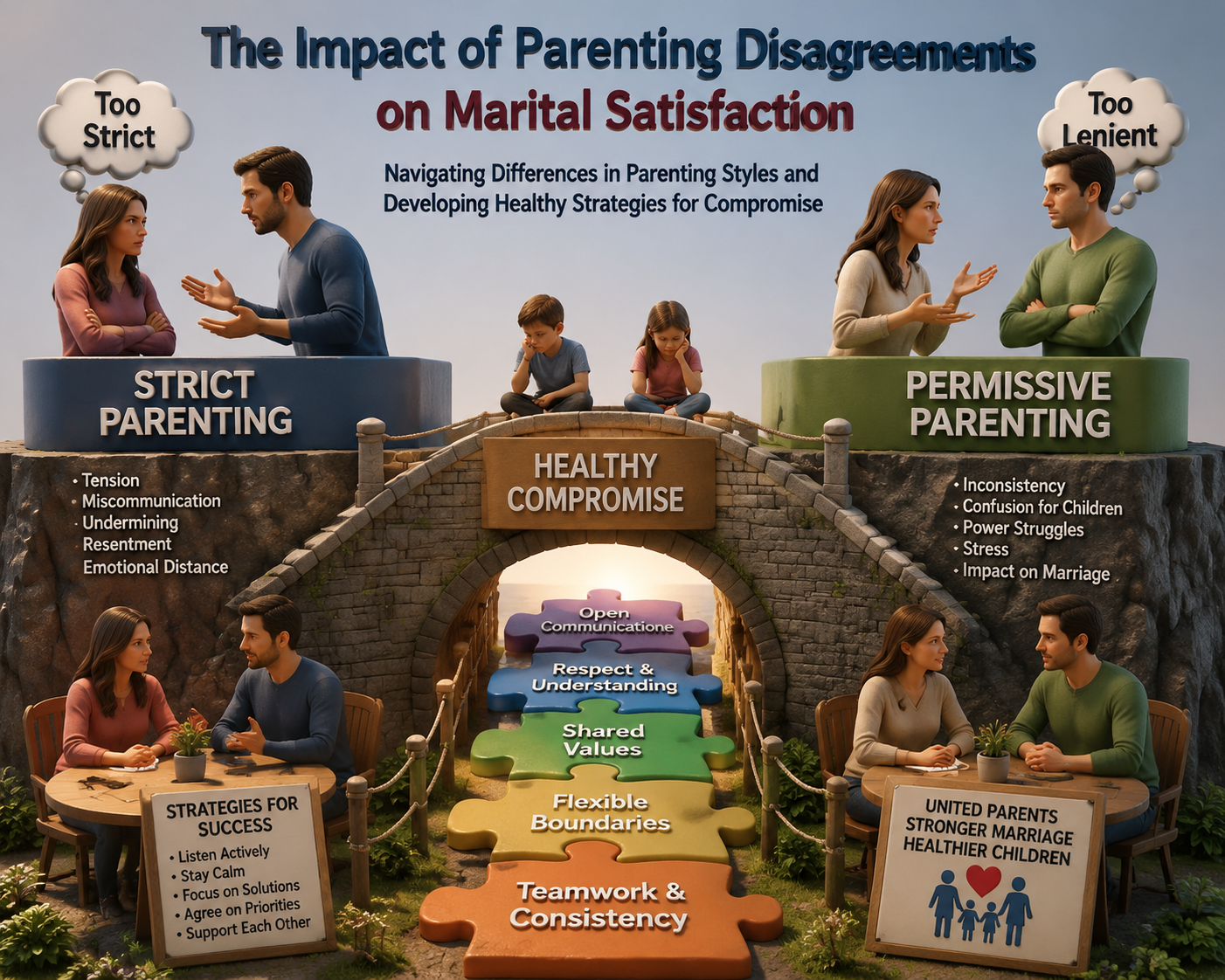
The Impact of Parenting Disagreements on Marital Satisfaction: Navigating Differences in Parenting Styles and Developing Healthy Strategies for Compromise
Parenting is one of the most rewarding experiences a couple can share, but it can also become one of the greatest sources of conflict in a marriage. Two people may deeply love one another and share the same hopes and dreams for their children while having very different ideas about how those goals should be achieved. One parent may believe in structure, rules, and consistent consequences, while the other may prioritize flexibility, emotional expression, and independence. One may be more protective, while the other encourages exploration and risk-taking. These differences do not necessarily mean that one parent is right and the other is wrong. However, when couples cannot communicate effectively or find common ground, disagreements about parenting can create tension that extends far beyond the immediate issue and can gradually affect marital satisfaction, emotional intimacy, and family harmony.
Why Parenting Disagreements Become So Emotional
Parenting disagreements are rarely just about the specific issue being discussed. A disagreement about bedtime, discipline, screen time, homework, or a child’s behavior may actually represent deeper beliefs about what makes a good parent. One parent may believe, “If I don’t establish strict rules, my child will become disrespectful,” while the other may think, “If we are too strict, our child will stop trusting us.” Both parents may be trying to protect their child, but they may be approaching parenting from completely different perspectives. These differences are often influenced by childhood experiences, cultural backgrounds, personality, personal values, previous relationships, education, and the way each individual was raised. Someone who grew up in a highly structured household may naturally believe that discipline and obedience create responsible adults, while someone who experienced overly strict or controlling parenting may intentionally choose a gentler and more emotionally supportive approach with their own children. Understanding these underlying influences is essential because couples often argue about what to do without taking time to understand why their partner believes a particular approach is important.
Common Sources of Parenting Conflict
Discipline is one of the most common areas of disagreement between parents. One partner may believe in immediate consequences, while the other prefers discussion, emotional coaching, or natural consequences. Problems become particularly damaging when parents undermine one another in front of the child. For example, if one parent says, “You’re grounded for the weekend,” and the other responds, “That’s ridiculous; you don’t need to be grounded,” the child may quickly learn that the parents can be played against one another. A healthier approach is for parents to discuss major disagreements privately and, whenever possible, present a reasonably consistent message to their children.
Technology and screen time have also become major sources of conflict for modern families. Parents may disagree about how much screen time children should have, what applications they should be allowed to use, whether they should have smartphones, and how closely their online activities should be monitored. One parent may see technology as an important educational and social tool, while the other may be concerned about excessive use, inappropriate content, social media, gaming, sleep disruption, or reduced family interaction. Instead of arguing about whether technology is simply “good” or “bad,” couples can establish clear family guidelines that address appropriate use, time limits, online safety, responsibilities, and privacy.
Education and academic expectations can create another source of tension. One parent may emphasize high grades, academic achievement, extracurricular activities, and preparation for the future, while the other may prioritize emotional well-being, creativity, social development, or allowing the child to explore interests without excessive pressure. Household responsibilities can also create conflict when parents have different expectations about chores, independence, allowances, and responsibilities. Extended family can add another layer of complexity when couples disagree about the influence of grandparents, family traditions, visitation, or how relatives should interact with their children. In all of these situations, the objective should not be determining which parent is right but identifying what approach best supports the child’s development while protecting the relationship between the parents.
How Parenting Conflict Can Affect Marital Satisfaction
Occasional disagreement is normal in a healthy marriage. The concern arises when parenting conflict becomes chronic, hostile, dismissive, or unresolved. Repeated disagreements can gradually create emotional distance between partners. Instead of experiencing one another as romantic partners, couples may begin functioning primarily as co-managers of the household. Their conversations become focused on schedules, homework, discipline, appointments, chores, finances, and responsibilities, while affection, emotional connection, and meaningful conversations receive less attention.
Unresolved parenting disagreements can also create resentment. One partner may begin thinking, “I’m always the one enforcing the rules,” while the other may feel, “My partner never supports me.” Over time, these perceptions can create a sense of loneliness within the marriage. Parents may also begin undermining one another, intentionally or unintentionally, which can place children in the middle of marital conflict. A child may learn to approach whichever parent is more likely to say yes, avoid consequences, or reverse the other parent’s decision. This dynamic can weaken parental authority while increasing tension between the adults. Persistent parenting conflict can also reduce intimacy because it becomes difficult to feel emotionally or physically connected when most interactions are characterized by criticism, frustration, defensiveness, or disagreement.
Healthy Disagreement Versus Destructive Conflict
Couples do not need to agree on everything to have a healthy marriage. In fact, differences can be beneficial when handled with respect because they allow partners to consider perspectives they may not have considered themselves. Healthy disagreement sounds like, “I understand why you think that approach would work. My concern is…” or “I don’t completely agree, but I’m willing to find a solution that works for both of us.” Destructive conflict sounds more like, “You’re a terrible parent,” “You never know what you’re doing,” or “I can’t trust you with the children.” The critical difference is not whether couples disagree but how they communicate during the disagreement. Respectful communication keeps the focus on the issue, while destructive communication attacks the person’s character and creates defensiveness.
Healthy Strategies for Reaching Parenting Compromises
One of the most important shifts couples can make is moving away from the question, “How can I prove that I’m right?” and toward, “What approach is most likely to help our child?” Parenting should not become a competition between two adults. The objective is to create an environment where children feel safe, loved, supported, accountable, and appropriately challenged. Couples should identify their shared parenting values before debating specific strategies. Even parents with very different styles often agree that they want their children to become responsible, respectful, independent, compassionate, emotionally healthy, confident, and resilient. Once these shared goals are identified, couples can discuss different methods for reaching them.
It is also helpful to distinguish between non-negotiable issues and areas where flexibility is appropriate. Safety concerns, serious behavioral issues, major medical decisions, and certain educational matters may require both parents to reach a clear agreement. Other issues, such as clothing preferences, recreational activities, minor household choices, or different ways of connecting emotionally with a child, may allow each parent to have some individual flexibility. Not every parenting difference needs to become a major marital discussion. Learning to determine which issues truly require agreement can significantly reduce unnecessary conflict.
Couples should also avoid fighting about parenting in front of their children whenever possible. Parents will inevitably disagree, but publicly criticizing or undermining one another can create confusion and insecurity. If a disagreement occurs, a parent can say, “Your mother and I have different perspectives about this. We’re going to discuss it privately and get back to you.” This teaches children that disagreement does not have to become disrespect and demonstrates healthy conflict resolution.
Another effective strategy is creating a simple family parenting agreement. This does not need to be a rigid rulebook. Couples can establish general expectations regarding discipline, bedtime, screen time, homework, chores, curfews, rewards, consequences, social activities, and family routines. Having these expectations established in advance reduces the likelihood that parents will debate their decisions in the middle of an emotionally charged situation. It also provides children with greater consistency.
Pause Before Reacting
When a parenting disagreement becomes emotionally charged, taking a pause can prevent a minor disagreement from escalating into a major marital conflict. Before responding, each partner can ask themselves: What am I feeling? What am I afraid might happen? What does my partner believe? What does our child need right now? Am I responding to this situation, or am I reacting to something from my own childhood? These questions can help parents recognize when their emotional response is connected to personal history rather than the current situation. Sometimes what appears to be an argument about a child’s behavior is actually a disagreement about fear, control, protection, independence, or unresolved experiences from the past.
Replace Criticism With Curiosity
One of the most effective communication strategies for couples is replacing criticism with curiosity. Instead of saying, “Why are you so strict?” a partner might ask, “Can you help me understand why this consequence feels important to you?” Instead of saying, “You let our child get away with everything,” a parent could ask, “What are you hoping our child learns by giving them more flexibility?” Curiosity creates an opportunity for understanding, while criticism tends to create defensiveness. The goal is to understand the belief behind the behavior rather than immediately judging the behavior itself.
Couples should also remind themselves that they are partners, not opponents. The problem is the problem—not each other. Instead of saying, “You and I disagree,” they can say, “We have two different perspectives. How can we combine them?” This simple shift in language reinforces collaboration. In many cases, parents discover that their differences can actually complement one another. One parent’s structure can work well alongside another parent’s emotional flexibility. For example, parents might agree that a child must complete homework before using electronics while allowing the child to choose when to complete the assignment within an agreed-upon timeframe. This approach provides both structure and autonomy.
Compromise Does Not Always Mean Meeting in the Middle
Healthy compromise does not necessarily mean that each parent gets exactly half of what they want. Sometimes one approach may be more appropriate based on the child’s age, developmental needs, safety, personality, or circumstances. The better question is, “What is the healthiest solution for our child in this particular situation?” When both approaches are reasonable, couples can also experiment. They might agree to try one strategy for two weeks and then evaluate whether it is working. This transforms a disagreement into a collaborative experiment rather than a battle over who is right.
Creating a Weekly Parenting Check-In
A simple weekly parenting meeting can also prevent small disagreements from becoming major sources of resentment. Couples can dedicate 15 to 20 minutes to discussing what went well during the week, what challenges they encountered, where they disagreed, what their child may need from them, and whether anything should change during the following week. They can also ask one another, “How can I better support you as a parent?” This question is particularly valuable because parenting can sometimes feel isolating. Feeling supported by one’s partner can strengthen both marital satisfaction and confidence as a parent.
When Professional Support May Help
Sometimes parenting disagreements become so persistent that couples struggle to resolve them independently. Professional counseling can provide a neutral and supportive environment where both partners can express concerns, understand the underlying causes of their disagreements, and develop healthier communication strategies. Couples may benefit from professional support when arguments about parenting occur frequently, communication has become hostile or disrespectful, one parent consistently undermines the other, parenting disagreements are affecting intimacy, one partner feels unsupported, children are repeatedly placed in the middle of marital conflict, or couples cannot reach agreements about significant parenting decisions. Seeking counseling is not a sign that a marriage has failed. In many cases, it is a proactive investment in the relationship and the overall well-being of the family.
The Goal Is Not Perfect Parenting
There is no perfect parenting style and no perfect parent. Children do not need parents who agree on every detail. They need parents who are willing to communicate, learn, apologize, adapt, and work together. Healthy parenting is not about eliminating every disagreement; it is about developing the ability to navigate disagreements without damaging the relationship or placing children in the middle. A strong marriage does not require two people to think exactly alike. It requires two people who respect one another enough to listen, understand, compromise, and continue working toward shared goals.
Parenting disagreements are inevitable, but marital disconnection does not have to be. When couples recognize that their different parenting styles often come from different experiences, values, personalities, and concerns, they can begin replacing criticism with understanding and competition with cooperation. The strongest families are not necessarily those where parents agree on everything; they are often the families where parents have learned how to disagree respectfully while remaining united in their love and commitment to their children.
Ultimately, the goal is not to determine which parent is right. The goal is to create a parenting partnership where both adults feel heard, respected, and supported, while children experience the consistency, emotional safety, boundaries, encouragement, and unconditional love they need to thrive. When couples learn to parent as a team rather than compete as individuals, they strengthen not only their children’s development but also the emotional foundation of their marriage. Different parenting styles do not have to divide a couple; with communication, empathy, flexibility, and a shared commitment to the well-being of the family, those differences can become strengths that make the family more balanced and resilient.

dr.dan
Related Posts

Election month is coming soon; tension within family may rise as to voting for the new leader. How to cope with family tensions during an election year and avoid conflict between parents and adult children?
Election time can be devastating for families voting for different leaders...

How can proper therapy help children of couples going through separation or divorce. The short and long term impact of broken families on children and their present behaviors inside and outside of school.
Separation and divorce are emotionally challenging experiences for families,...

The ONE of many challenges in Parenting: The art of active listening with teenage kids and create healthy and engaging conversations within family dynamics. The do’s and don’ts of interactions.
Parenting teenagers is often considered one of the most rewarding yet...

The very difficult decision to make in life: Knowing when to cut off interaction with toxic family members
So I know I will get a lot of negative feedback with this article and most will...