
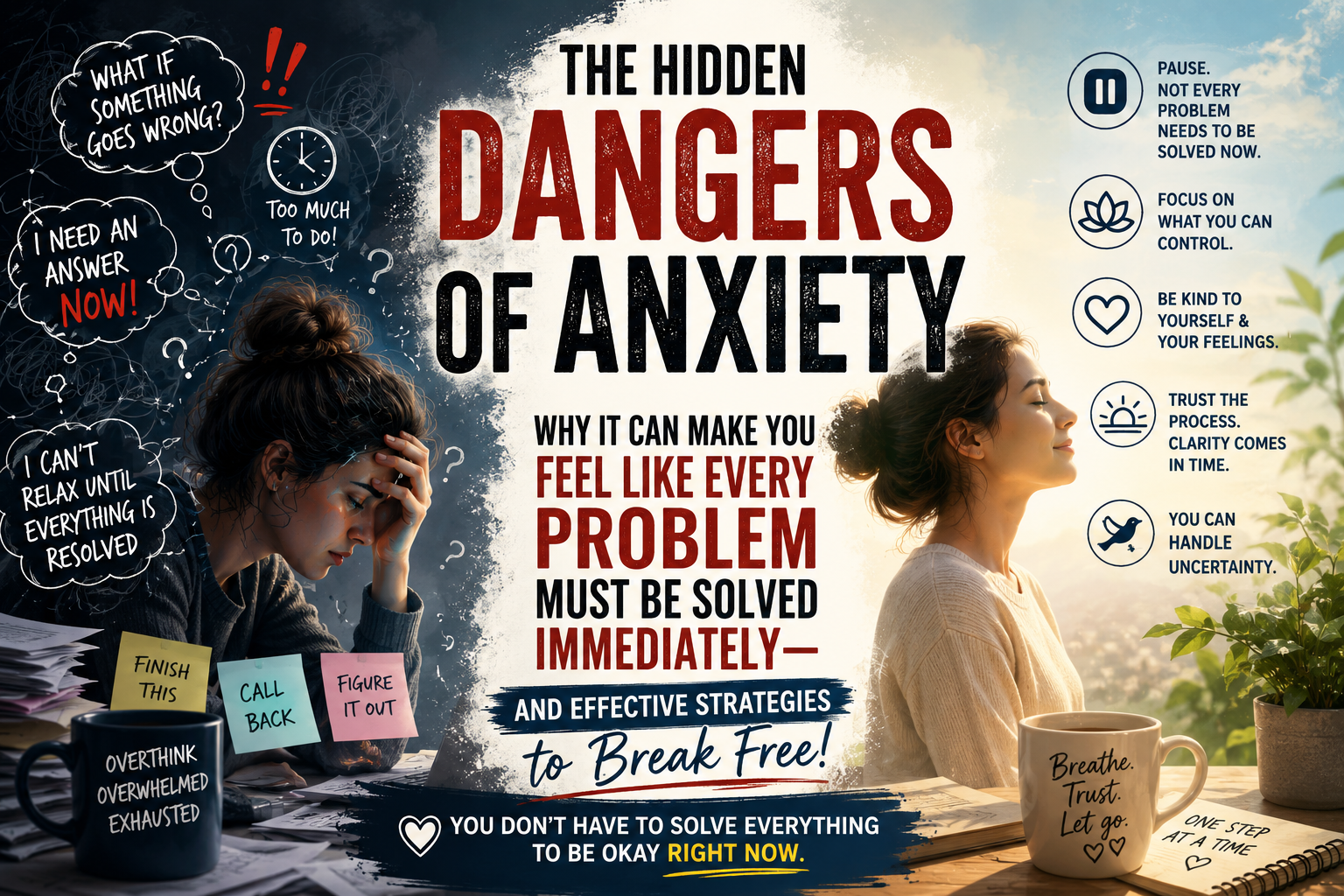
The Hidden Dangers of Anxiety: Why It Can Make You Feel Like Every Problem Must Be Solved Immediately—And Effective Strategies to Break Free From the Cycle
Anxiety is often described as worry, fear, nervousness, or a feeling that something bad might happen. But anxiety can be much more complicated than simply feeling worried. One of its less obvious effects is the intense pressure it can create to fix, resolve, analyze, or control every problem immediately. When anxiety takes over, an unresolved issue can feel almost unbearable. Your mind may tell you that you cannot relax until you have found an answer, made a decision, clarified a misunderstanding, completed a task, or eliminated whatever is causing discomfort. The problem is that life rarely provides immediate solutions. Many situations require time, patience, uncertainty, or simply the willingness to let things unfold. When anxiety convinces you that every uncomfortable feeling must disappear right now, you can become trapped in a cycle that actually makes anxiety stronger.
At the heart of this experience is an understandable desire: you want relief. When something feels uncertain or threatening, the brain naturally looks for ways to restore a sense of safety. Anxiety can intensify this process until the mind begins treating uncertainty itself as a problem that must be eliminated. You might repeatedly replay a conversation, search for reassurance, check your phone, research an issue, plan every possible outcome, send another message to make sure someone is okay, or mentally rehearse what you will do if something goes wrong. These behaviors can provide a temporary sense of control. For a few moments, you may feel calmer because you have done something. Yet the relief often does not last. Soon another question appears, another possibility comes to mind, or another uncertainty demands your attention.
This is one of anxiety’s most deceptive characteristics. The anxious mind can make excessive problem-solving feel productive even when it is actually keeping you stuck. You may believe that thinking about something more will eventually make you feel better, but sometimes additional thinking simply creates additional questions. You solve one hypothetical problem and discover three more. You look for certainty and find more reasons to doubt. You try to eliminate every negative possibility and end up becoming increasingly aware of everything that could potentially go wrong.
The cycle often begins with a trigger. It could be an uncomfortable conversation, an unanswered text message, a mistake at work, a financial concern, a relationship issue, an upcoming event, a health concern, or even a vague feeling that something is not right. The trigger itself may be relatively small, but anxiety can quickly assign enormous importance to it. The mind starts asking, “What if something is wrong?” Then comes the urge to figure it out. “What should I do?” “What does this mean?” “What if I made things worse?” “What if I wait and something happens?” The questions can continue until the person feels compelled to take action. This urgency is important because anxiety often does not merely say, “There is a problem.” It says, “There is a problem, and you must solve it immediately.” That second message is what can turn ordinary uncertainty into emotional exhaustion. You may notice that you have difficulty concentrating on anything else while an unresolved issue is hanging over you. Even when you are watching television, spending time with family, working, or trying to sleep, part of your attention remains locked onto the problem. Your mind keeps returning to it because it believes that continuing to think is necessary. You may even feel guilty when you attempt to relax because a part of you says, “How can you relax when this still hasn’t been figured out?”
This is where anxiety can begin taking away something extremely valuable: your ability to experience the present moment without constantly trying to protect yourself from the future. The human brain is designed to notice potential threats. That ability is incredibly useful. If there is an immediate danger, recognizing it and responding quickly can be lifesaving. But anxiety can activate this threat-detection system in situations where immediate action is unnecessary or impossible. The brain can respond to uncertainty as though uncertainty itself were a threat. Instead of distinguishing between “This is uncomfortable” and “This is dangerous,” anxiety can blur the two.
As a result, an uncomfortable emotion may begin to feel like an emergency.
You might think, “I can’t stand feeling this way,” or “I need to get rid of this feeling.” The natural response is then to do something that promises relief. You seek reassurance. You distract yourself. You analyze. You check. You avoid. You try to control another person’s reaction. You make a decision simply to end the uncertainty, even if you are not ready to make it. The specific behavior can vary, but the underlying goal is often the same: make the uncomfortable feeling stop. There is nothing wrong with wanting to feel better. The difficulty begins when your brain learns that negative emotions are intolerable and must always be removed as quickly as possible. When that happens, ordinary emotional experiences can become frightening in their own right. Ironically, constantly trying to eliminate anxiety can teach the brain to become more afraid of anxiety. Imagine that every time you feel uncertain, you immediately begin researching. Every time you worry that someone is upset with you, you ask for reassurance. Every time you make a mistake, you repeatedly review what happened. Every time you experience an uncomfortable thought, you try to prove that it is not true. Your brain may gradually learn a pattern: “Whenever this feeling appears, we need to do something immediately.” The behavior provides short-term relief, which reinforces the habit. The next time anxiety appears, the urge to act can become even stronger. This is why learning to tolerate uncertainty and uncomfortable emotions can be so powerful. The goal is not to become careless, indifferent, or passive. The goal is to develop the ability to recognize when action is genuinely necessary and when anxiety is simply demanding action because it wants immediate relief. There is an important difference between solving a problem and trying to eliminate uncertainty. If your car has a flat tire, there is a practical problem that requires action. If you have an important deadline tomorrow, creating a plan can be helpful. If you hurt someone’s feelings, having an honest conversation may be appropriate. But many of life’s most distressing questions cannot be solved through immediate mental effort. You cannot always know exactly what another person is thinking. You cannot guarantee that every decision will produce the desired outcome. You cannot control how everyone will respond to you. You cannot predict every future event. You cannot completely eliminate the possibility of disappointment.
Trying to achieve that level of certainty can become an exhausting full-time job.
One of the most helpful strategies is learning to pause before responding to the anxious urge. When you feel the pressure to immediately solve something, give yourself a moment and ask, “Is there actually something I need to do right now, or am I trying to make this uncomfortable feeling disappear?” That question can create valuable space between the emotion and the reaction. Sometimes there is a genuine action you can take. If so, take it calmly and intentionally. But if there is nothing productive to do at that moment, practice allowing the uncertainty to exist without immediately responding to it. This can feel uncomfortable at first. In fact, it may feel extremely uncomfortable. But discomfort is not failure. It is part of learning. You are teaching your mind that uncertainty can be experienced without automatically turning into an emergency.
Another powerful shift is changing the question from “How can I make this feeling go away?” to “How can I take care of myself while this feeling is here?” Those questions may sound similar, but psychologically they are very different. The first treats the emotion as something that must be defeated. The second acknowledges that emotions can be present without controlling your behavior. You might say to yourself, “I am anxious right now, and I don’t have to solve everything this minute.” You might remind yourself, “I can handle not knowing.” You might recognize, “My mind is looking for certainty because it feels threatened, but that doesn’t mean I need to give it certainty.” These statements are not about pretending that everything is fine. They are about creating a healthier relationship with your thoughts and emotions. It can also help to distinguish between thinking and worrying. Thinking generally moves toward something useful: a decision, a plan, an understanding, or an action. Worry often circles around the same questions without producing meaningful resolution. You may repeatedly ask yourself the same thing in slightly different ways, hoping that one more round of thinking will finally create certainty. When you notice yourself going in circles, try asking, “Has this thinking produced anything new?” If the answer is no, continuing to think may not be problem-solving anymore. It may simply be anxiety seeking reassurance. Another important strategy is setting boundaries around problem-solving. Anxiety often tells you that you must think about an issue whenever it appears. Instead, you can consciously decide when you are going to address it. If something does not require immediate attention, you might tell yourself, “I will give this my attention later, but I don’t need to solve it right now.” This can be especially useful when anxious thoughts appear at night. Rather than allowing your mind to turn bedtime into a strategy session, remind yourself that tomorrow is a more appropriate time to address what can actually be addressed.
Learning to tolerate uncertainty does not happen overnight. It is a skill, and like any skill, it develops through practice. The first time you resist an anxious urge, you may feel more anxious rather than less. That does not mean the strategy is not working. Your brain has become accustomed to receiving immediate reassurance or taking immediate action. When you change the pattern, your anxiety may temporarily protest. With repeated practice, however, you can begin discovering something important: you can feel anxious without obeying anxiety. That realization can be transformative.
You may still experience worry. You may still have moments when uncertainty feels uncomfortable. You may still want to know exactly how something will turn out. The goal is not to become a person who never worries. The goal is to become someone who does not allow every anxious thought to dictate what happens next. It is also important to remember that not every thought deserves an answer. Anxiety can produce thoughts that feel urgent, convincing, and important simply because they are emotionally intense. But intensity is not the same thing as truth. A thought such as “Something must be wrong” is a mental event, not automatically a fact. A thought such as “I have to figure this out right now” is an instruction from your anxious mind, not a command you are required to follow. Developing this perspective can create psychological freedom. Instead of arguing with every anxious thought, you can notice it and choose how much attention to give it.
There is also tremendous value in returning your attention to what is happening in front of you. Anxiety frequently pulls attention into imagined futures or endless reviews of the past. Grounding yourself in the present can interrupt that cycle. Notice your surroundings. Pay attention to your breathing. Feel your feet against the floor. Listen to the sounds around you. Focus on the task you are actually doing. These simple acts can remind your nervous system that, in this particular moment, you are here rather than inside every possible future scenario your mind has created. Healthy problem-solving also requires accepting that some answers take time. Sometimes the best decision is not to decide immediately. Sometimes clarity arrives after you sleep, gather more information, speak with someone you trust, or simply allow emotions to settle. Immediate action is not always wise action. There is a difference between urgency and importance. Anxiety can make something feel urgent simply because it feels uncomfortable. But an emotionally urgent feeling does not necessarily mean that immediate action is required.
This distinction can change the way you approach difficult situations. Instead of asking, “How do I make this go away?” you can ask, “What is actually within my control?” You can then direct your energy toward that small area of control and release what is outside it. Perhaps you can communicate clearly, but you cannot control another person’s response. Perhaps you can prepare for an event, but you cannot guarantee the outcome. Perhaps you can make a thoughtful decision, but you cannot guarantee that every consequence will be perfect. Perhaps you can apologize sincerely, but you cannot force someone else to forgive you immediately. Life becomes considerably less exhausting when you stop demanding certainty from situations that cannot provide it.
For some people, anxiety can become severe enough to significantly interfere with daily life, relationships, work, sleep, or the ability to function. When persistent anxiety feels overwhelming or difficult to manage independently, reaching out to a qualified mental-health professional can be an important and courageous step. Approaches such as cognitive behavioral therapy and other evidence-based treatments can help people understand anxiety patterns, change unhelpful responses, and develop greater tolerance for uncertainty. Seeking support is not a sign that you are weak or incapable. Sometimes the strongest decision is recognizing that you do not have to figure everything out alone.
Ultimately, one of the most important lessons about anxiety is that you do not have to solve every problem in order to be okay in this moment. Some problems can wait. Some questions will remain unanswered for a while. Some feelings will come and go without requiring immediate action. Some situations will resolve themselves in ways you could not have predicted. And some challenges will require you to accept uncertainty rather than defeat it. The goal is not to eliminate every negative emotion from your life. That would be impossible, and attempting to do so can create even more suffering. The goal is to develop the confidence to experience difficult emotions without immediately becoming their servant. You can feel worried and still breathe. You can feel uncertain and still continue your day. You can have unanswered questions and still rest. You can experience fear without allowing fear to make every decision.
And you can remind yourself that a problem does not become more solvable simply because you worry about it more intensely. Sometimes the most powerful response to anxiety is not another hour of analysis, another search for reassurance, or another attempt to control the uncontrollable. Sometimes it is a pause. A breath. A decision to wait. A willingness to say, “I don’t know yet, and I can handle not knowing.”
That is not giving up. That is learning to trust yourself.
And with practice, you may discover that the peace you were desperately trying to create by solving everything immediately was never dependent on having every answer. It was built, instead, on developing the courage to face uncertainty and realizing that you are capable of moving forward even when you don’t know exactly what happens next.
Learn More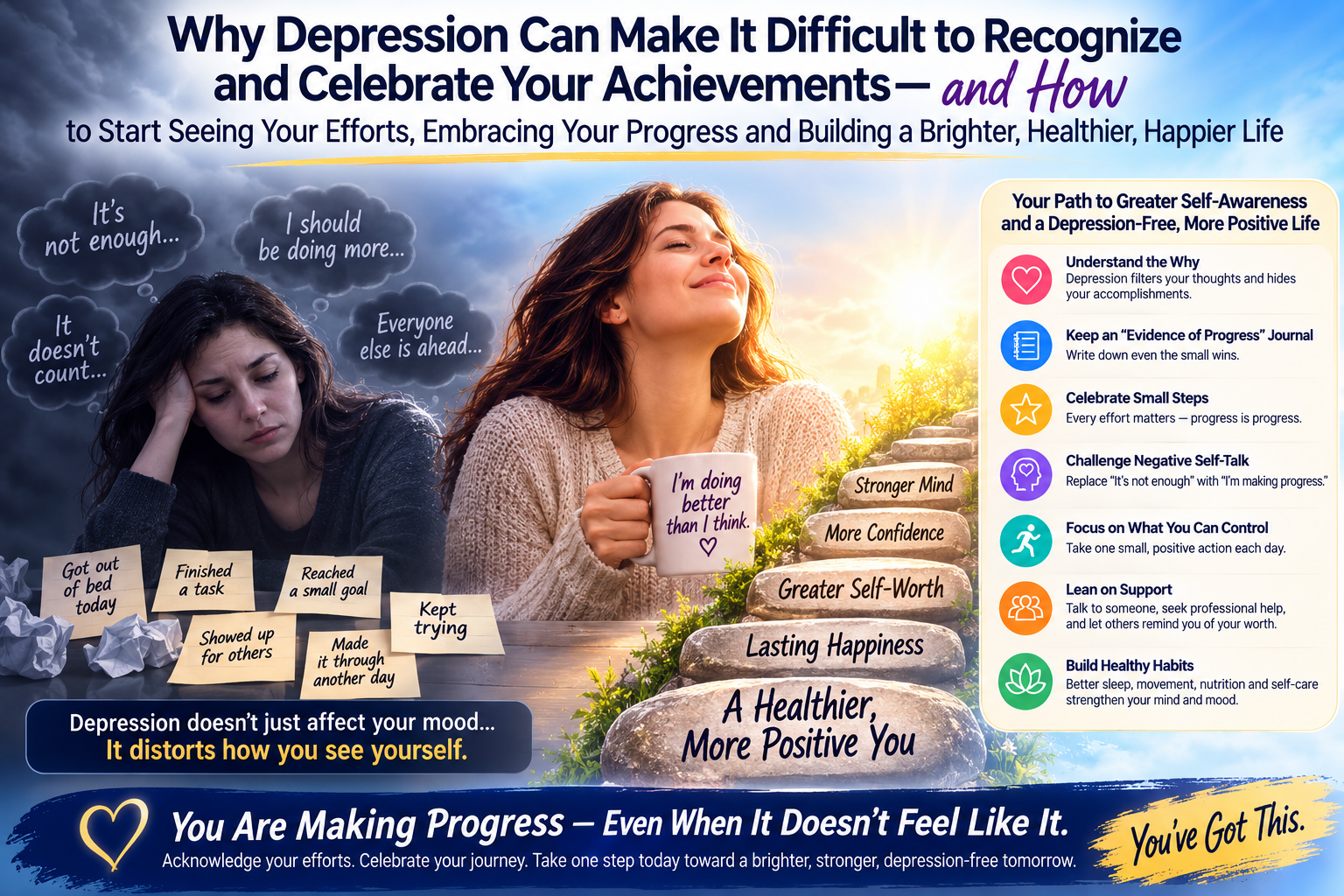
Why depression can make it difficult to recognize and celebrate your achievements—and how to begin acknowledging your efforts, embracing your progress, and taking empowering steps toward a healthier, more positive, and depression-free life.
Depression has a way of changing the way we see ourselves, our accomplishments, and even the meaning of success. You can accomplish something you once worked incredibly hard to achieve, receive recognition from others, reach an important milestone, or overcome an obstacle that once seemed impossible—and still feel little or nothing inside. Instead of excitement, you may feel emptiness. Instead of pride, you may hear an inner voice telling you that what you accomplished was not important, not good enough, or simply what you were “supposed” to do. This can be one of the most frustrating and misunderstood experiences of depression.
One of the most important things to understand is that difficulty celebrating an achievement does not necessarily mean that you are ungrateful, lazy, negative, or incapable of appreciating the good things in your life. Depression can affect motivation, emotional responsiveness, self-esteem, concentration, and the ability to experience pleasure. As a result, something that objectively deserves celebration may not emotionally register as something worth celebrating. Your circumstances may have changed, but your internal experience may still be telling you that nothing has really changed.
Depression can also create a powerful tendency to minimize accomplishments. You might complete a difficult project and immediately think, “Anyone could have done that.” You might reach a personal goal and respond with, “It wasn’t that difficult.” You might receive a compliment and immediately dismiss it. You may compare yourself to someone who appears to be further ahead and conclude that your achievement is insignificant. Over time, this pattern can make you feel as though you are constantly moving forward without ever allowing yourself to recognize how far you have traveled.
Another challenge is that many people unintentionally make achievement the condition for self-worth. They tell themselves, “I’ll be proud of myself when I succeed,” or “I’ll finally feel good about myself when I accomplish this.” The problem is that when success becomes the requirement for feeling worthy, there is always another mountain to climb. Even after reaching the goal, the mind may quickly create a new standard. What was once a dream becomes an expectation, and what should have been a moment of satisfaction becomes another reason to feel inadequate.
Depression can intensify this cycle because the mind often becomes more focused on perceived failures than genuine progress. You may remember the one thing that went wrong while forgetting the ten things that went right. You may focus on what you still need to accomplish instead of acknowledging what you have already overcome. This does not mean that you are choosing to think negatively. Depression can influence attention and interpretation, making negative information feel more convincing and positive information easier to dismiss.
This is why learning to acknowledge your effort is so important. Your achievement is not only the final outcome. It is also the courage, persistence, sacrifices, lessons, disappointments, and small decisions that allowed you to get there. Sometimes the greatest accomplishment is not reaching the destination but continuing to move forward when you were emotionally exhausted and uncertain about whether you could continue.
You deserve to recognize the effort behind your progress.
Perhaps you got out of bed on a difficult morning. Perhaps you made an important phone call that you had been avoiding. Perhaps you went to work despite feeling emotionally drained. Perhaps you asked for help instead of pretending everything was fine. Perhaps you established a healthier boundary, returned to therapy, reconnected with someone you trust, or simply decided that you would give yourself another day to try. These moments may not look impressive from the outside, but they can represent enormous victories for someone struggling with depression.
One powerful shift is learning to replace “Is this accomplishment big enough to celebrate?” with “What did this accomplishment require from me?” This question moves your attention away from comparing your achievement to someone else’s and toward understanding your own journey. Maybe what you accomplished required courage. Maybe it required patience. Maybe it required you to overcome fear. Maybe it required you to keep going when giving up felt easier. Your progress becomes meaningful when you understand what it took to create it.
You also do not have to wait until you feel proud before acknowledging yourself. Sometimes the action comes before the emotion. You can say, “I am proud of myself for making this effort,” even if you do not emotionally feel proud yet. You can recognize your progress even when your mind tells you that it does not matter. Over time, repeatedly practicing this form of self-recognition can help create a different relationship with your accomplishments.
Start with small victories rather than waiting for major milestones. Depression often encourages an all-or-nothing mentality: either you completely succeed or you have failed. A healthier perspective recognizes progress in degrees. Getting through a difficult day can be progress. Completing one task can be progress. Taking care of yourself can be progress. Having an honest conversation can be progress. Trying again after disappointment can be progress. Small steps become significant when they are repeated consistently.
It is also important to separate your identity from your productivity. You are not valuable because of how much you accomplish. You are not more deserving of love because you earn more money, achieve more professionally, maintain a perfect relationship, or constantly perform at your highest level. Achievement can be meaningful, but it should not be the foundation of your worth.
You are a human being before you are a performer, employee, parent, partner, entrepreneur, student, caregiver, or professional.
This distinction can be particularly important for people who have spent years being “the strong one.” When everyone expects you to be capable, independent, successful, and resilient, you may begin believing that you are only worthy when you are functioning at full capacity. Depression can then feel like a personal failure because it challenges the identity you have built around being strong.
But strength is not the absence of struggle.
Strength can also mean admitting that you are struggling. Strength can mean asking for support. Strength can mean slowing down. Strength can mean recognizing that you cannot solve everything by yourself. And sometimes strength means allowing yourself to be human without turning every difficult moment into evidence that something is wrong with you.
Another important step is becoming aware of your internal dialogue. Listen to how you speak to yourself after an accomplishment. Would you speak to a close friend the same way? If your friend completed something difficult and told you, “It wasn’t a big deal,” would you agree with them? Or would you remind them of everything they had overcome to get there?
Try offering yourself the same compassion.
Instead of saying, “I should have done more,” try saying, “I did what I could with what I had at that time.” Instead of “Anyone could have done this,” try “This mattered to me, and I worked for it.” Instead of “I’m still not where I want to be,” try “I may not be where I want to be yet, but I am not where I started.” This does not mean pretending everything is wonderful. It means developing a more balanced and compassionate perspective.
There is also tremendous value in allowing other people to celebrate you. Depression can make compliments uncomfortable. You may instinctively reject praise or explain away your accomplishments. Someone tells you, “You did an amazing job,” and you respond, “It wasn’t anything.” The next time someone genuinely acknowledges something you have accomplished, try simply saying, “Thank you.” You do not have to convince yourself that their praise is completely true. Just allow yourself to receive it.
Celebration does not have to mean throwing a party or feeling overwhelming happiness. Celebration can be quiet. It can be taking a moment to breathe and recognize what you accomplished. It can be treating yourself with kindness. It can be sharing your success with someone who genuinely cares about you. It can be writing down what you accomplished and allowing yourself to acknowledge it without immediately moving on to the next goal.Creating a daily practice of recognizing effort can also be helpful. At the end of the day, ask yourself: “What did I do today that required effort?” The answer does not need to be extraordinary. You are training your mind to notice progress rather than automatically searching for shortcomings.
Another powerful question is, “What would the version of me from five years ago think about where I am today?” We often become so focused on our current destination that we forget to look backward. The person you are today may possess skills, wisdom, resilience, relationships, experiences, and knowledge that your younger self desperately wanted. Your progress may be invisible to you simply because you have become accustomed to it.
Healing also requires patience. There is no single decision that makes depression disappear forever. For many people, recovery involves a combination of professional support, healthy routines, meaningful relationships, self-awareness, and sometimes medication as recommended by a qualified healthcare professional. Seeking professional help is not a sign that you have failed. It is a sign that you are willing to invest in your well-being.
If depression has made it difficult to experience pleasure, motivation, hope, or satisfaction for an extended period, consider speaking with a mental health professional. Depression is treatable, and you do not have to navigate it alone. If you ever experience thoughts of harming yourself or believe you may not be safe, seek immediate professional or emergency support in your area.
Most importantly, remember that the absence of celebration does not erase the achievement. You can accomplish something meaningful and still feel emotionally numb. You can make progress and still feel exhausted. You can be proud of yourself and still have difficult days. Healing is not about forcing yourself to be positive every moment. It is about learning to make room for hope while honestly acknowledging what you are experiencing. Your life does not have to become perfect before you are allowed to appreciate it. Your journey does not have to be finished before you are allowed to acknowledge how far you have come. And you do not have to become someone else before you are worthy of compassion, respect, and love.
Perhaps the first step toward a healthier relationship with yourself is simply recognizing this: you are trying. You are learning. You are growing. You are still here. And even if you cannot celebrate your achievements today, you can begin by acknowledging the effort it took to get this far. Greatness is not always found in extraordinary accomplishments. Sometimes greatness is found in the quiet decision to keep moving forward when life feels extraordinarily difficult. Give yourself permission to notice that.
Give yourself permission to appreciate that. And give yourself permission to believe that your next chapter can be different from your last.
Learn More
The Impact of Parenting Disagreements on Marital Satisfaction: Navigating Differences in Parenting Styles and Developing Healthy Strategies for Compromise
Parenting is one of the most rewarding experiences a couple can share, but it can also become one of the greatest sources of conflict in a marriage. Two people may deeply love one another and share the same hopes and dreams for their children while having very different ideas about how those goals should be achieved. One parent may believe in structure, rules, and consistent consequences, while the other may prioritize flexibility, emotional expression, and independence. One may be more protective, while the other encourages exploration and risk-taking. These differences do not necessarily mean that one parent is right and the other is wrong. However, when couples cannot communicate effectively or find common ground, disagreements about parenting can create tension that extends far beyond the immediate issue and can gradually affect marital satisfaction, emotional intimacy, and family harmony.
Why Parenting Disagreements Become So Emotional
Parenting disagreements are rarely just about the specific issue being discussed. A disagreement about bedtime, discipline, screen time, homework, or a child’s behavior may actually represent deeper beliefs about what makes a good parent. One parent may believe, “If I don’t establish strict rules, my child will become disrespectful,” while the other may think, “If we are too strict, our child will stop trusting us.” Both parents may be trying to protect their child, but they may be approaching parenting from completely different perspectives. These differences are often influenced by childhood experiences, cultural backgrounds, personality, personal values, previous relationships, education, and the way each individual was raised. Someone who grew up in a highly structured household may naturally believe that discipline and obedience create responsible adults, while someone who experienced overly strict or controlling parenting may intentionally choose a gentler and more emotionally supportive approach with their own children. Understanding these underlying influences is essential because couples often argue about what to do without taking time to understand why their partner believes a particular approach is important.
Common Sources of Parenting Conflict
Discipline is one of the most common areas of disagreement between parents. One partner may believe in immediate consequences, while the other prefers discussion, emotional coaching, or natural consequences. Problems become particularly damaging when parents undermine one another in front of the child. For example, if one parent says, “You’re grounded for the weekend,” and the other responds, “That’s ridiculous; you don’t need to be grounded,” the child may quickly learn that the parents can be played against one another. A healthier approach is for parents to discuss major disagreements privately and, whenever possible, present a reasonably consistent message to their children.
Technology and screen time have also become major sources of conflict for modern families. Parents may disagree about how much screen time children should have, what applications they should be allowed to use, whether they should have smartphones, and how closely their online activities should be monitored. One parent may see technology as an important educational and social tool, while the other may be concerned about excessive use, inappropriate content, social media, gaming, sleep disruption, or reduced family interaction. Instead of arguing about whether technology is simply “good” or “bad,” couples can establish clear family guidelines that address appropriate use, time limits, online safety, responsibilities, and privacy.
Education and academic expectations can create another source of tension. One parent may emphasize high grades, academic achievement, extracurricular activities, and preparation for the future, while the other may prioritize emotional well-being, creativity, social development, or allowing the child to explore interests without excessive pressure. Household responsibilities can also create conflict when parents have different expectations about chores, independence, allowances, and responsibilities. Extended family can add another layer of complexity when couples disagree about the influence of grandparents, family traditions, visitation, or how relatives should interact with their children. In all of these situations, the objective should not be determining which parent is right but identifying what approach best supports the child’s development while protecting the relationship between the parents.
How Parenting Conflict Can Affect Marital Satisfaction
Occasional disagreement is normal in a healthy marriage. The concern arises when parenting conflict becomes chronic, hostile, dismissive, or unresolved. Repeated disagreements can gradually create emotional distance between partners. Instead of experiencing one another as romantic partners, couples may begin functioning primarily as co-managers of the household. Their conversations become focused on schedules, homework, discipline, appointments, chores, finances, and responsibilities, while affection, emotional connection, and meaningful conversations receive less attention.
Unresolved parenting disagreements can also create resentment. One partner may begin thinking, “I’m always the one enforcing the rules,” while the other may feel, “My partner never supports me.” Over time, these perceptions can create a sense of loneliness within the marriage. Parents may also begin undermining one another, intentionally or unintentionally, which can place children in the middle of marital conflict. A child may learn to approach whichever parent is more likely to say yes, avoid consequences, or reverse the other parent’s decision. This dynamic can weaken parental authority while increasing tension between the adults. Persistent parenting conflict can also reduce intimacy because it becomes difficult to feel emotionally or physically connected when most interactions are characterized by criticism, frustration, defensiveness, or disagreement.
Healthy Disagreement Versus Destructive Conflict
Couples do not need to agree on everything to have a healthy marriage. In fact, differences can be beneficial when handled with respect because they allow partners to consider perspectives they may not have considered themselves. Healthy disagreement sounds like, “I understand why you think that approach would work. My concern is…” or “I don’t completely agree, but I’m willing to find a solution that works for both of us.” Destructive conflict sounds more like, “You’re a terrible parent,” “You never know what you’re doing,” or “I can’t trust you with the children.” The critical difference is not whether couples disagree but how they communicate during the disagreement. Respectful communication keeps the focus on the issue, while destructive communication attacks the person’s character and creates defensiveness.
Healthy Strategies for Reaching Parenting Compromises
One of the most important shifts couples can make is moving away from the question, “How can I prove that I’m right?” and toward, “What approach is most likely to help our child?” Parenting should not become a competition between two adults. The objective is to create an environment where children feel safe, loved, supported, accountable, and appropriately challenged. Couples should identify their shared parenting values before debating specific strategies. Even parents with very different styles often agree that they want their children to become responsible, respectful, independent, compassionate, emotionally healthy, confident, and resilient. Once these shared goals are identified, couples can discuss different methods for reaching them.
It is also helpful to distinguish between non-negotiable issues and areas where flexibility is appropriate. Safety concerns, serious behavioral issues, major medical decisions, and certain educational matters may require both parents to reach a clear agreement. Other issues, such as clothing preferences, recreational activities, minor household choices, or different ways of connecting emotionally with a child, may allow each parent to have some individual flexibility. Not every parenting difference needs to become a major marital discussion. Learning to determine which issues truly require agreement can significantly reduce unnecessary conflict.
Couples should also avoid fighting about parenting in front of their children whenever possible. Parents will inevitably disagree, but publicly criticizing or undermining one another can create confusion and insecurity. If a disagreement occurs, a parent can say, “Your mother and I have different perspectives about this. We’re going to discuss it privately and get back to you.” This teaches children that disagreement does not have to become disrespect and demonstrates healthy conflict resolution.
Another effective strategy is creating a simple family parenting agreement. This does not need to be a rigid rulebook. Couples can establish general expectations regarding discipline, bedtime, screen time, homework, chores, curfews, rewards, consequences, social activities, and family routines. Having these expectations established in advance reduces the likelihood that parents will debate their decisions in the middle of an emotionally charged situation. It also provides children with greater consistency.
Pause Before Reacting
When a parenting disagreement becomes emotionally charged, taking a pause can prevent a minor disagreement from escalating into a major marital conflict. Before responding, each partner can ask themselves: What am I feeling? What am I afraid might happen? What does my partner believe? What does our child need right now? Am I responding to this situation, or am I reacting to something from my own childhood? These questions can help parents recognize when their emotional response is connected to personal history rather than the current situation. Sometimes what appears to be an argument about a child’s behavior is actually a disagreement about fear, control, protection, independence, or unresolved experiences from the past.
Replace Criticism With Curiosity
One of the most effective communication strategies for couples is replacing criticism with curiosity. Instead of saying, “Why are you so strict?” a partner might ask, “Can you help me understand why this consequence feels important to you?” Instead of saying, “You let our child get away with everything,” a parent could ask, “What are you hoping our child learns by giving them more flexibility?” Curiosity creates an opportunity for understanding, while criticism tends to create defensiveness. The goal is to understand the belief behind the behavior rather than immediately judging the behavior itself.
Couples should also remind themselves that they are partners, not opponents. The problem is the problem—not each other. Instead of saying, “You and I disagree,” they can say, “We have two different perspectives. How can we combine them?” This simple shift in language reinforces collaboration. In many cases, parents discover that their differences can actually complement one another. One parent’s structure can work well alongside another parent’s emotional flexibility. For example, parents might agree that a child must complete homework before using electronics while allowing the child to choose when to complete the assignment within an agreed-upon timeframe. This approach provides both structure and autonomy.
Compromise Does Not Always Mean Meeting in the Middle
Healthy compromise does not necessarily mean that each parent gets exactly half of what they want. Sometimes one approach may be more appropriate based on the child’s age, developmental needs, safety, personality, or circumstances. The better question is, “What is the healthiest solution for our child in this particular situation?” When both approaches are reasonable, couples can also experiment. They might agree to try one strategy for two weeks and then evaluate whether it is working. This transforms a disagreement into a collaborative experiment rather than a battle over who is right.
Creating a Weekly Parenting Check-In
A simple weekly parenting meeting can also prevent small disagreements from becoming major sources of resentment. Couples can dedicate 15 to 20 minutes to discussing what went well during the week, what challenges they encountered, where they disagreed, what their child may need from them, and whether anything should change during the following week. They can also ask one another, “How can I better support you as a parent?” This question is particularly valuable because parenting can sometimes feel isolating. Feeling supported by one’s partner can strengthen both marital satisfaction and confidence as a parent.
When Professional Support May Help
Sometimes parenting disagreements become so persistent that couples struggle to resolve them independently. Professional counseling can provide a neutral and supportive environment where both partners can express concerns, understand the underlying causes of their disagreements, and develop healthier communication strategies. Couples may benefit from professional support when arguments about parenting occur frequently, communication has become hostile or disrespectful, one parent consistently undermines the other, parenting disagreements are affecting intimacy, one partner feels unsupported, children are repeatedly placed in the middle of marital conflict, or couples cannot reach agreements about significant parenting decisions. Seeking counseling is not a sign that a marriage has failed. In many cases, it is a proactive investment in the relationship and the overall well-being of the family.
The Goal Is Not Perfect Parenting
There is no perfect parenting style and no perfect parent. Children do not need parents who agree on every detail. They need parents who are willing to communicate, learn, apologize, adapt, and work together. Healthy parenting is not about eliminating every disagreement; it is about developing the ability to navigate disagreements without damaging the relationship or placing children in the middle. A strong marriage does not require two people to think exactly alike. It requires two people who respect one another enough to listen, understand, compromise, and continue working toward shared goals.
Parenting disagreements are inevitable, but marital disconnection does not have to be. When couples recognize that their different parenting styles often come from different experiences, values, personalities, and concerns, they can begin replacing criticism with understanding and competition with cooperation. The strongest families are not necessarily those where parents agree on everything; they are often the families where parents have learned how to disagree respectfully while remaining united in their love and commitment to their children.
Ultimately, the goal is not to determine which parent is right. The goal is to create a parenting partnership where both adults feel heard, respected, and supported, while children experience the consistency, emotional safety, boundaries, encouragement, and unconditional love they need to thrive. When couples learn to parent as a team rather than compete as individuals, they strengthen not only their children’s development but also the emotional foundation of their marriage. Different parenting styles do not have to divide a couple; with communication, empathy, flexibility, and a shared commitment to the well-being of the family, those differences can become strengths that make the family more balanced and resilient.
Learn More
Feeling underappreciated in a relationship: The silent threat affecting couples worldwide. Discover effective strategies to strengthen appreciation, deepen connection, and avoid becoming part of this growing statistic.
When people think about the reasons relationships fail, they often imagine dramatic events such as infidelity, financial hardship, constant conflict, or irreconcilable differences. While these issues certainly play a role in many breakups, one of the most damaging relationship threats is often far less visible. It develops quietly over time, frequently unnoticed until emotional distance has already taken hold. That threat is the feeling of being underappreciated.
At the beginning of a relationship, appreciation tends to come naturally. Partners notice and acknowledge even the smallest gestures. A thoughtful text message, a compliment, a surprise gift, or a simple act of kindness can create feelings of gratitude and connection. During this stage, both individuals often feel seen, valued, and important. However, as relationships mature and life becomes increasingly demanding, many couples unintentionally shift their focus away from appreciation and toward responsibility, routine, and obligation.
What was once viewed as a loving gesture gradually becomes expected. The partner who consistently prepares meals, manages household responsibilities, works long hours, provides emotional support, or makes sacrifices for the family may stop receiving acknowledgment for these contributions. Instead of being appreciated, their efforts become part of the background noise of daily life. Over time, this lack of recognition can create feelings of frustration, disappointment, and emotional exhaustion.
The painful reality is that many people do not leave relationships because they have stopped loving their partner. They leave because they no longer feel valued by the person they love. Feeling invisible within a relationship can be one of the loneliest experiences a person can endure. It creates a sense of emotional isolation that often leads individuals to question their worth, their efforts, and sometimes even the future of the relationship itself.
Underappreciation rarely appears overnight. It develops gradually through countless small moments. A thank you that goes unspoken. An effort that goes unnoticed. A sacrifice that is taken for granted. Although each individual incident may seem insignificant, their cumulative effect can be profound. Emotional wounds often result not from a single major event but from a series of small disappointments that accumulate over months or years.
One of the most effective ways to prevent this pattern is through the intentional practice of gratitude. Appreciation is not something that should be assumed; it must be expressed. Many people mistakenly believe that their partner already knows how much they are valued. While this may be partially true, hearing words of appreciation has a powerful psychological impact. A sincere acknowledgment of effort, support, or commitment can strengthen emotional bonds and reinforce feelings of connection. Simple statements such as “I appreciate everything you do” or “Thank you for always being there for me” can have a greater impact than many realize.
Another important strategy involves shifting attention from shortcomings to strengths. Human beings possess a natural tendency to notice problems more readily than positive experiences. In relationships, this often means that mistakes receive more attention than successes. Over time, couples may become experts at identifying what is wrong while overlooking what is right. Healthy relationships thrive when partners actively seek opportunities to recognize each other’s positive qualities, efforts, and contributions.
Communication also plays a critical role in fostering appreciation. Many couples engage in conversations focused primarily on logistics, responsibilities, finances, schedules, and problem-solving. While these discussions are necessary, they should not replace meaningful emotional communication. Taking time to listen attentively, express genuine curiosity, and validate each other’s experiences helps create an environment where both partners feel respected and understood. Feeling heard is one of the most powerful forms of appreciation a person can receive.
Equally important is understanding that people experience appreciation in different ways. Some individuals feel most valued through verbal affirmation, while others experience appreciation through quality time, physical affection, thoughtful gestures, or acts of service. Relationship difficulties often arise when one partner expresses appreciation in a way that feels meaningful to them but not necessarily to the other person. Learning how a partner receives and interprets appreciation can dramatically strengthen emotional intimacy and reduce misunderstandings.
Another common challenge occurs when couples begin keeping score. Relationships can become strained when individuals constantly compare who is giving more, sacrificing more, or contributing more. This transactional mindset often fuels resentment and competition rather than cooperation and connection. Healthy relationships flourish when both partners focus less on measuring contributions and more on supporting one another as members of the same team. Mutual generosity creates a stronger foundation than constant accounting.
Regular relationship check-ins can also help prevent feelings of underappreciation from escalating. Life moves quickly, and many couples become so busy managing responsibilities that they neglect the health of the relationship itself. Setting aside dedicated time to discuss emotional needs, concerns, and positive experiences creates opportunities to address issues before they become deeply rooted. These conversations allow partners to express what makes them feel loved, valued, and appreciated while strengthening trust and understanding.
It is equally important to celebrate progress rather than waiting for major milestones. Many people reserve recognition for significant achievements while overlooking the small victories that occur every day. Acknowledging effort, resilience, growth, and persistence can create a culture of appreciation within the relationship. Whether it is overcoming a challenge, reaching a personal goal, or simply navigating a difficult week together, celebrating these moments reinforces partnership and emotional connection.
The most successful relationships are not those that avoid problems altogether. Rather, they are relationships in which both individuals consistently feel seen, valued, respected, and appreciated. Appreciation acts as an emotional buffer during difficult times, helping couples navigate stress, disagreements, and life’s inevitable challenges. When people feel valued, they become more patient, more forgiving, and more willing to invest in the relationship.
Ultimately, appreciation is one of the simplest yet most powerful tools available to couples. It costs nothing, requires little time, and has the potential to transform the emotional climate of a relationship. In a world where many individuals feel disconnected despite being surrounded by others, taking the time to genuinely acknowledge a partner’s efforts can make all the difference.
The silent threat of underappreciation continues to affect couples across the globe, but it is far from inevitable. By practicing gratitude, communicating openly, recognizing effort, and intentionally making appreciation a daily habit, couples can deepen their connection, strengthen their bond, and avoid becoming part of a growing statistic. In the end, people flourish where they feel valued, and relationships thrive when appreciation is not assumed but consistently expressed.
Learn More
Trauma and Validation: Understanding How Past Emotional Wounds Create a Subconscious Need to Overexplain, Defend, and Justify Your Behavior to Others
Human beings naturally seek understanding, acceptance, and connection. We all want to feel seen, heard, and valued by those around us. However, for some individuals, this desire goes far beyond a normal need for connection. They find themselves constantly explaining their decisions, defending their choices, and justifying their behavior to others—even when no explanation is required. They may spend hours replaying conversations, crafting detailed responses, or worrying about how others perceive them. While this behavior is often mistaken for insecurity or people-pleasing, the roots frequently run much deeper. In many cases, the tendency to overexplain is connected to unresolved emotional wounds and trauma.
Trauma is not defined solely by catastrophic events. Emotional trauma can develop through repeated experiences of criticism, rejection, invalidation, abandonment, neglect, or growing up in environments where one’s thoughts and feelings were consistently dismissed. Over time, these experiences shape how individuals view themselves and the world around them. The subconscious mind begins to create protective strategies designed to prevent future emotional pain. One of these strategies is the persistent need to seek validation through explanation and justification.
For a child growing up in a highly critical household, every decision may have required defense. They may have been forced to explain why they felt sad, justify their preferences, or defend themselves against accusations and judgment. Instead of being accepted and understood, they learned that acceptance was conditional. Their feelings were not enough on their own; they needed evidence, arguments, and explanations to earn understanding.
As this child becomes an adult, the environment may change, but the subconscious programming often remains intact. The individual continues to operate as though they are standing before a judge who must approve every decision they make. Even in healthy relationships, they may feel compelled to provide lengthy explanations for simple choices. They may explain why they declined an invitation, why they changed careers, why they need personal space, or why they established a boundary. Deep beneath the surface lies a fear that without sufficient explanation, they will be misunderstood, rejected, criticized, or abandoned.
The subconscious mind is remarkably efficient at preserving survival strategies. It does not distinguish between a dangerous environment from childhood and a safe environment in adulthood. Instead, it relies on patterns that once helped the individual survive emotionally. If overexplaining reduced conflict in the past, the subconscious mind stores this behavior as a protective mechanism. The individual may not consciously realize why they feel compelled to explain themselves. They simply experience anxiety, discomfort, or guilt whenever they choose not to.
Validation plays a central role in this dynamic. Validation is the acknowledgment that a person’s feelings, thoughts, or experiences are understandable and meaningful. Healthy validation helps children develop a stable sense of self-worth. When validation is absent or inconsistent, individuals often begin searching for it externally. They become dependent upon the approval and understanding of others to determine whether their thoughts, feelings, and actions are acceptable.
As a result, they may unconsciously believe that if they can just provide the perfect explanation, others will finally understand them and grant them the validation they seek. They become trapped in an endless cycle. They explain themselves hoping to feel secure. Yet because true security comes from within, external validation provides only temporary relief. Soon another situation arises, triggering the same fears and leading to more explanation and justification.
This pattern often becomes particularly visible in romantic relationships. Individuals with unresolved emotional wounds may find themselves constantly clarifying their intentions, defending their actions, or trying to prove that they are a good partner. They may fear being misunderstood and become highly sensitive to perceived criticism. Even neutral comments can trigger feelings of inadequacy or rejection. The subconscious mind interprets these situations through the lens of past experiences rather than present reality.
The workplace can also become a stage for this behavior. Employees who struggle with validation wounds may overexplain mistakes, justify every decision, or seek excessive reassurance from supervisors. They may fear that a single misunderstanding could damage their reputation or result in rejection. Their anxiety is often less about the current situation and more about unresolved emotional experiences that taught them their worth depended on meeting the expectations of others.
One of the most challenging aspects of this pattern is that it often appears rational on the surface. The individual may genuinely believe they are simply being thorough, responsible, or transparent. While those qualities can be healthy, overexplaining is different. It is driven not by communication but by fear. The goal is not merely to share information but to reduce anxiety, avoid criticism, and secure acceptance.
People who frequently overexplain often struggle with boundaries as well. Boundaries require individuals to trust that their needs and decisions are valid even if others disagree. However, when someone has learned that acceptance depends upon justification, boundaries can feel dangerous. They may feel obligated to explain every limit they set or defend every personal choice they make. Rather than simply saying “no,” they provide lengthy explanations designed to prevent disappointment, conflict, or judgment.
Healing begins with awareness. Individuals must first recognize that their need to overexplain may not be a personality trait but a trauma response. What once served as protection may no longer be necessary. Understanding the origin of the behavior allows people to approach themselves with compassion rather than self-criticism.
As healing progresses, individuals can begin practicing self-validation. Self-validation involves acknowledging one’s own feelings, experiences, and decisions without requiring external approval. It means recognizing that emotions are legitimate even when others disagree. It means accepting that personal boundaries do not require unanimous support. Most importantly, it means understanding that worthiness is not earned through explanation.
Therapeutic approaches such as cognitive behavioral therapy, trauma-informed counseling, attachment-based therapy, mindfulness practices, and emotional processing techniques can help individuals uncover the roots of their validation-seeking behaviors. These approaches help people identify subconscious beliefs formed during childhood and replace them with healthier perspectives rooted in self-worth and emotional security.
One of the most powerful shifts occurs when individuals realize that they are no longer responsible for managing everyone else’s perceptions of them. They begin to understand that being misunderstood is sometimes an unavoidable part of life. Not everyone will agree with their choices, and not everyone needs to. Emotional freedom emerges when people stop viewing acceptance as something that must be earned and start recognizing it as something they can offer themselves.
The journey from trauma-driven validation seeking to genuine self-acceptance is rarely immediate. It requires patience, self-awareness, and often professional support. Yet the rewards are profound. Individuals who heal these wounds discover a newfound sense of confidence and peace. They become less reactive to criticism, more comfortable with boundaries, and more authentic in their relationships. They no longer feel compelled to defend every decision or justify every action.
Ultimately, the need to overexplain is often not about communication at all. It is about safety. It is the subconscious mind’s attempt to protect against old wounds that have not fully healed. When individuals learn to validate themselves, trust their own judgment, and embrace their inherent worth, they no longer need to convince others that they deserve acceptance. They already know that they do. In that realization lies true freedom—the freedom to live authentically without constantly seeking permission, approval, or validation from the outside world.
Learn More
The real ONLINE psychological killer: Social media comparison: How anxiety therapy can assist people comparing themselves to fake online social media successes. Social media DETOX is a must.
The phenomenon often referred to as the “real online killer”—social media comparison—can be most effectively understood through the framework of Social Comparison Theory, originally proposed by Leon Festinger. This theory explains that individuals possess an inherent drive to evaluate themselves, often in relation to others, particularly when objective standards are absent. In the context of social media, this natural psychological tendency becomes amplified and distorted due to the highly curated, filtered, and performative nature of online identities. What individuals are comparing themselves to is not reality, but an edited projection of success, beauty, and happiness, carefully constructed to maximize social approval.
This dynamic fosters a persistent pattern of upward social comparison, in which individuals measure themselves against those they perceive as more successful or fulfilled. Unlike balanced real-world comparisons, social media disproportionately exposes users to highlight reels—vacations, achievements, relationships, and aesthetic ideals—while concealing struggle, failure, and emotional complexity. This asymmetry creates a skewed cognitive environment that reinforces maladaptive beliefs such as “I am not enough,” “I am behind,” or “Everyone else has it figured out.” These beliefs are rooted in cognitive distortions, including selective abstraction, overgeneralization, and catastrophizing, which collectively distort an individual’s perception of self and reality.
Over time, repeated engagement in these distorted comparisons can activate and strengthen negative core schemas, particularly those related to inadequacy, rejection, and unworthiness. These schemas operate at a deep, often unconscious level, influencing emotional responses and behavioral patterns. Individuals may begin to experience chronic self-doubt, diminished self-esteem, and a heightened sensitivity to perceived social evaluation. In more severe cases, this can contribute to the development or exacerbation of anxiety-related conditions, including Generalized Anxiety Disorder and social anxiety, characterized by persistent worry, hypervigilance, and physiological symptoms such as restlessness, muscle tension, and difficulty concentrating.
From a neurobiological standpoint, social media platforms are designed to exploit the brain’s reward circuitry, particularly the dopaminergic system. Intermittent reinforcement—through likes, comments, and shares—creates a variable reward schedule similar to that seen in gambling behaviors. This unpredictability strengthens compulsive engagement, as users repeatedly check their devices in anticipation of social validation. However, this external reinforcement gradually shifts the individual’s locus of self-worth from internal to external sources, making self-esteem increasingly contingent upon digital feedback. The result is a fragile and unstable sense of identity that fluctuates based on perceived online approval.
Additionally, the constant exposure to idealized images and lifestyles can lead to identity diffusion, particularly among individuals in formative developmental stages. Rather than cultivating an authentic sense of self, individuals may begin to model their identity based on external templates, striving to replicate what is socially rewarded online. This process can create internal conflict, as the “performed self” diverges from the “experienced self,” leading to emotional dissonance, dissatisfaction, and a sense of inauthenticity.
Therapeutic intervention plays a critical role in addressing the psychological impact of social media comparison. Approaches grounded in Cognitive Behavioral Therapy are particularly effective in targeting the cognitive and behavioral mechanisms underlying this phenomenon. CBT focuses on identifying and restructuring maladaptive thought patterns, helping individuals challenge the validity of their comparisons and reframe their interpretations of online content. For example, clients are guided to recognize that social media posts represent selective self-presentation rather than objective reality, thereby reducing the emotional intensity associated with upward comparison.
Beyond cognitive restructuring, therapy also emphasizes the development of metacognitive awareness—the ability to observe one’s thoughts without becoming fully identified with them. This awareness allows individuals to disengage from automatic comparison processes and cultivate a more balanced and compassionate self-perspective. Techniques such as mindfulness-based interventions further support emotional regulation by grounding individuals in the present moment and reducing rumination on perceived inadequacies.
A social media detox emerges as a crucial behavioral intervention within this framework. From a psychological standpoint, detoxification functions as a form of stimulus control, reducing exposure to triggers that perpetuate comparison and emotional distress. By intentionally limiting or eliminating social media use for a defined period, individuals create space for cognitive recalibration and emotional recovery. This process allows the nervous system to stabilize, decreases reliance on external validation, and encourages the reestablishment of intrinsic sources of self-worth.
Importantly, a detox is not merely about avoidance, but about intentional re-engagement with one’s internal world. During this period, individuals are encouraged to reconnect with values, goals, and activities that foster a sense of competence, autonomy, and authenticity. This aligns with principles from self-determination theory, which emphasizes the importance of intrinsic motivation in psychological well-being. As individuals shift their focus from external comparison to internal alignment, they begin to rebuild a more stable and resilient sense of identity.
To put it in layman terms, social media comparison happens because of a mix of how we think, how we feel, and how social media is designed to keep us engaged. The platforms themselves aren’t the real problem, but the way they highlight perfect, edited moments can make our natural habits—like comparing ourselves—much stronger and more harmful. This can slowly affect how we see ourselves and lower our confidence or happiness.
Fixing this isn’t just about one change—it takes a few things working together. It means becoming aware of your thoughts, learning how to manage your emotions, and changing certain habits, like how often or why you use social media. With support, like therapy, and by taking intentional breaks from social media, people can step out of the constant comparison cycle. Over time, this helps them reconnect with who they truly are, build real confidence, and develop a healthier relationship with both themselves and the online world.
Learn More
How cognitive distortions drive anxiety and how therapy can address them: the various ways we interpret everyday challenges and their impact on our emotions
Anxiety is more than just occasional worry—it’s a persistent, often invisible burden that can shape how we view ourselves, others, and the world around us. One of the key reasons anxiety takes hold is the way our minds interpret daily experiences. Our thoughts are not always neutral; they are filtered through mental shortcuts and patterns known as cognitive distortions. These distortions are habitual ways of thinking that exaggerate danger, personalize negative events, or twist reality in ways that fuel emotional distress. While everyone experiences them from time to time, when these distorted thoughts become automatic, they can make ordinary challenges feel overwhelming, unmanageable, or even threatening.
Take, for instance, a common scenario: a person receives a brief critique from their manager on a work project. A neutral mind might interpret this as constructive feedback, a chance to improve, or simply a normal part of professional growth. Someone under the influence of cognitive distortions, however, might immediately think, “I’m terrible at my job. I’ll never succeed. Everyone thinks I’m incompetent.” Suddenly, a simple piece of feedback has escalated into a full-blown crisis in the mind, sparking anxiety, sleeplessness, and even avoidance of future projects. This pattern illustrates the distortion of “catastrophizing,” where the mind automatically jumps to the worst-case scenario, ignoring context or evidence.
Another common example can be found in social situations. Imagine receiving a text from a friend that is brief or delayed. A rational interpretation might be, “They’re busy; they’ll reply later.” Cognitive distortions, however, can transform this into spiraling worry: “They must be upset with me. I probably did something wrong. They don’t like me anymore.” This distortion, known as “mind reading,” assumes we know others’ thoughts and intentions, often in a negative and inaccurate way. Anxiety grows because the mind fabricates threats that may not exist, and the body responds as if danger is real.
Cognitive distortions can also distort how we interpret setbacks. Picture missing a workout because of a busy schedule. A balanced perspective might say, “I’ll get back on track tomorrow.” A distorted interpretation could be, “I can never stick to anything. I’m lazy and undisciplined. I’ll never reach my goals.” Suddenly, a single missed day feels like evidence of permanent failure, and anxiety about long-term outcomes intensifies. Over time, these small daily distortions compound, creating a persistent sense of worry and inadequacy.
Therapy offers a structured and effective way to address these distorted thinking patterns. Cognitive Behavioral Therapy (CBT), one of the most researched and widely used approaches, helps individuals identify when their thoughts are inaccurate or exaggerated. It then guides them in examining the evidence for and against these beliefs, teaching them to replace automatic distortions with more balanced, realistic interpretations. For example, in the workplace critique scenario, therapy can help the client reframe their thinking: “One critique doesn’t define my abilities. I’ve successfully completed many projects, and this is a chance to improve.” Over time, this practice rewires thought patterns, reducing the emotional intensity that previously accompanied minor triggers.
Therapy also incorporates tools for regulating the physical and emotional response to anxiety. Mindfulness techniques help people stay present, preventing the mind from spiraling into catastrophic future scenarios. Grounding exercises anchor attention to the present, easing the rush of worry. Breathing techniques calm the nervous system, reducing the physical symptoms that often accompany distorted thinking, such as heart palpitations, rapid breathing, or tense muscles. These strategies create a feedback loop: calmer physical states help the mind interpret situations more realistically, further reducing anxiety.
Relatable examples of cognitive distortions abound in everyday life. Students may interpret a single low grade as proof they are “not smart enough,” ignoring the context of overall performance. Parents may see a child’s tantrum and immediately think, “I’m failing as a parent,” despite evidence of consistent nurturing and care. People navigating relationships may misinterpret neutral expressions or delayed responses as rejection or disinterest, fueling anxiety in ways that undermine connection. In each case, the distortion amplifies emotional reactions, making ordinary life experiences feel fraught with danger or failure.
Over time, the cumulative effect of cognitive distortions is profound. They affect not just mental health but decision-making, relationships, work performance, and overall quality of life. They can lead to avoidance behaviors—skipping social events, postponing tasks, or withdrawing from loved ones—because the mind predicts negative outcomes that may never occur. In essence, cognitive distortions create a self-reinforcing cycle: distorted thoughts trigger anxiety, anxiety confirms distorted thinking, and the cycle continues.
The good news is that therapy can break this cycle. By making the mind’s distortions visible, giving clients tools to challenge them, and teaching practical coping strategies, therapy empowers individuals to take control of their emotional lives. They learn to see challenges as manageable rather than catastrophic, setbacks as temporary rather than permanent, and social cues as neutral rather than threatening. Gradually, this fosters resilience, confidence, and a sense of emotional stability.
In conclusion, cognitive distortions are often silent drivers of anxiety, shaping our interpretations of everyday events in ways that magnify stress, fear, and self-doubt. They turn minor challenges into major crises in the mind and fuel emotional patterns that interfere with life. Therapy, particularly evidence-based approaches like CBT, provides tools to identify, challenge, and reframe these distorted thoughts, restoring balance and perspective. By learning to reinterpret daily experiences more accurately, individuals can reclaim a sense of control over their emotions, navigate life’s challenges with confidence, and experience less anxiety in the moments that matter most.
Learn More
Depression and the Fear of False Improvement: The Hidden Cost of Rapid Self-Growth
Personal growth has become one of the defining pursuits of modern life. From social media feeds filled with inspirational quotes to an endless supply of podcasts, books, and courses promising rapid transformation, the idea of “becoming your best self” is omnipresent. On the surface, this emphasis on self-improvement seems positive—encouraging individuals to reflect, learn, and grow. Yet, beneath the surface lies a subtle, often overlooked danger: the fear of false improvement and the emotional toll it can take, particularly for those already struggling with depression.
Depression is not simply sadness; it is a pervasive sense of emptiness, hopelessness, and self-doubt. When individuals dealing with depression encounter the modern culture of rapid self-improvement, the pressure to “fix themselves” quickly can feel unbearable. They are constantly confronted with the expectation that change should be visible, measurable, and swift. Social media amplifies this effect, showing carefully curated snapshots of other people’s growth—smooth transformations, perfect routines, and seemingly effortless success. The unspoken message is clear: if you are not improving at the same pace, you are failing.
This expectation sets the stage for a phenomenon that could be called the fear of false improvement. Individuals may attempt to follow the self-help advice, adopt new routines, or push themselves toward ambitious goals, but the results rarely appear as quickly as promised. Progress in personal growth, particularly when dealing with mental health challenges, is rarely linear or instantaneous. Yet the constant comparison to idealized timelines can create a sense of inadequacy, triggering self-criticism, frustration, and, paradoxically, deepening depressive symptoms. Instead of feeling empowered by growth, people may feel more stuck, more hopeless, and more like they are failing at life itself.
The problem is compounded by the culture of overachievement that often accompanies personal growth rhetoric. High expectations, when unmet, inevitably bring high disappointment. The more one internalizes the belief that they should be improving rapidly, the more painful every perceived failure becomes. The very tools designed to inspire growth—goal-setting, self-tracking, affirmations, visualization—can transform into instruments of pressure, amplifying feelings of guilt, shame, and inadequacy. Depression, already a condition that feeds on negative self-perception, is uniquely vulnerable to this trap.
Moreover, the notion of “false improvement” introduces another layer of stress. Individuals may fear that even when they make progress, it is only superficial—performative rather than genuine. They may question whether their growth is real or just a temporary mask to appear functional, capable, or happy. This fear can lead to anxiety, self-doubt, and emotional paralysis, creating a vicious cycle where the pressure to improve fuels the very symptoms they are attempting to overcome.
The cultural obsession with rapid results also undermines patience and self-compassion, both essential components of authentic personal growth. Real change—whether in mindset, behavior, or emotional regulation—requires time, consistent effort, and often the willingness to experience setbacks. The promise of instant improvement not only misrepresents reality but can also make slow progress feel like failure. When every small misstep is magnified by the expectation of fast transformation, individuals may retreat from growth altogether, reinforcing feelings of hopelessness and depression.
Addressing this problem requires a shift in how personal growth is approached. Growth should be reframed as a journey rather than a race. Progress, particularly when it involves mental health or deep-seated behavioral change, is rarely linear, and the timeline is unique to each individual. Emphasizing small, sustainable improvements, celebrating incremental successes, and accepting setbacks as part of the process can reduce the emotional toll of high expectations. Equally important is fostering self-compassion, the ability to treat oneself with patience, kindness, and understanding even in moments of perceived failure.
Ultimately, the fear of false improvement highlights a critical paradox of modern self-help culture: the very tools designed to empower can inadvertently exacerbate distress when expectations outpace reality. Personal growth remains a valuable pursuit, but it must be approached with mindfulness, patience, and realistic goals. By embracing the slow, often messy process of genuine transformation, individuals can protect themselves from the hidden dangers of rapid improvement culture and cultivate meaningful, lasting change without the added burden of depression and self-doubt.
Learn More
Some Negative Outcomes of Long-Term Relationships Related to Physical Desires: Strategies for Keeping the Spark Alive and Healthy
Long-term relationships and marriages are often built on deep emotional bonds, shared experiences, and mutual support. Over time, however, many couples face challenges when it comes to physical desire. It’s a natural aspect of human relationships that sexual attraction and intimacy can fluctuate, and without conscious effort, these changes can lead to frustration, emotional distance, or even resentment. Understanding the negative outcomes and applying strategies to maintain a healthy sexual connection is essential for sustaining a thriving long-term relationship.
One of the most common negative outcomes in long-term relationships is the decline in sexual frequency or desire. Daily responsibilities, work stress, childcare, and aging can contribute to a reduced libido for one or both partners. When sexual needs are unmet or mismatched, partners may feel rejected, unappreciated, or emotionally disconnected. Over time, this can erode trust and intimacy, making partners less likely to openly communicate their desires and frustrations. In some cases, individuals may seek fulfillment outside the relationship, either emotionally or physically, which can create further tension and risk the stability of the partnership.
Another challenge is the development of sexual monotony. Couples who have been together for many years often fall into predictable routines, where sexual activity becomes habitual rather than exciting. While familiarity is comforting, it can dull the thrill of physical intimacy and reduce emotional excitement. Over time, this can lead to dissatisfaction, even if the relationship is otherwise strong. Additionally, physical changes such as hormonal shifts, weight fluctuations, or health issues can affect sexual performance or self-confidence, further complicating the dynamic.
Despite these challenges, there are effective strategies for keeping the spark alive in long-term relationships. Open and honest communication is the cornerstone. Couples who regularly discuss their desires, fantasies, and concerns create a safe space where intimacy can flourish. This includes discussing not only physical needs but emotional needs, as both are deeply intertwined. Active listening, empathy, and non-judgmental dialogue help partners feel understood and valued, enhancing sexual and emotional connection.
Another strategy is prioritizing quality time and novelty in the relationship. Physical desire thrives on excitement, anticipation, and emotional closeness. Scheduling date nights, weekend getaways, or even small, intimate moments at home can help maintain a sense of romance. Exploring new sexual experiences together, whether through trying new positions, role-playing, or introducing sensual elements like massage or shared fantasies, can reignite passion and curiosity. Creativity and playfulness often counteract monotony and make intimacy feel fresh and rewarding.
Physical and emotional self-care also plays a vital role. Maintaining individual health, fitness, and confidence directly impacts sexual desire and performance. Partners who feel good about themselves are more likely to engage actively and positively in physical intimacy. Similarly, practicing stress management, mindfulness, and emotional regulation can prevent external pressures from undermining sexual connection.
Lastly, couples may benefit from seeking professional guidance when challenges persist. Sex therapy, counseling, or relationship coaching can provide structured tools to address desire discrepancies, rekindle intimacy, and develop strategies for long-term satisfaction. Therapy can also help partners navigate sensitive issues like trauma, performance anxiety, or sexual dissatisfaction in a safe and constructive environment.
In conclusion, long-term relationships are vulnerable to declines in physical desire due to routine, stress, life changes, and personal insecurities. While these challenges are common, they are far from insurmountable. Through open communication, intentional romance, creative exploration, self-care, and professional support when necessary, couples can sustain a healthy, passionate, and fulfilling physical connection. The key is to treat intimacy as an ongoing journey rather than a static achievement—keeping the spark alive requires curiosity, commitment, and care, but the rewards are a deeper bond and a more vibrant partnership. Being adventurous in the bedroom goes beyond just the physical act. When both partners put time and energy into intimacy, the possibilities are endless for a healthy, exciting, and creatively fulfilling sexual journey.
Learn More
Why anxiety can make you fear happiness or calm and strategies on how to eliminate this fear with psychotherapy. Take control of your mental health with the right modality!
It sounds contradictory, but many people who struggle with anxiety are not only afraid of stress—they are afraid of calm. Moments of happiness, peace, or emotional stability can trigger discomfort, racing thoughts, or even panic. Instead of enjoying the quiet, the mind begins scanning for danger. Instead of embracing joy, the body tightens as if preparing for impact. If this has happened to you, you are not broken. You are conditioned.
Anxiety is not just an emotion; it is a survival response. Over time, when someone experiences chronic stress, trauma, unpredictability, or repeated disappointment, the nervous system adapts. It learns that vigilance equals safety. Hyperawareness becomes protective. Worry becomes preparation. Tension becomes readiness. When this pattern is repeated long enough, the brain wires itself to believe that staying on guard prevents pain.
The problem is that once the nervous system is trained to operate in survival mode, calm feels unfamiliar. And what is unfamiliar often feels unsafe. If your body has spent years bracing for impact, relaxation can feel like vulnerability. The silence after chaos can feel suspicious. Peace can feel like “the calm before the storm.” The mind may whisper, “Something bad is about to happen,” simply because things are going well.
There is also a phenomenon known as fear of positive emotion. For some individuals, happiness in the past was followed by loss, criticism, betrayal, or trauma. The brain connects joy with danger, not because joy is dangerous, but because it was once paired with pain. If you allowed yourself to feel hopeful and were later hurt, your system may have concluded that hope is risky. Anxiety then steps in as a shield. It dulls excitement. It questions good news. It creates “what if” scenarios. It believes it is protecting you from future disappointment.
Control plays another powerful role. Anxiety gives an illusion of control. When you worry, you feel like you are preparing. When you analyze every possible outcome, you feel proactive. Calm, however, requires surrender. It requires trusting the present moment without rehearsing catastrophe. For someone accustomed to controlling outcomes through hypervigilance, letting go can feel terrifying. The mind may think, “If I stop worrying, I’ll miss something important.” This belief keeps the anxiety cycle intact.
Neurologically, this makes sense. The amygdala, the brain’s alarm system, becomes hypersensitive with chronic anxiety. It scans constantly for threats, even neutral or positive ones. Meanwhile, the prefrontal cortex, responsible for rational thinking and emotional regulation, can become overridden by survival responses. The body reacts before logic has a chance to intervene. This is why anxiety during happy moments feels automatic and difficult to control.
Psychotherapy is powerful because it addresses both the cognitive patterns and the physiological conditioning behind this fear. It does not simply tell you to “relax.” It helps retrain your entire system to experience safety again.
One of the first steps in therapy is psychoeducation. Understanding how anxiety works reduces secondary fear. When you learn that your nervous system is reacting out of habit—not because danger is present—you begin separating sensation from reality. Knowledge alone can reduce intensity because the unknown becomes understood.
Cognitive-based therapies help uncover the unconscious beliefs driving fear of calm. Thoughts such as “If I’m happy, something bad will follow,” “I don’t deserve peace,” or “Relaxing makes me weak” are brought into awareness. These beliefs are not criticized; they are explored. Where did they originate? What experiences shaped them? Are they still accurate today? Through restructuring and reframing, the brain gradually adopts healthier interpretations.
For individuals whose anxiety is rooted in trauma or chronic stress, somatic and trauma-informed approaches are essential. Anxiety is not only stored in thoughts; it is stored in the body. Muscle tension, shallow breathing, digestive issues, and sleep disturbances are all signs of a system stuck in survival mode. Therapeutic modalities that focus on body awareness, breath regulation, and gradual nervous system recalibration allow calm to be introduced slowly and safely. The goal is not forced relaxation but regulated safety.
Exposure-based strategies are also useful, but in a nuanced way. Instead of exposing someone to feared external situations, therapy can involve exposure to positive internal states. For example, practicing sitting with calm for short periods and noticing the urge to escape. Gradually increasing tolerance for peaceful sensations teaches the nervous system that nothing catastrophic happens when you relax. This builds emotional resilience.
Mindfulness-based therapies help individuals observe anxious thoughts without immediately reacting to them. Rather than fighting the thought “This won’t last,” you learn to notice it as a mental event, not a prophecy. Over time, this decreases the brain’s reactivity and increases emotional flexibility.
For some clients, deeper work involves identity reconstruction. When anxiety has been present for many years, it can become part of self-concept. You may unconsciously believe that being vigilant is who you are. Therapy helps separate identity from symptoms. You are not your anxiety; you are someone who developed anxiety as an adaptive response.
The process of eliminating fear of happiness does not happen overnight. It requires consistency, patience, and the right modality tailored to your history and nervous system. However, the brain is neuroplastic. It can rewire. Patterns learned through repetition can be unlearned through new repetition. Each time you allow yourself to experience calm without fleeing into worry, you are reshaping neural pathways.
Taking control of your mental health means recognizing that anxiety is not a life sentence. It is a pattern that can be reconditioned. The right psychotherapeutic approach provides structure, safety, and strategy. Whether through cognitive modalities, trauma-focused therapy, somatic work, or integrative approaches, the key is alignment with your specific needs.
Happiness is not a threat. Calm is not a warning sign. Peace does not mean you are unprepared. With effective psychotherapy, you can retrain your mind and body to interpret safety as safety. You can learn that joy does not need to be braced for, and quiet moments do not need to be questioned. When your nervous system feels secure, you no longer fear losing happiness—you learn how to sustain it.
Learn More