
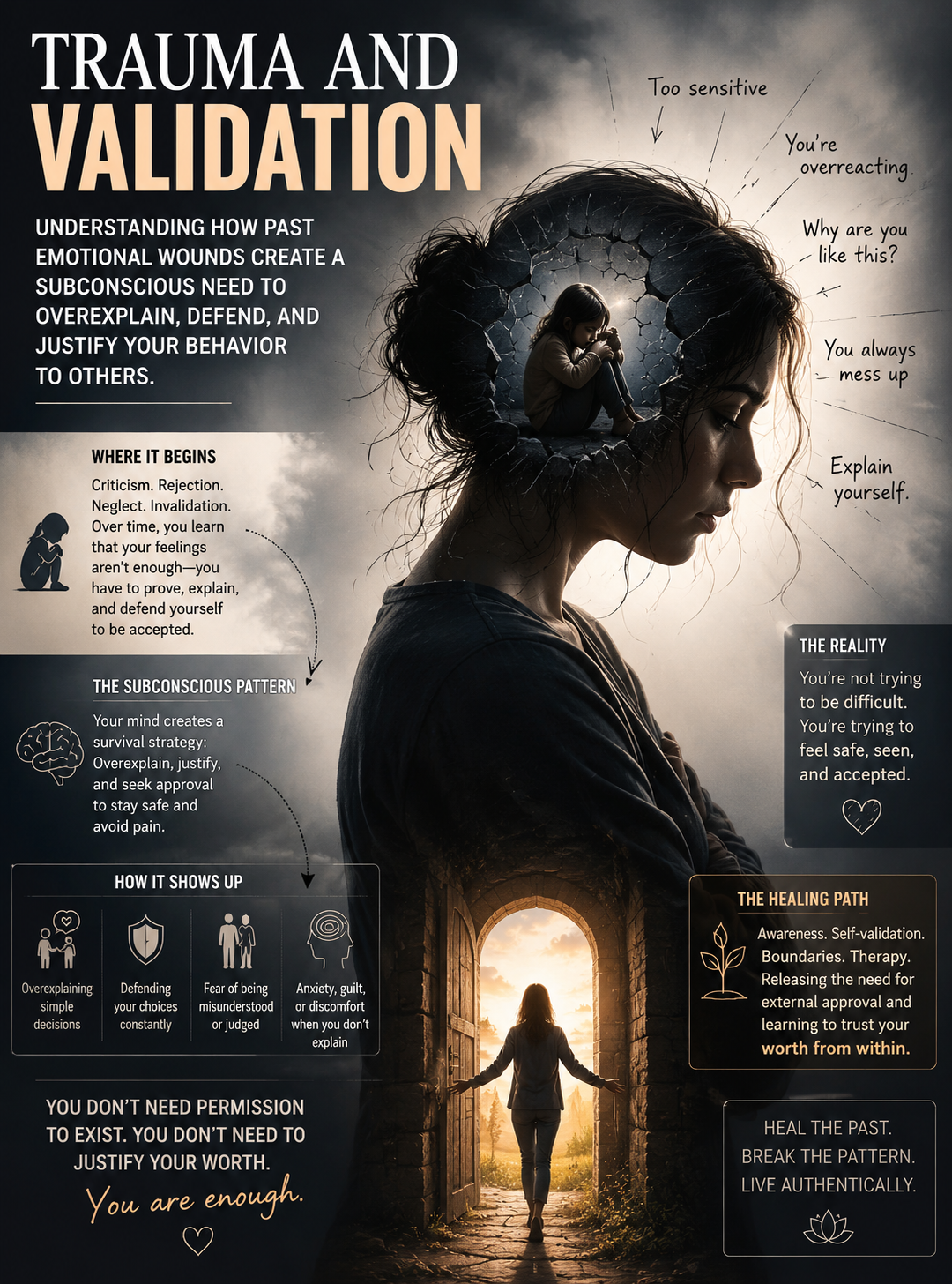
Trauma and Validation: Understanding How Past Emotional Wounds Create a Subconscious Need to Overexplain, Defend, and Justify Your Behavior to Others
Human beings naturally seek understanding, acceptance, and connection. We all want to feel seen, heard, and valued by those around us. However, for some individuals, this desire goes far beyond a normal need for connection. They find themselves constantly explaining their decisions, defending their choices, and justifying their behavior to others—even when no explanation is required. They may spend hours replaying conversations, crafting detailed responses, or worrying about how others perceive them. While this behavior is often mistaken for insecurity or people-pleasing, the roots frequently run much deeper. In many cases, the tendency to overexplain is connected to unresolved emotional wounds and trauma.
Trauma is not defined solely by catastrophic events. Emotional trauma can develop through repeated experiences of criticism, rejection, invalidation, abandonment, neglect, or growing up in environments where one’s thoughts and feelings were consistently dismissed. Over time, these experiences shape how individuals view themselves and the world around them. The subconscious mind begins to create protective strategies designed to prevent future emotional pain. One of these strategies is the persistent need to seek validation through explanation and justification.
For a child growing up in a highly critical household, every decision may have required defense. They may have been forced to explain why they felt sad, justify their preferences, or defend themselves against accusations and judgment. Instead of being accepted and understood, they learned that acceptance was conditional. Their feelings were not enough on their own; they needed evidence, arguments, and explanations to earn understanding.
As this child becomes an adult, the environment may change, but the subconscious programming often remains intact. The individual continues to operate as though they are standing before a judge who must approve every decision they make. Even in healthy relationships, they may feel compelled to provide lengthy explanations for simple choices. They may explain why they declined an invitation, why they changed careers, why they need personal space, or why they established a boundary. Deep beneath the surface lies a fear that without sufficient explanation, they will be misunderstood, rejected, criticized, or abandoned.
The subconscious mind is remarkably efficient at preserving survival strategies. It does not distinguish between a dangerous environment from childhood and a safe environment in adulthood. Instead, it relies on patterns that once helped the individual survive emotionally. If overexplaining reduced conflict in the past, the subconscious mind stores this behavior as a protective mechanism. The individual may not consciously realize why they feel compelled to explain themselves. They simply experience anxiety, discomfort, or guilt whenever they choose not to.
Validation plays a central role in this dynamic. Validation is the acknowledgment that a person’s feelings, thoughts, or experiences are understandable and meaningful. Healthy validation helps children develop a stable sense of self-worth. When validation is absent or inconsistent, individuals often begin searching for it externally. They become dependent upon the approval and understanding of others to determine whether their thoughts, feelings, and actions are acceptable.
As a result, they may unconsciously believe that if they can just provide the perfect explanation, others will finally understand them and grant them the validation they seek. They become trapped in an endless cycle. They explain themselves hoping to feel secure. Yet because true security comes from within, external validation provides only temporary relief. Soon another situation arises, triggering the same fears and leading to more explanation and justification.
This pattern often becomes particularly visible in romantic relationships. Individuals with unresolved emotional wounds may find themselves constantly clarifying their intentions, defending their actions, or trying to prove that they are a good partner. They may fear being misunderstood and become highly sensitive to perceived criticism. Even neutral comments can trigger feelings of inadequacy or rejection. The subconscious mind interprets these situations through the lens of past experiences rather than present reality.
The workplace can also become a stage for this behavior. Employees who struggle with validation wounds may overexplain mistakes, justify every decision, or seek excessive reassurance from supervisors. They may fear that a single misunderstanding could damage their reputation or result in rejection. Their anxiety is often less about the current situation and more about unresolved emotional experiences that taught them their worth depended on meeting the expectations of others.
One of the most challenging aspects of this pattern is that it often appears rational on the surface. The individual may genuinely believe they are simply being thorough, responsible, or transparent. While those qualities can be healthy, overexplaining is different. It is driven not by communication but by fear. The goal is not merely to share information but to reduce anxiety, avoid criticism, and secure acceptance.
People who frequently overexplain often struggle with boundaries as well. Boundaries require individuals to trust that their needs and decisions are valid even if others disagree. However, when someone has learned that acceptance depends upon justification, boundaries can feel dangerous. They may feel obligated to explain every limit they set or defend every personal choice they make. Rather than simply saying “no,” they provide lengthy explanations designed to prevent disappointment, conflict, or judgment.
Healing begins with awareness. Individuals must first recognize that their need to overexplain may not be a personality trait but a trauma response. What once served as protection may no longer be necessary. Understanding the origin of the behavior allows people to approach themselves with compassion rather than self-criticism.
As healing progresses, individuals can begin practicing self-validation. Self-validation involves acknowledging one’s own feelings, experiences, and decisions without requiring external approval. It means recognizing that emotions are legitimate even when others disagree. It means accepting that personal boundaries do not require unanimous support. Most importantly, it means understanding that worthiness is not earned through explanation.
Therapeutic approaches such as cognitive behavioral therapy, trauma-informed counseling, attachment-based therapy, mindfulness practices, and emotional processing techniques can help individuals uncover the roots of their validation-seeking behaviors. These approaches help people identify subconscious beliefs formed during childhood and replace them with healthier perspectives rooted in self-worth and emotional security.
One of the most powerful shifts occurs when individuals realize that they are no longer responsible for managing everyone else’s perceptions of them. They begin to understand that being misunderstood is sometimes an unavoidable part of life. Not everyone will agree with their choices, and not everyone needs to. Emotional freedom emerges when people stop viewing acceptance as something that must be earned and start recognizing it as something they can offer themselves.
The journey from trauma-driven validation seeking to genuine self-acceptance is rarely immediate. It requires patience, self-awareness, and often professional support. Yet the rewards are profound. Individuals who heal these wounds discover a newfound sense of confidence and peace. They become less reactive to criticism, more comfortable with boundaries, and more authentic in their relationships. They no longer feel compelled to defend every decision or justify every action.
Ultimately, the need to overexplain is often not about communication at all. It is about safety. It is the subconscious mind’s attempt to protect against old wounds that have not fully healed. When individuals learn to validate themselves, trust their own judgment, and embrace their inherent worth, they no longer need to convince others that they deserve acceptance. They already know that they do. In that realization lies true freedom—the freedom to live authentically without constantly seeking permission, approval, or validation from the outside world.

dr.dan
Related Posts

The many ways that depression influences sleep patterns: From insomnia to hypersomnia (not always symptom of narcolepsy).
Depression can significantly influence your daily sleep in various ways....
The many faces of anxiety: Does the latter affect more than just the brain? Is it just mental or the physical gets affected? Let’s tackle each spectrum.
Anxiety is a complex condition that impacts more than just the brain, with...

Numerous strategies to cope with ongoing gaslighting from loved ones and those you care about when facing constant emotional manipulation and distortion of reality.
Experiencing gaslighting from someone you care about can be profoundly...
Stuck in survival: How trauma disconnects you from feeling safe inside. Strategies to regain control and feel at peace.
When a person experiences trauma, the mind does not simply remember the event as...