

Trauma and Validation: Understanding How Past Emotional Wounds Create a Subconscious Need to Overexplain, Defend, and Justify Your Behavior to Others
Human beings naturally seek understanding, acceptance, and connection. We all want to feel seen, heard, and valued by those around us. However, for some individuals, this desire goes far beyond a normal need for connection. They find themselves constantly explaining their decisions, defending their choices, and justifying their behavior to others—even when no explanation is required. They may spend hours replaying conversations, crafting detailed responses, or worrying about how others perceive them. While this behavior is often mistaken for insecurity or people-pleasing, the roots frequently run much deeper. In many cases, the tendency to overexplain is connected to unresolved emotional wounds and trauma.
Trauma is not defined solely by catastrophic events. Emotional trauma can develop through repeated experiences of criticism, rejection, invalidation, abandonment, neglect, or growing up in environments where one’s thoughts and feelings were consistently dismissed. Over time, these experiences shape how individuals view themselves and the world around them. The subconscious mind begins to create protective strategies designed to prevent future emotional pain. One of these strategies is the persistent need to seek validation through explanation and justification.
For a child growing up in a highly critical household, every decision may have required defense. They may have been forced to explain why they felt sad, justify their preferences, or defend themselves against accusations and judgment. Instead of being accepted and understood, they learned that acceptance was conditional. Their feelings were not enough on their own; they needed evidence, arguments, and explanations to earn understanding.
As this child becomes an adult, the environment may change, but the subconscious programming often remains intact. The individual continues to operate as though they are standing before a judge who must approve every decision they make. Even in healthy relationships, they may feel compelled to provide lengthy explanations for simple choices. They may explain why they declined an invitation, why they changed careers, why they need personal space, or why they established a boundary. Deep beneath the surface lies a fear that without sufficient explanation, they will be misunderstood, rejected, criticized, or abandoned.
The subconscious mind is remarkably efficient at preserving survival strategies. It does not distinguish between a dangerous environment from childhood and a safe environment in adulthood. Instead, it relies on patterns that once helped the individual survive emotionally. If overexplaining reduced conflict in the past, the subconscious mind stores this behavior as a protective mechanism. The individual may not consciously realize why they feel compelled to explain themselves. They simply experience anxiety, discomfort, or guilt whenever they choose not to.
Validation plays a central role in this dynamic. Validation is the acknowledgment that a person’s feelings, thoughts, or experiences are understandable and meaningful. Healthy validation helps children develop a stable sense of self-worth. When validation is absent or inconsistent, individuals often begin searching for it externally. They become dependent upon the approval and understanding of others to determine whether their thoughts, feelings, and actions are acceptable.
As a result, they may unconsciously believe that if they can just provide the perfect explanation, others will finally understand them and grant them the validation they seek. They become trapped in an endless cycle. They explain themselves hoping to feel secure. Yet because true security comes from within, external validation provides only temporary relief. Soon another situation arises, triggering the same fears and leading to more explanation and justification.
This pattern often becomes particularly visible in romantic relationships. Individuals with unresolved emotional wounds may find themselves constantly clarifying their intentions, defending their actions, or trying to prove that they are a good partner. They may fear being misunderstood and become highly sensitive to perceived criticism. Even neutral comments can trigger feelings of inadequacy or rejection. The subconscious mind interprets these situations through the lens of past experiences rather than present reality.
The workplace can also become a stage for this behavior. Employees who struggle with validation wounds may overexplain mistakes, justify every decision, or seek excessive reassurance from supervisors. They may fear that a single misunderstanding could damage their reputation or result in rejection. Their anxiety is often less about the current situation and more about unresolved emotional experiences that taught them their worth depended on meeting the expectations of others.
One of the most challenging aspects of this pattern is that it often appears rational on the surface. The individual may genuinely believe they are simply being thorough, responsible, or transparent. While those qualities can be healthy, overexplaining is different. It is driven not by communication but by fear. The goal is not merely to share information but to reduce anxiety, avoid criticism, and secure acceptance.
People who frequently overexplain often struggle with boundaries as well. Boundaries require individuals to trust that their needs and decisions are valid even if others disagree. However, when someone has learned that acceptance depends upon justification, boundaries can feel dangerous. They may feel obligated to explain every limit they set or defend every personal choice they make. Rather than simply saying “no,” they provide lengthy explanations designed to prevent disappointment, conflict, or judgment.
Healing begins with awareness. Individuals must first recognize that their need to overexplain may not be a personality trait but a trauma response. What once served as protection may no longer be necessary. Understanding the origin of the behavior allows people to approach themselves with compassion rather than self-criticism.
As healing progresses, individuals can begin practicing self-validation. Self-validation involves acknowledging one’s own feelings, experiences, and decisions without requiring external approval. It means recognizing that emotions are legitimate even when others disagree. It means accepting that personal boundaries do not require unanimous support. Most importantly, it means understanding that worthiness is not earned through explanation.
Therapeutic approaches such as cognitive behavioral therapy, trauma-informed counseling, attachment-based therapy, mindfulness practices, and emotional processing techniques can help individuals uncover the roots of their validation-seeking behaviors. These approaches help people identify subconscious beliefs formed during childhood and replace them with healthier perspectives rooted in self-worth and emotional security.
One of the most powerful shifts occurs when individuals realize that they are no longer responsible for managing everyone else’s perceptions of them. They begin to understand that being misunderstood is sometimes an unavoidable part of life. Not everyone will agree with their choices, and not everyone needs to. Emotional freedom emerges when people stop viewing acceptance as something that must be earned and start recognizing it as something they can offer themselves.
The journey from trauma-driven validation seeking to genuine self-acceptance is rarely immediate. It requires patience, self-awareness, and often professional support. Yet the rewards are profound. Individuals who heal these wounds discover a newfound sense of confidence and peace. They become less reactive to criticism, more comfortable with boundaries, and more authentic in their relationships. They no longer feel compelled to defend every decision or justify every action.
Ultimately, the need to overexplain is often not about communication at all. It is about safety. It is the subconscious mind’s attempt to protect against old wounds that have not fully healed. When individuals learn to validate themselves, trust their own judgment, and embrace their inherent worth, they no longer need to convince others that they deserve acceptance. They already know that they do. In that realization lies true freedom—the freedom to live authentically without constantly seeking permission, approval, or validation from the outside world.
Learn More
The way you stand expresses everything: How physical posture can influence mood states and strategies to keep yourself aligned, both mentally and physically.
The way you stand is never just physical. It is communication, not only to the world around you, but to your own mind. Before a single word is spoken, before a thought is fully formed, your body has already taken a position—and that position quietly shapes how you feel, how you think, and how you show up.
Posture is often dismissed as a matter of appearance, something corrected for aesthetics or etiquette. But beneath that surface lies something far more influential. The human body and mind are deeply interconnected, constantly exchanging signals in both directions. When you stand tall, your brain interprets that stance as readiness, confidence, and control. When you collapse inward, your nervous system reads it as withdrawal, uncertainty, even defeat. Over time, these signals don’t just reflect your state—they begin to define it.
Think about the last time you felt overwhelmed or discouraged. Chances are, your shoulders dropped, your gaze lowered, your chest tightened. Now consider moments when you felt capable, focused, or energized. Your spine likely lengthened, your breathing deepened, and your presence expanded. These are not coincidences. They are patterns wired into your biology.
Your posture influences your breathing, and your breathing influences your emotional regulation. A compressed posture restricts airflow, keeping breaths shallow and rapid, which can amplify stress responses. An open posture allows for fuller breaths, signaling safety to your brain and helping stabilize your mood. In this way, something as simple as lifting your chest or aligning your spine becomes a lever you can use to shift your internal state.
But the impact goes even deeper. The way you hold yourself affects how you perceive challenges and opportunities. When your body is aligned and grounded, your thinking tends to follow suit. You become more decisive, more present, and more capable of handling pressure. When your body is tense or collapsed, your thoughts often mirror that contraction, narrowing your perspective and limiting your sense of possibility.
Alignment, then, is not just physical—it is a full-system experience. It is the integration of body, mind, and intention.
To cultivate this alignment, awareness is the starting point. You don’t need to overhaul your posture all at once. Instead, begin by noticing. Notice how you sit when you’re working, how you stand when you’re waiting, how you carry yourself when you walk into a room. Awareness creates choice, and choice creates change.
From there, introduce small but deliberate adjustments. Lengthen your spine as if gently being pulled upward. Relax your shoulders without letting them collapse. Keep your chin level, allowing your gaze to meet the world directly. These are not rigid corrections but subtle shifts—signals to your body that you are present and engaged.
Equally important is the rhythm of movement. Staying aligned doesn’t mean staying still. The body thrives on motion. Regular stretching, walking, and mindful movement help release tension and reset posture naturally. When you move with intention, you reinforce the connection between physical alignment and mental clarity.
Mental alignment follows a similar principle. Just as the body can drift into unhelpful patterns, so can the mind. Thoughts of doubt, distraction, or negativity can pull you out of alignment just as easily as poor posture. The key is not to eliminate these thoughts entirely, but to notice them without becoming anchored to them. When you bring your attention back—whether through your breath, your posture, or your focus—you reestablish alignment.
There is also power in consistency. A single moment of standing tall can shift your mood briefly, but repeated moments build a new baseline. Over time, aligned posture and aligned thinking become your default rather than your exception. This is where transformation happens—not in dramatic gestures, but in steady, intentional practice.
What makes this especially powerful is that it is always available to you. No matter the environment, no matter the circumstances, you have the ability to adjust your posture, to take a deeper breath, to realign yourself in real time. It is a quiet form of control in a world that often feels unpredictable.
The way you stand truly does express everything, because it reflects the relationship you have with yourself. When you stand with intention, you send a message that you are grounded, capable, and ready. And as that message repeats, your mind begins to believe it, your actions begin to reflect it, and your life begins to align with it.
So the next time you find yourself drifting—physically or mentally—don’t underestimate the power of a simple reset. Straighten your spine. Open your chest. Breathe fully. In that moment, you’re not just adjusting your posture. You’re reclaiming your state, your focus, and your direction.
And that’s where lasting change begins.
Learn More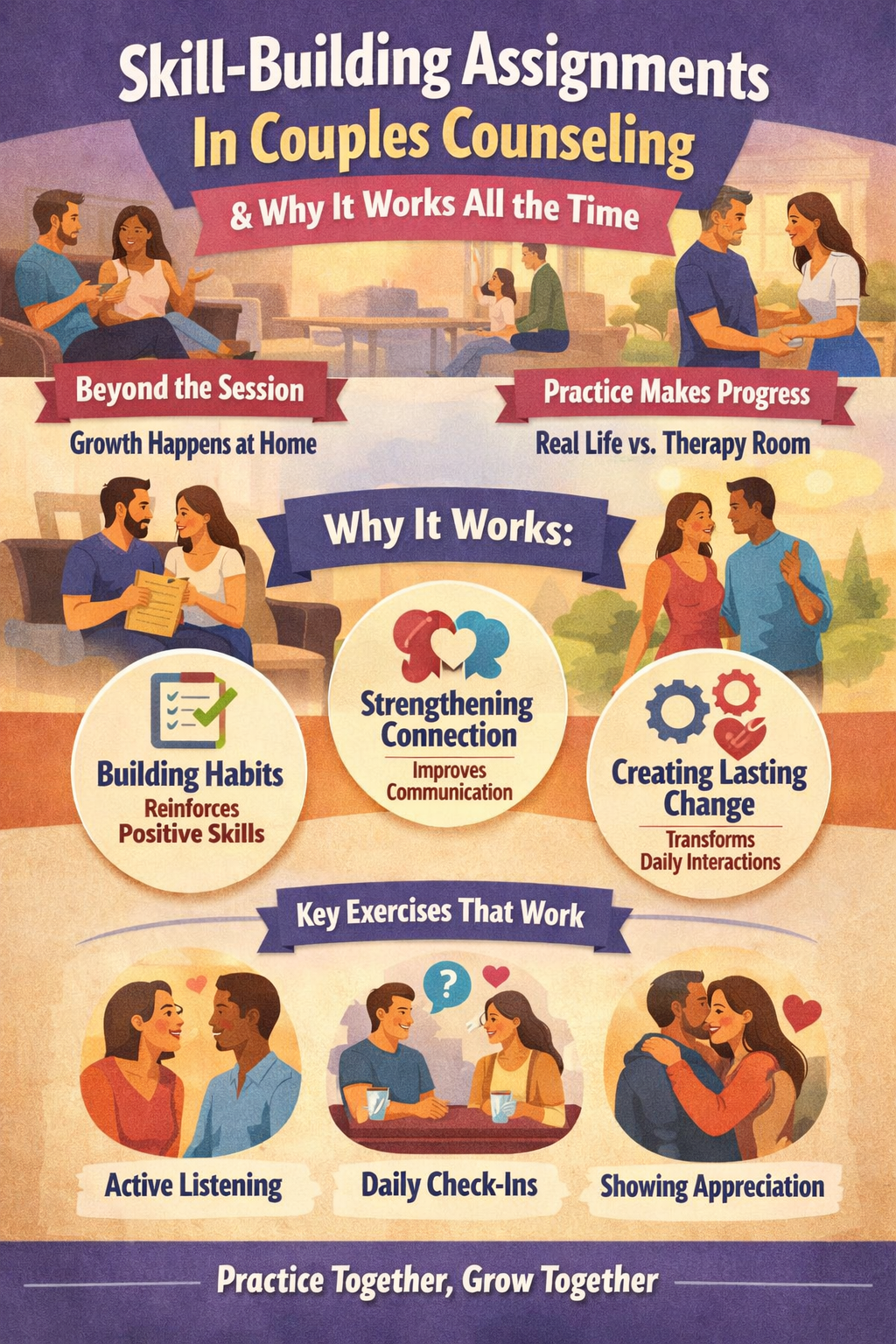
The importance of skill-building assignments in couples therapy: Why collaborative practice outside of therapy sessions has greater impact than in-session work, and universally effective strategies for relationship growth
Couples therapy is often misunderstood as something that happens only inside the therapist’s office, within the boundaries of a weekly session. In reality, the most meaningful change rarely happens in that one hour of guided conversation. Instead, it unfolds in the days and moments between sessions, when couples are living their real lives—navigating stress, miscommunication, emotional triggers, and daily responsibilities. This is where “skill training” assignments become essential. They bridge the gap between insight and transformation, turning awareness into behavior and intention into habit.
Skill training assignments are structured exercises given by the therapist for couples to practice outside of sessions. These assignments are not busy work; they are the core mechanism through which therapy becomes effective. During sessions, couples often gain clarity. They may understand patterns, identify emotional triggers, and even experience moments of connection and resolution. However, understanding something intellectually is very different from applying it under real-life emotional pressure. Skill training assignments create opportunities to practice new behaviors in the exact environments where old patterns used to dominate.
One of the primary reasons work outside the therapy room is more impactful than work inside it is context. In a therapy session, the environment is controlled, calm, and facilitated by a professional whose role is to guide and mediate. Couples are often more regulated emotionally, more reflective, and more intentional in their communication. But real relational difficulty does not occur in controlled environments. It happens in moments of fatigue after a long workday, during financial stress, in parenting disagreements, or when unresolved emotional wounds are triggered unexpectedly. Skill training assignments allow couples to rehearse healthier responses directly within these real-life conditions, where change actually matters.
Another reason external practice is more powerful is repetition. Change in relationships is not created through single insights, but through repeated experiences that reshape emotional memory. When couples practice communication tools, emotional regulation techniques, or conflict resolution strategies only during therapy, the learning remains theoretical. But when they repeatedly apply those same skills at home, in real arguments or emotional conversations, the brain begins to rewire. Over time, new relational habits replace old defensive patterns. This repetition builds confidence and reduces reactivity, which is often one of the biggest barriers in distressed relationships.
Skill training also empowers couples to take ownership of their growth. Therapy sessions can sometimes unintentionally create dependency on the therapist as the “mediator of truth” or the “only safe space” for difficult conversations. While guidance is important, lasting change requires autonomy. When couples are given structured exercises to complete between sessions, they begin to internalize the process of repair and connection. They learn that healing does not depend on the therapist being present, but on their willingness to practice new ways of relating to each other consistently.
One of the most effective strategies in skill training is structured communication practice. This involves setting aside intentional time at home to talk without interruption, defensiveness, or problem-solving pressure. Couples are often guided to use reflective listening, where one partner speaks while the other listens and then repeats back what they heard before responding. This simple structure slows down emotional escalation and creates a sense of being understood, which is often the foundation of conflict resolution.
Another powerful approach is emotional check-ins. Instead of only discussing problems when conflict arises, couples are encouraged to regularly share their emotional state, stress levels, and needs. This reduces emotional buildup, which often leads to explosive arguments. When partners become more attuned to each other’s emotional world in small, consistent ways, the relationship becomes more stable and less reactive over time.
Behavioral assignments that focus on appreciation and positive reinforcement are also highly effective. Many struggling couples fall into patterns where most communication becomes problem-focused or critical. Structured exercises that require partners to intentionally acknowledge what they appreciate about each other help rebalance emotional perception. This does not ignore problems, but it creates a healthier emotional foundation from which problems can be addressed.
Another important element is repair practice. Every couple will experience misunderstandings or emotional missteps even during healing. Skill training assignments often include learning how to pause, revisit a disagreement, and repair emotional ruptures without escalating into blame or withdrawal. This teaches couples that conflict does not have to end in distance; it can end in reconnection.
Ultimately, the power of skill training assignments lies in their ability to transform therapy from an intellectual experience into a lived one. The therapist’s office becomes a place of learning, while real life becomes the practice field. Without this bridge, couples may leave sessions with insight but little change. With it, they begin to build new relational habits that gradually replace the patterns that once created disconnection.
True relationship growth does not come from perfect conversations in therapy. It comes from imperfect conversations at home that are handled differently than before. It is in those repeated moments of choosing patience over reaction, understanding over defensiveness, and connection over withdrawal that real transformation takes place.
Learn More
The real ONLINE psychological killer: Social media comparison: How anxiety therapy can assist people comparing themselves to fake online social media successes. Social media DETOX is a must.
The phenomenon often referred to as the “real online killer”—social media comparison—can be most effectively understood through the framework of Social Comparison Theory, originally proposed by Leon Festinger. This theory explains that individuals possess an inherent drive to evaluate themselves, often in relation to others, particularly when objective standards are absent. In the context of social media, this natural psychological tendency becomes amplified and distorted due to the highly curated, filtered, and performative nature of online identities. What individuals are comparing themselves to is not reality, but an edited projection of success, beauty, and happiness, carefully constructed to maximize social approval.
This dynamic fosters a persistent pattern of upward social comparison, in which individuals measure themselves against those they perceive as more successful or fulfilled. Unlike balanced real-world comparisons, social media disproportionately exposes users to highlight reels—vacations, achievements, relationships, and aesthetic ideals—while concealing struggle, failure, and emotional complexity. This asymmetry creates a skewed cognitive environment that reinforces maladaptive beliefs such as “I am not enough,” “I am behind,” or “Everyone else has it figured out.” These beliefs are rooted in cognitive distortions, including selective abstraction, overgeneralization, and catastrophizing, which collectively distort an individual’s perception of self and reality.
Over time, repeated engagement in these distorted comparisons can activate and strengthen negative core schemas, particularly those related to inadequacy, rejection, and unworthiness. These schemas operate at a deep, often unconscious level, influencing emotional responses and behavioral patterns. Individuals may begin to experience chronic self-doubt, diminished self-esteem, and a heightened sensitivity to perceived social evaluation. In more severe cases, this can contribute to the development or exacerbation of anxiety-related conditions, including Generalized Anxiety Disorder and social anxiety, characterized by persistent worry, hypervigilance, and physiological symptoms such as restlessness, muscle tension, and difficulty concentrating.
From a neurobiological standpoint, social media platforms are designed to exploit the brain’s reward circuitry, particularly the dopaminergic system. Intermittent reinforcement—through likes, comments, and shares—creates a variable reward schedule similar to that seen in gambling behaviors. This unpredictability strengthens compulsive engagement, as users repeatedly check their devices in anticipation of social validation. However, this external reinforcement gradually shifts the individual’s locus of self-worth from internal to external sources, making self-esteem increasingly contingent upon digital feedback. The result is a fragile and unstable sense of identity that fluctuates based on perceived online approval.
Additionally, the constant exposure to idealized images and lifestyles can lead to identity diffusion, particularly among individuals in formative developmental stages. Rather than cultivating an authentic sense of self, individuals may begin to model their identity based on external templates, striving to replicate what is socially rewarded online. This process can create internal conflict, as the “performed self” diverges from the “experienced self,” leading to emotional dissonance, dissatisfaction, and a sense of inauthenticity.
Therapeutic intervention plays a critical role in addressing the psychological impact of social media comparison. Approaches grounded in Cognitive Behavioral Therapy are particularly effective in targeting the cognitive and behavioral mechanisms underlying this phenomenon. CBT focuses on identifying and restructuring maladaptive thought patterns, helping individuals challenge the validity of their comparisons and reframe their interpretations of online content. For example, clients are guided to recognize that social media posts represent selective self-presentation rather than objective reality, thereby reducing the emotional intensity associated with upward comparison.
Beyond cognitive restructuring, therapy also emphasizes the development of metacognitive awareness—the ability to observe one’s thoughts without becoming fully identified with them. This awareness allows individuals to disengage from automatic comparison processes and cultivate a more balanced and compassionate self-perspective. Techniques such as mindfulness-based interventions further support emotional regulation by grounding individuals in the present moment and reducing rumination on perceived inadequacies.
A social media detox emerges as a crucial behavioral intervention within this framework. From a psychological standpoint, detoxification functions as a form of stimulus control, reducing exposure to triggers that perpetuate comparison and emotional distress. By intentionally limiting or eliminating social media use for a defined period, individuals create space for cognitive recalibration and emotional recovery. This process allows the nervous system to stabilize, decreases reliance on external validation, and encourages the reestablishment of intrinsic sources of self-worth.
Importantly, a detox is not merely about avoidance, but about intentional re-engagement with one’s internal world. During this period, individuals are encouraged to reconnect with values, goals, and activities that foster a sense of competence, autonomy, and authenticity. This aligns with principles from self-determination theory, which emphasizes the importance of intrinsic motivation in psychological well-being. As individuals shift their focus from external comparison to internal alignment, they begin to rebuild a more stable and resilient sense of identity.
To put it in layman terms, social media comparison happens because of a mix of how we think, how we feel, and how social media is designed to keep us engaged. The platforms themselves aren’t the real problem, but the way they highlight perfect, edited moments can make our natural habits—like comparing ourselves—much stronger and more harmful. This can slowly affect how we see ourselves and lower our confidence or happiness.
Fixing this isn’t just about one change—it takes a few things working together. It means becoming aware of your thoughts, learning how to manage your emotions, and changing certain habits, like how often or why you use social media. With support, like therapy, and by taking intentional breaks from social media, people can step out of the constant comparison cycle. Over time, this helps them reconnect with who they truly are, build real confidence, and develop a healthier relationship with both themselves and the online world.
Learn More