
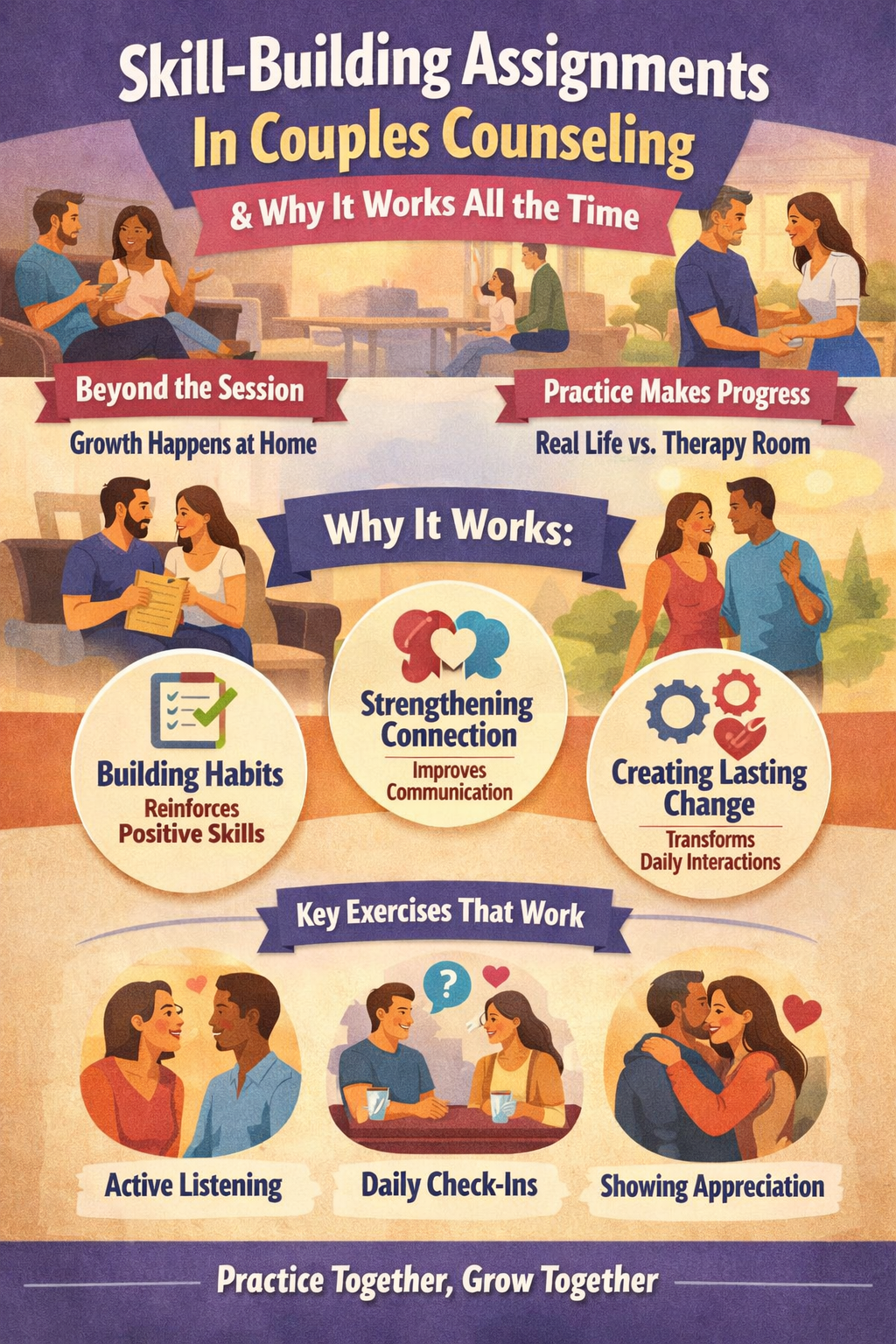
The importance of skill-building assignments in couples therapy: Why collaborative practice outside of therapy sessions has greater impact than in-session work, and universally effective strategies for relationship growth
Couples therapy is often misunderstood as something that happens only inside the therapist’s office, within the boundaries of a weekly session. In reality, the most meaningful change rarely happens in that one hour of guided conversation. Instead, it unfolds in the days and moments between sessions, when couples are living their real lives—navigating stress, miscommunication, emotional triggers, and daily responsibilities. This is where “skill training” assignments become essential. They bridge the gap between insight and transformation, turning awareness into behavior and intention into habit.
Skill training assignments are structured exercises given by the therapist for couples to practice outside of sessions. These assignments are not busy work; they are the core mechanism through which therapy becomes effective. During sessions, couples often gain clarity. They may understand patterns, identify emotional triggers, and even experience moments of connection and resolution. However, understanding something intellectually is very different from applying it under real-life emotional pressure. Skill training assignments create opportunities to practice new behaviors in the exact environments where old patterns used to dominate.
One of the primary reasons work outside the therapy room is more impactful than work inside it is context. In a therapy session, the environment is controlled, calm, and facilitated by a professional whose role is to guide and mediate. Couples are often more regulated emotionally, more reflective, and more intentional in their communication. But real relational difficulty does not occur in controlled environments. It happens in moments of fatigue after a long workday, during financial stress, in parenting disagreements, or when unresolved emotional wounds are triggered unexpectedly. Skill training assignments allow couples to rehearse healthier responses directly within these real-life conditions, where change actually matters.
Another reason external practice is more powerful is repetition. Change in relationships is not created through single insights, but through repeated experiences that reshape emotional memory. When couples practice communication tools, emotional regulation techniques, or conflict resolution strategies only during therapy, the learning remains theoretical. But when they repeatedly apply those same skills at home, in real arguments or emotional conversations, the brain begins to rewire. Over time, new relational habits replace old defensive patterns. This repetition builds confidence and reduces reactivity, which is often one of the biggest barriers in distressed relationships.
Skill training also empowers couples to take ownership of their growth. Therapy sessions can sometimes unintentionally create dependency on the therapist as the “mediator of truth” or the “only safe space” for difficult conversations. While guidance is important, lasting change requires autonomy. When couples are given structured exercises to complete between sessions, they begin to internalize the process of repair and connection. They learn that healing does not depend on the therapist being present, but on their willingness to practice new ways of relating to each other consistently.
One of the most effective strategies in skill training is structured communication practice. This involves setting aside intentional time at home to talk without interruption, defensiveness, or problem-solving pressure. Couples are often guided to use reflective listening, where one partner speaks while the other listens and then repeats back what they heard before responding. This simple structure slows down emotional escalation and creates a sense of being understood, which is often the foundation of conflict resolution.
Another powerful approach is emotional check-ins. Instead of only discussing problems when conflict arises, couples are encouraged to regularly share their emotional state, stress levels, and needs. This reduces emotional buildup, which often leads to explosive arguments. When partners become more attuned to each other’s emotional world in small, consistent ways, the relationship becomes more stable and less reactive over time.
Behavioral assignments that focus on appreciation and positive reinforcement are also highly effective. Many struggling couples fall into patterns where most communication becomes problem-focused or critical. Structured exercises that require partners to intentionally acknowledge what they appreciate about each other help rebalance emotional perception. This does not ignore problems, but it creates a healthier emotional foundation from which problems can be addressed.
Another important element is repair practice. Every couple will experience misunderstandings or emotional missteps even during healing. Skill training assignments often include learning how to pause, revisit a disagreement, and repair emotional ruptures without escalating into blame or withdrawal. This teaches couples that conflict does not have to end in distance; it can end in reconnection.
Ultimately, the power of skill training assignments lies in their ability to transform therapy from an intellectual experience into a lived one. The therapist’s office becomes a place of learning, while real life becomes the practice field. Without this bridge, couples may leave sessions with insight but little change. With it, they begin to build new relational habits that gradually replace the patterns that once created disconnection.
True relationship growth does not come from perfect conversations in therapy. It comes from imperfect conversations at home that are handled differently than before. It is in those repeated moments of choosing patience over reaction, understanding over defensiveness, and connection over withdrawal that real transformation takes place.
Learn More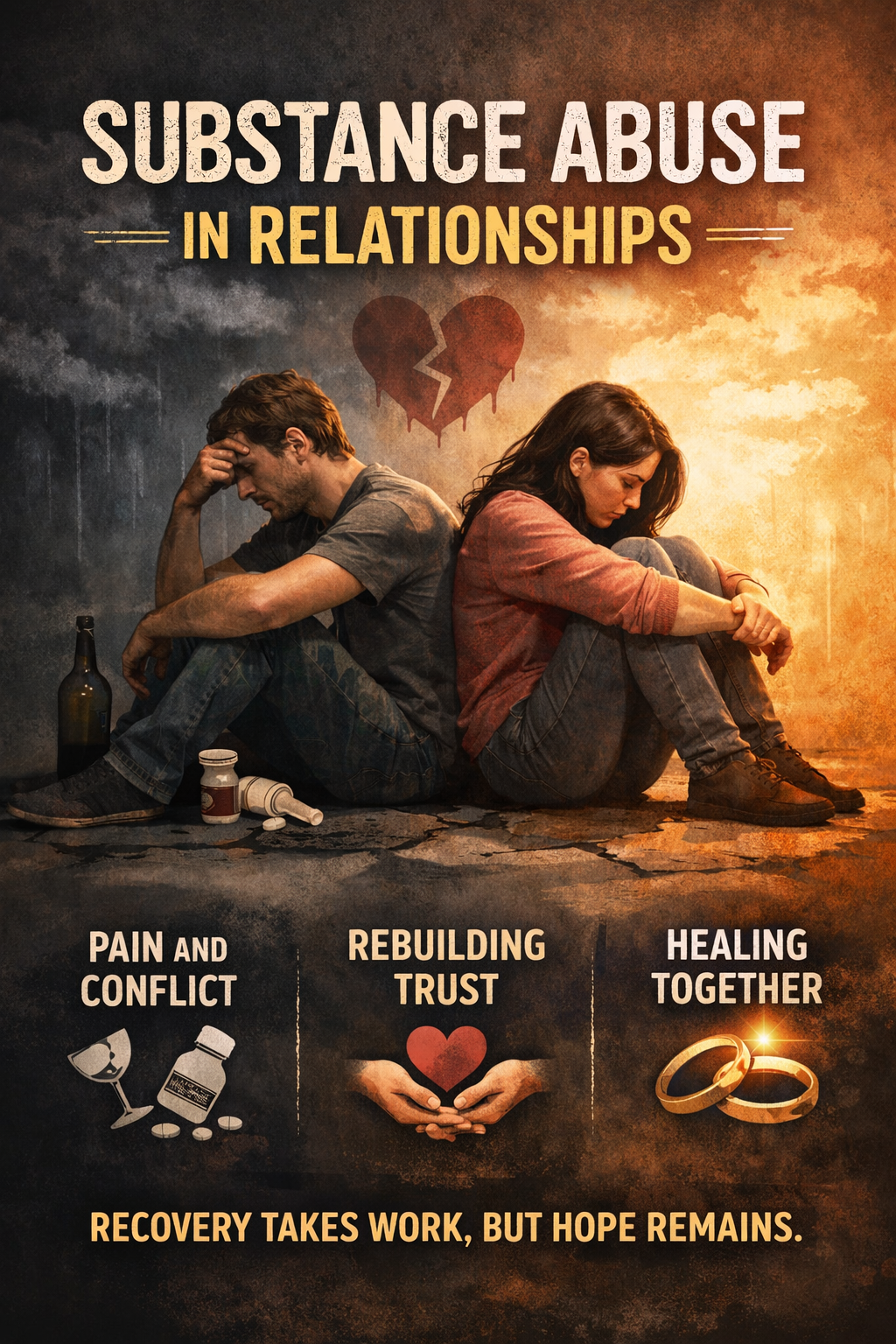
Substance abuse in marriage: Healthy and effective ways to address the challenges of addiction while keeping family dynamic intact. How can couples counseling can help navigate through these hurdles!
Substance abuse within a marriage is rarely an isolated issue; it is a deeply layered challenge that affects emotional connection, communication, trust, and the overall stability of the family system. Addiction does not exist in a vacuum. It reshapes daily interactions, influences decision-making, and often introduces unpredictability into what should be a space of safety and partnership. Over time, both partners can find themselves caught in patterns that feel impossible to escape—one struggling with dependency, the other struggling with how to respond, support, or protect themselves and the family.
In many relationships, substance abuse gradually shifts roles and responsibilities. The non-using partner may take on more control, attempting to compensate for instability, while the partner struggling with addiction may withdraw, become defensive, or experience shame. This imbalance can lead to resentment, emotional fatigue, and a breakdown in mutual respect. Trust, once compromised, becomes one of the most difficult elements to rebuild. Broken promises, secrecy, and repeated disappointments can leave lasting emotional wounds that do not simply disappear once substance use is reduced or stopped.
At the same time, it is important to recognize that addiction is not solely a matter of willpower. It is often connected to underlying emotional pain, unresolved trauma, stress, or mental health challenges. When couples begin to understand this, the dynamic can shift from one of blame to one of awareness. This does not excuse harmful behavior, but it creates a more productive foundation for addressing it. Acknowledging the deeper roots of substance use allows both partners to approach the issue with greater clarity and intention.
Healthy and effective ways to address substance abuse in marriage require both structure and compassion. Open communication becomes a cornerstone, but it must be intentional and constructive. Conversations should focus on expressing feelings and needs rather than assigning fault. This helps reduce defensiveness and creates space for honest dialogue. At the same time, boundaries are essential. Boundaries are not about punishment; they are about protection. They define what is acceptable within the relationship and help maintain a sense of stability, especially when behaviors become unpredictable or harmful.
Another key element is consistency. Change does not happen overnight, and recovery is often a nonlinear process. There may be progress followed by setbacks, and both partners need to be prepared for this reality. Developing routines that support stability—such as regular check-ins, shared responsibilities, and healthy habits—can provide a sense of grounding. These routines help rebuild a sense of normalcy within the family and reinforce a shared commitment to moving forward.
Equally important is the ability to separate the person from the addiction. When a partner is struggling with substance use, their behavior may not reflect their true intentions or values. Holding onto the distinction between the individual and the addiction can prevent the relationship from becoming defined solely by the problem. This perspective allows for accountability without stripping away empathy, which is critical for long-term healing.
Couples counseling offers a structured and supportive environment to navigate these complexities. It brings both partners into the healing process, rather than isolating the issue to one individual. This shared approach can significantly reduce feelings of loneliness and misunderstanding that often arise in relationships affected by addiction. Within therapy, couples are guided to identify patterns that may be contributing to the cycle of substance use and conflict, and they are equipped with tools to interrupt those patterns.
One of the most powerful aspects of couples counseling is its focus on communication. Many couples dealing with substance abuse fall into cycles of criticism, defensiveness, or avoidance. Therapy helps replace these patterns with more effective ways of expressing needs and listening to one another. Learning how to communicate without escalating conflict can reduce emotional triggers that might otherwise contribute to relapse or further disconnection.
In addition to communication, counseling emphasizes rebuilding trust through consistent, observable actions. Trust is not restored through words alone; it is rebuilt through reliability, honesty, and follow-through over time. Therapists often help couples set realistic expectations, allowing trust to develop gradually rather than expecting immediate repair. This process can be challenging, but it is essential for restoring a sense of safety within the relationship.
Counseling also addresses the emotional toll that addiction takes on both partners. The individual struggling with substance use may experience guilt, shame, or fear of failure, while the other partner may carry feelings of anger, hurt, or helplessness. Providing space for both experiences to be acknowledged is crucial. When both partners feel heard and validated, it becomes easier to move forward without being anchored to past pain.
Beyond the couple itself, the family dynamic must also be considered. Children, if present, are often deeply affected by substance abuse, even if it is not openly discussed. Maintaining a stable and supportive environment for them requires intentional effort. This includes minimizing exposure to conflict, providing reassurance, and modeling healthy coping strategies. Couples counseling can help parents align on how to support their children while also addressing their own challenges.
Recovery within a marriage is not just about eliminating substance use; it is about redefining the relationship. It involves creating new patterns of interaction, rediscovering shared values, and rebuilding a sense of partnership. This process can lead to a stronger and more resilient connection, one that is rooted in honesty, mutual support, and a deeper understanding of one another.
There will be moments of difficulty, and progress may feel slow at times. However, the willingness to confront the issue together, to seek support, and to remain committed to growth can transform even the most strained relationships. When both partners engage in the process with intention, it becomes possible not only to address the challenges of addiction but to emerge from them with a renewed sense of strength and unity.
A marriage tested by substance abuse carries the weight of hardship, but it also holds the potential for profound transformation. With patience, structure, and the right support, couples can move beyond survival and begin to build a relationship that is healthier, more stable, and deeply connected.
Learn More