
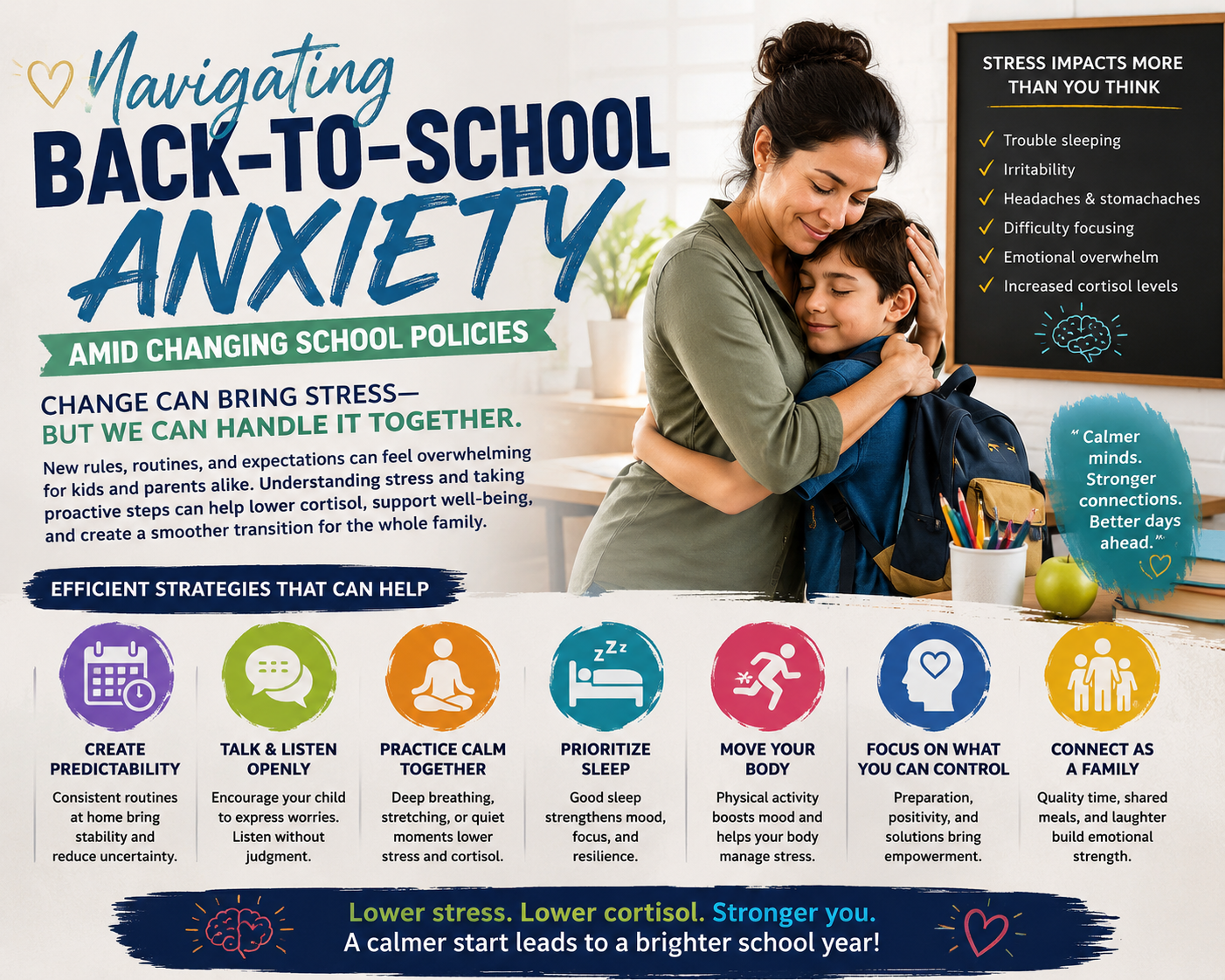
Navigating back-to-school anxiety amid changing school policies. Imminent changes that can bring stress to kids and parents and knowing what to do to reduce the levels of cortisol in your body. Efficient strategies that can help you for school year 2026-2027.
The return to school can be an exciting time filled with new opportunities, friendships, and personal growth, but it can also create anxiety for both children and parents. Changes in school policies, schedules, classroom expectations, transportation, technology, academic requirements, or safety procedures can make an already stressful transition feel even more uncertain. For children, changes to familiar routines may create feelings of fear, confusion, or frustration. For parents, concerns about how their children will adjust can lead to worry, sleepless nights, and emotional exhaustion. Understanding how stress affects the mind and body can help families approach the new school year with greater confidence and resilience.
One of the body’s primary responses to stress involves the release of cortisol, a hormone that plays an important role in helping us respond to challenges. Cortisol itself is not harmful; in fact, it is essential for maintaining energy, alertness, and an appropriate response to stressful situations. The concern arises when stress becomes prolonged and the body remains in a heightened state of alertness without enough opportunities for recovery. When children or adults experience ongoing worry, uncertainty, poor sleep, emotional pressure, and constant stimulation, they may begin to feel mentally and physically overwhelmed. The objective should not be to eliminate cortisol, because that is neither realistic nor desirable. Instead, the goal is to develop healthy habits that help the body regulate its stress response and return to a calmer state.
One of the most effective ways to manage back-to-school anxiety is to create a sense of predictability at home. When many things outside the home are changing, a consistent family routine can provide a powerful feeling of stability. Regular sleep and wake times, predictable meals, preparation for the next day, designated homework periods, family conversations, and opportunities for relaxation can help children feel more secure. Children do not need every moment of their day controlled, but knowing what to expect can reduce uncertainty and make transitions easier. A stable home environment can become an emotional anchor when other parts of life feel unpredictable.
Communication is equally important. Parents should create opportunities for children to talk openly about what they are experiencing without immediately dismissing their concerns or trying to fix everything. A child who says, “I don’t want to go back to school,” may not simply be expressing dislike. They may be worried about making friends, dealing with academic pressure, adjusting to a new teacher, being separated from their parents, or dealing with changes they do not fully understand. Instead of responding with, “Don’t worry, everything will be fine,” parents can ask, “What part of going back to school worries you the most?” This simple question can open the door to a much deeper conversation and help identify what is actually causing the anxiety.
Parents should also be mindful of how they communicate their own concerns. Children are extremely sensitive to the emotional states of the adults around them. If parents constantly express fear, frustration, or uncertainty about school changes, children may interpret those emotions as evidence that something dangerous is happening. This does not mean parents should hide their feelings or pretend that everything is perfect. Instead, parents can model healthy emotional regulation by saying something like, “I know there are some changes this year, and I have questions too. We will learn what we need to know and figure things out together.” This teaches children that uncertainty does not automatically mean danger and that difficult situations can be approached calmly and constructively.
Another important strategy is helping children distinguish between what they can control and what they cannot. School policies, decisions made by administrators, the behavior of other students, and unexpected changes are not always within a family’s control. Spending excessive time worrying about these things can increase stress without producing a solution. Instead, families can focus on the areas they can influence, such as preparing school supplies, establishing routines, communicating with teachers, maintaining healthy sleep habits, and helping children develop problem-solving skills. A useful question for both parents and children is, “Is there something I can do about this right now?” If the answer is yes, take an appropriate action. If the answer is no, learning to accept the uncertainty can prevent unnecessary emotional exhaustion.
Physical health also plays an important role in managing stress. Adequate sleep, regular physical activity, proper hydration, and balanced nutrition can support the body’s ability to cope with daily challenges. When children are tired, hungry, dehydrated, or physically inactive, they may have greater difficulty regulating their emotions and concentrating. The same is true for parents. A parent who is constantly exhausted and running on caffeine may have less emotional capacity to respond calmly to a child’s anxiety. Establishing healthy routines before school begins can therefore benefit the entire family.
Breathing and relaxation techniques can also help individuals manage moments of heightened anxiety. Slow, comfortable breathing with a slightly longer exhale can encourage the body to shift away from a heightened stress response. Parents can practice these techniques with their children rather than presenting them as something the child needs to do because they are “anxious.” Taking several slow breaths together, stretching, going for a walk, listening to calming music, or spending a few quiet minutes together can become simple family rituals that promote emotional regulation.
It is also important to teach children that experiencing anxiety does not mean they are incapable of handling a situation. Sometimes adults unintentionally reinforce anxiety by trying to eliminate every uncomfortable experience for their children. While protecting children is a natural parental instinct, children also need opportunities to develop confidence through manageable challenges. Allowing them to solve age-appropriate problems, communicate with teachers, make decisions, recover from mistakes, and experience normal frustrations can help them discover that they are more capable than they may initially believe. Resilience develops when people learn that discomfort is something they can move through rather than something they must always avoid.
Parents can further help children by teaching them how to challenge catastrophic thinking. Anxiety often focuses on the worst possible outcome. A child might think, “What if nobody likes me?” or “What if I can’t do the work?” Instead of simply saying, “That won’t happen,” parents can help the child consider what they would do if the challenge occurred. They might discuss how the child could approach a classmate, ask a teacher for assistance, seek support from a counselor, or practice a difficult academic skill. This shifts the focus from predicting disaster to developing confidence in one’s ability to respond. The message becomes, “We don’t know exactly what will happen, but we know that we can figure things out.”
Parents should also be careful about consuming too much information about school changes. During uncertain periods, it is natural to repeatedly check emails, social media, school announcements, and online discussions. However, constantly monitoring information can sometimes increase anxiety rather than reduce it. Families can establish reasonable times to review school communications and then return their attention to everyday life. Being informed is valuable, but being consumed by information can keep the brain in a constant state of alertness.
Perhaps one of the most important lessons for families is that stress cannot always be avoided. The goal is not to create a completely stress-free childhood or a perfectly predictable school year. Instead, the goal is to develop the emotional skills necessary to navigate uncertainty. Children need to learn that they can experience nervousness and still move forward. Parents need to recognize that they do not have to know every answer immediately. Families need to understand that change can be uncomfortable without necessarily being harmful.
Back-to-school anxiety can therefore become an opportunity for growth. Instead of viewing every challenge as something that must be eliminated, families can use these experiences to teach emotional awareness, communication, problem-solving, resilience, and self-regulation. When children see their parents responding to uncertainty with patience and confidence, they learn that they too can face difficult situations without becoming overwhelmed by them.
If anxiety becomes persistent or begins to significantly interfere with a child’s ability to attend school, sleep, eat, socialize, concentrate, or function normally, professional support may be appropriate. The same applies to parents whose own anxiety becomes overwhelming or interferes with their daily lives. Seeking support is not a sign of weakness; it can be an important step toward developing healthier coping strategies.
As another school year begins, families should remember that they cannot control every policy, decision, change, or challenge that may arise. What they can control is how they prepare, how they communicate, how they care for their physical and emotional well-being, and how they respond when uncertainty appears. The ultimate goal is not to eliminate stress or cortisol from our lives, but to teach ourselves and our children how to move from stress back toward balance.
We cannot always control what changes around us, but we can learn to control how we respond to those changes. And sometimes, the greatest lesson a new school year can teach us is that we are far more capable of handling change than we ever realized.
Learn More
Parenting challenges of the 21st century: Emotional support strategies for stressed parents and ways to raise kids successfully without the damaging long term effect of stress.
Parenting in the 21st century presents a unique blend of pressures and paradoxes. Never before has the world changed so rapidly, shifted so unpredictably, or demanded so much instant connectivity while simultaneously isolating individuals from deeper support systems. Modern parents are navigating economic uncertainty, constantly connected digital landscapes, heightened social expectations, and fragmented community networks. At the same time, children grow up in environments filled with digital stimulation, academic competition, social comparison, and influences that previous generations could scarcely imagine. This complex context has created a new set of parenting stressors that can affect both parents’ and children’s emotional well-being.
One of the most pervasive challenges today is the influence of technology on family life. Smartphones and screens mediate many interactions, and social media often becomes a measuring stick against which parents compare their own performance. It is common for parents to scroll through curated images of other families, feeling pressure to emulate lifestyles that are often unrealistic and unrepresentative. While technology offers unprecedented access to information and connection, it also fuels anxiety, distraction, and an underlying fear of not doing “enough.” Meanwhile, children are exposed to digital environments at younger ages, increasing the need for parents to monitor online behavior and manage screen time, which can become an additional source of stress for caregivers.
Economic and work-related pressures further compound the emotional load. Many parents juggle demanding careers with caregiving responsibilities, striving to provide financially while also being emotionally available at home. The rise of hybrid and gig-based work models sometimes blurs the boundaries between professional commitments and family time. Long work hours away from home, or the strain of balancing responsibilities, can leave parents feeling exhausted, guilty, and stretched thin. When parents are under constant strain, it can affect their capacity to engage with children patiently, listen deeply, or model healthy stress management.
Adding to these pressures are heightened expectations around children’s achievements. Academic milestones, extracurricular success, and early specialization create an environment in which both parents and children feel the stakes are high. This can lead to over-scheduling, reduced downtime, and a constant sense of urgency. While intentions are rooted in love and aspiration, this persistent intensity can unwittingly transmit stress to children, influencing their own sense of self-worth and emotional regulation.
Despite the complexity of these challenges, it is possible for parents to cultivate emotional well-being for themselves and their children. A critical first step for parents is to care for their own mental health with the same intentionality they apply to their children’s needs. Recognizing personal stress signals, practicing self-awareness, and attending to emotional needs are not indulgences—they are prerequisites for effective caregiving. When parents learn to regulate their emotions, they model for their children how to navigate life’s inevitable ups and downs with resilience. Mindfulness, for example, does not require hours of meditation or special equipment; it can begin with simple moments of awareness between tasks, intentional breathing before responding to a child’s frustration, or sensing one’s own emotional reactions without judgment.
Supportive social connections play a vital role in reducing isolation and sustaining emotional health. Parents often underestimate the power of sharing experiences with others who understand the challenges of raising children in modern contexts. Reaching out to friends, family members, or community groups can provide both validation and perspective. In such interactions, parents can exchange coping strategies, offer encouragement, and remind one another that perfection is neither expected nor possible. Parenting communities, whether online or in person, can help normalize struggles and reduce the burden of feeling solely responsible.
Another key emotional support strategy is reevaluating internal expectations. Parents are often their own harshest critics, operating under unspoken rules about what “good parenting” should look like. Reframing these standards to focus on presence, connection, and attuned care can relieve unnecessary pressure. A parent who approaches challenges with curiosity, humility, and openness is likely to foster a secure emotional environment for their child—even on days when everything does not go as planned.
Children, for their part, thrive when they feel emotionally safe and supported. Emotional safety arises from consistent presence, empathetic listening, and validation of the child’s inner world. When parents acknowledge a child’s feelings and experiences without immediate dismissal or correction, children learn that their emotions are understood and acceptable. This foundational trust builds emotional intelligence, allowing children to recognize and regulate their feelings over time. Rather than striving for behavioral perfection, supporting a child’s emotional experience promotes long-term resilience.
Positive parenting also involves focusing on a child’s internal growth rather than external achievement. Praising curiosity, effort, and persistence—rather than only outcomes—encourages a growth mindset. Children who understand that effort and learning matter more than perfection are less susceptible to performance anxiety. This orientation toward learning, rather than only success, promotes joy, adaptability, and self-confidence.
Problem-solving skills are fundamental to emotional resilience. When children are guided through challenges with supportive dialogue rather than directive instruction, they build confidence in their own capacities. Asking thoughtful questions such as “What do you think could help?” or “How did that make you feel?” invites children to explore options, reflect on experiences, and strengthen their problem-solving abilities. These conversations model critical thinking and reinforce the idea that problems are opportunities for growth, not threats to self-worth.
Parents also play a crucial role in helping children manage stress physically and psychologically. Establishing consistent routines for sleep, meals, and downtime creates a sense of predictability and safety for children. Regular opportunities for play and creative expression provide natural outlets for processing emotions and tension. By creating safe spaces for both structured and unstructured activities, parents help children navigate the world without becoming overwhelmed by stress.
Reducing long-term damaging effects of stress also involves limiting overexposure to stress triggers. This might mean reevaluating overscheduling, setting boundaries around news and media consumption, and creating intentional family rituals that foster connection rather than performance. When stress is chronic and unaddressed, it can shape a child’s nervous system and influence future emotional and physical health. By attending to emotional needs early and consistently, parents create a buffer against the lasting impact of stress.
Ultimately, parenting in the 21st century is a journey of connection, resilience, and intentional presence. While the challenges are real and varied, so too are the opportunities for growth. Parents who attend to their own emotional well-being, cultivate supportive relationships, and foster secure, compassionate environments for their children are laying the foundation for healthy development. A vision of successful parenting does not revolve around perfection or control, but around attuned presence—being fully with one another, learning together, and creating a life shaped by connection rather than stress. When parents and children move through life with awareness, empathy, and mutual support, they build not only strong families but resilient futures.
Learn More
The ONE of many challenges in Parenting: The art of active listening with teenage kids and create healthy and engaging conversations within family dynamics. The do’s and don’ts of interactions.
Parenting teenagers is often considered one of the most rewarding yet simultaneously challenging stages in family life. Adolescence is a period of tremendous growth, exploration, and self-discovery, but it is also a time of emotional turbulence, evolving social pressures, and an intensified need for independence. For many parents, these changes can feel overwhelming, leaving them uncertain about how to connect meaningfully with their children. Among the numerous challenges that arise during this stage, one skill stands out as both essential and transformative: the art of active listening. Mastering this skill allows parents to create healthy, engaging conversations, maintain strong family bonds, and navigate the complexities of adolescent life with empathy and understanding.
Active listening is far more than simply hearing words. It involves fully engaging with a child’s thoughts, emotions, and intentions, showing genuine interest, and responding in ways that convey understanding. Teenagers are particularly sensitive to whether they are being truly heard or simply tolerated. When parents practice active listening, they demonstrate that their child’s perspective is valued and respected. This acknowledgment fosters trust, encourages openness, and makes it more likely that a teenager will seek guidance or share difficult experiences rather than withdraw in silence or act out through rebellious behavior. Active listening also helps parents understand the root causes of certain behaviors, enabling more thoughtful and effective responses to challenges such as mood swings, conflicts with peers, or academic pressures.
Creating an environment that encourages active, meaningful communication requires careful attention to family dynamics. Parents must cultivate patience, empathy, and emotional intelligence, recognizing that a teenager’s feelings are valid even if their perspective differs from an adult’s. Engaging in conversations with curiosity rather than judgment can transform ordinary exchanges into opportunities for connection. Asking questions that invite reflection, rather than simply eliciting yes or no responses, encourages adolescents to think critically and express themselves more fully. Statements that reflect understanding and empathy, such as acknowledging frustration or validating disappointment, communicate care far more effectively than immediate advice or criticism.
However, the path to effective communication is fraught with potential pitfalls. One of the most common mistakes parents make is dismissing or minimizing their teenager’s emotions. Phrases like “You’re overreacting” or “It’s not a big deal” can unintentionally communicate that their feelings are unimportant, which may lead to withdrawal or resentment. Interrupting a teen mid-sentence, responding with impatience, or immediately attempting to solve a problem can similarly shut down dialogue. Parents must resist the urge to dominate conversations or impose solutions prematurely. Likewise, sarcasm, judgment, or belittling humor can have lasting negative effects on a child’s willingness to communicate openly. By consciously avoiding these behaviors, parents create a space where teens feel safe, respected, and empowered to express themselves.
Active listening also involves recognizing nonverbal cues and emotional undercurrents. Often, teenagers communicate as much through body language, tone, and facial expressions as through their words. Parents who observe these signals and respond thoughtfully are better equipped to understand the full context of a child’s feelings. This attentiveness demonstrates that the parent is fully present, not merely performing a superficial check-in, and reinforces the message that the teenager’s inner world matters.
Another key aspect of effective communication is modeling healthy dialogue. Parents who actively listen, respond empathetically, and express their own thoughts and emotions constructively teach adolescents the skills they need for future relationships. This modeling includes demonstrating patience, using reflective language, and showing that disagreements can be navigated respectfully without escalating into conflict. By witnessing these interactions firsthand, teenagers learn to communicate with self-awareness, respect, and emotional intelligence—skills that will serve them long after they leave the family home.
Importantly, active listening is not a one-time effort but a consistent practice. Family dynamics thrive when parents make conscious, repeated efforts to engage in meaningful dialogue. This involves not only listening during moments of conflict but also during everyday interactions—talking about school, friendships, hobbies, or current events. Regular, thoughtful conversations help normalize open communication, build trust, and reduce the emotional distance that often grows between parents and teenagers. Over time, these interactions contribute to a more cohesive, resilient family unit, capable of navigating challenges together rather than in isolation.
Finally, the benefits of active listening extend far beyond immediate conflict resolution. Teens who feel heard are more likely to develop strong self-esteem, resilience, and emotional regulation. They are more willing to seek guidance, discuss difficult topics such as mental health or risky behaviors, and collaborate with their parents in problem-solving. For parents, the rewards are equally significant: deeper connections, reduced misunderstandings, and the satisfaction of nurturing a healthy, thriving family dynamic.
While parenting teenagers is undeniably challenging, active listening emerges as one of the most powerful tools in fostering meaningful communication and strong family relationships. By fully engaging with their children, validating emotions, avoiding judgment, and modeling constructive dialogue, parents create an environment where teenagers feel supported, understood, and empowered. The art of active listening transforms everyday conversations into opportunities for connection, growth, and mutual respect, enabling families to navigate the complexities of adolescence together. It is through this intentional practice that parents can turn the challenges of teenage years into meaningful opportunities for lasting bonds and enduring understanding.
Learn More