
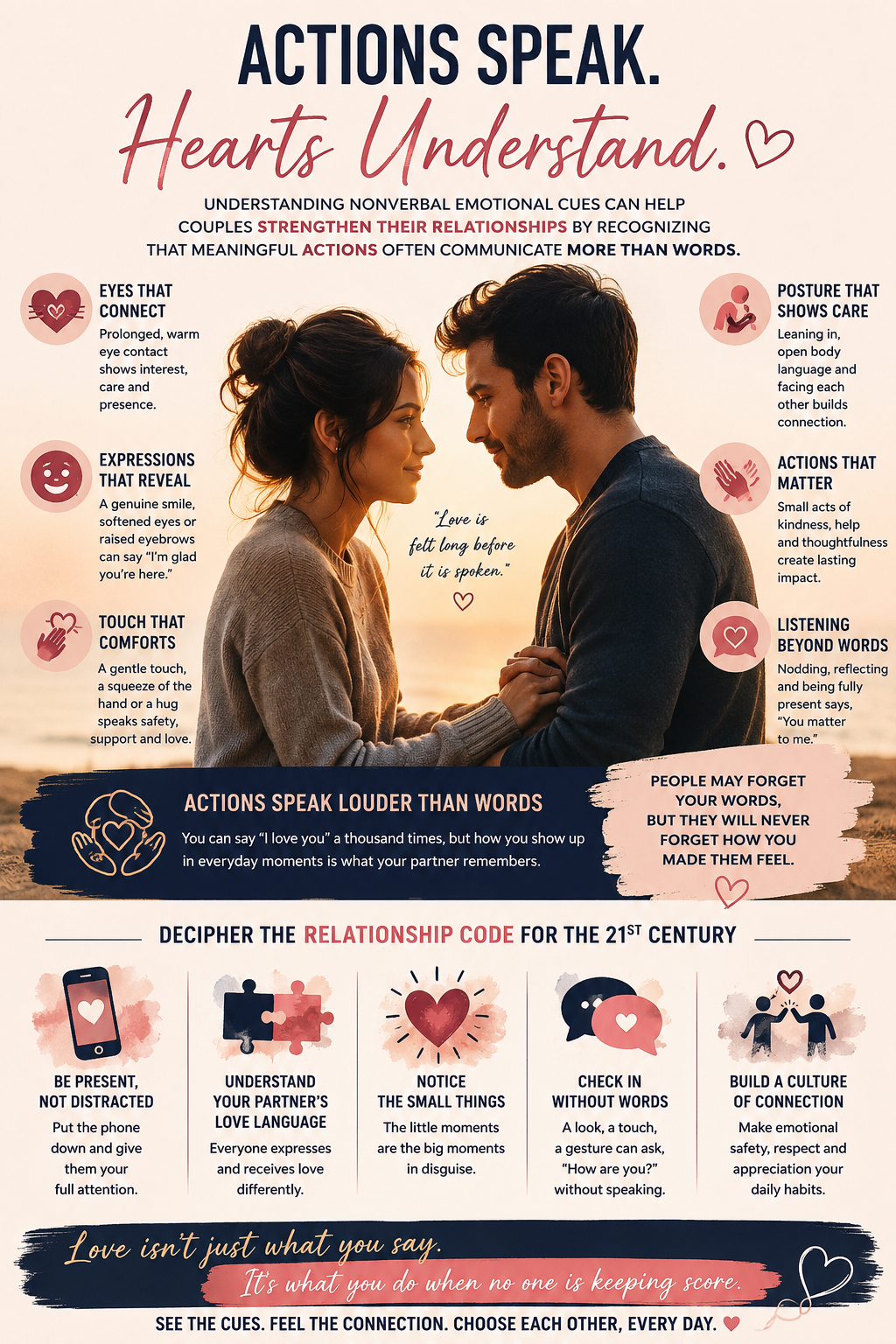
Understanding nonverbal emotional cues can help couples strengthen their relationships by recognizing that meaningful actions often communicate more than words. Decipher the relationship code for the 21st century.
Understanding nonverbal emotional cues can transform the way couples experience and sustain their relationships, especially in a world where communication is increasingly fast, digital, and often fragmented. While words remain important, they represent only a fraction of how human beings actually convey meaning and emotional truth. In many relationships, what is felt but not said often carries more weight than spoken language, and it is in these unspoken moments that the real depth of connection is revealed. Meaningful actions, subtle expressions, tone, presence, and consistency often communicate love, concern, frustration, or distance far more accurately than carefully chosen sentences. When couples begin to recognize this silent dimension of communication, they begin to unlock what can be described as the relationship code of the 21st century.
Modern relationships are shaped by constant interaction, yet emotional misunderstanding remains common because people often focus heavily on words while overlooking behavior and emotional signals. A partner may say they are fine, but their posture, lack of eye contact, or emotional withdrawal may suggest otherwise. Another may express love verbally while their actions fail to reflect attention, care, or prioritization. These inconsistencies can create confusion and emotional insecurity, not because love is absent, but because it is not being communicated in a way that feels coherent or trustworthy. In contrast, when words and actions align, relationships tend to feel stable, safe, and emotionally fulfilling.
Nonverbal emotional cues include facial expressions that reveal subtle shifts in feeling, tone of voice that carries emotional texture beyond language, body language that reflects openness or distance, eye contact that signals presence or avoidance, and physical touch that communicates reassurance or affection without words. Even everyday actions such as remembering small details, showing up during difficult moments, or offering help without being asked become powerful expressions of emotional investment. These cues often operate beneath conscious awareness, yet they shape how individuals perceive love, trust, and emotional safety within a relationship.
From a psychological perspective, humans are naturally wired to read nonverbal information because it has historically been essential for survival and social bonding. Emotional attunement, the ability to sense and respond appropriately to another person’s emotional state, plays a central role in healthy relationships. Couples who develop this skill tend to experience deeper connection because they are not only hearing each other but also sensing each other. They notice changes in mood, respond with empathy, and adjust their behavior in ways that reinforce emotional security rather than misunderstanding or conflict.
Misinterpretation often occurs when individuals assume that words alone define meaning. However, emotional truth is frequently embedded in how something is said rather than what is said. A simple question can feel warm or distant depending on tone, just as silence can feel comforting or rejecting depending on context and relationship dynamics. Similarly, physical presence can either reinforce emotional closeness or highlight emotional distance depending on engagement and attentiveness. When couples learn to observe these patterns without rushing to judgment, they create space for more accurate understanding and deeper emotional clarity.
One of the most powerful shifts in relationships occurs when partners begin to interpret behavior as communication rather than assuming it is random or purely functional. A partner who becomes quiet may not be withdrawing love but processing stress or emotional overload. Someone who becomes irritable may not be expressing rejection but rather unmet emotional needs or fatigue. When couples begin to explore the meaning beneath behavior instead of reacting only to its surface form, they move from defensiveness to curiosity, which significantly strengthens emotional connection.
In the context of modern life, where digital communication often replaces face-to-face interaction, the importance of nonverbal cues becomes even more pronounced. Text messages and online conversations lack tone, presence, and physical expression, making misunderstandings more likely. A delayed response may be interpreted as disinterest, and brief messages may feel emotionally cold even when no negative intention exists. Because of this, couples who prioritize in-person connection and mindful presence often experience greater emotional clarity and fewer misunderstandings.
At the heart of strong relationships is emotional consistency, where words, actions, and nonverbal behavior all communicate the same underlying message. Trust develops when a partner’s behavior reliably reflects their stated intentions. Love becomes more tangible when it is demonstrated through consistent presence, thoughtful actions, and emotional responsiveness rather than occasional verbal reassurance alone. Over time, these patterns create a sense of emotional safety that allows both individuals to feel secure in expressing vulnerability.
Deciphering the relationship code of the 21st century is ultimately about shifting from surface-level communication to deeper emotional awareness. It involves learning to see beyond words, to recognize the emotional signals embedded in behavior, and to respond with empathy rather than assumption. It requires slowing down enough to notice what is being communicated in silence, in gestures, and in consistency. When couples embrace this level of awareness, they move beyond transactional communication and into a more intuitive, connected, and emotionally intelligent way of relating.
In its essence, this understanding reveals that love is not only spoken but continuously demonstrated. It is present in how partners show up for each other, how they respond during moments of stress, how they maintain attention in everyday interactions, and how they repair misunderstandings when they arise. The strongest relationships are not those that avoid miscommunication entirely, but those where both individuals are committed to understanding the emotional language beneath it. When couples learn to read and respond to nonverbal emotional cues with care and intention, they do not just improve communication; they elevate the entire quality of their connection.
Learn More