
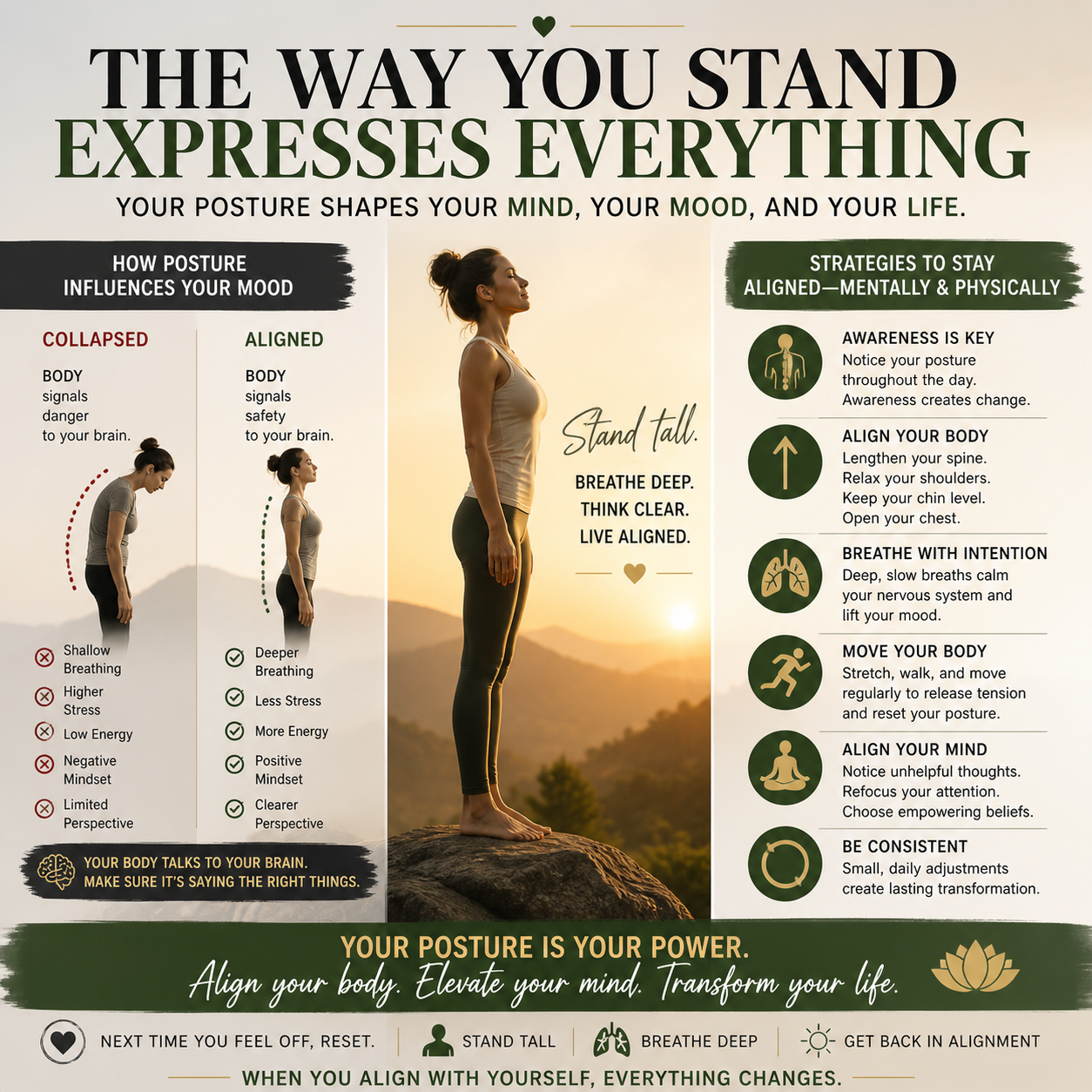
The way you stand expresses everything: How physical posture can influence mood states and strategies to keep yourself aligned, both mentally and physically.
The way you stand is never just physical. It is communication, not only to the world around you, but to your own mind. Before a single word is spoken, before a thought is fully formed, your body has already taken a position—and that position quietly shapes how you feel, how you think, and how you show up.
Posture is often dismissed as a matter of appearance, something corrected for aesthetics or etiquette. But beneath that surface lies something far more influential. The human body and mind are deeply interconnected, constantly exchanging signals in both directions. When you stand tall, your brain interprets that stance as readiness, confidence, and control. When you collapse inward, your nervous system reads it as withdrawal, uncertainty, even defeat. Over time, these signals don’t just reflect your state—they begin to define it.
Think about the last time you felt overwhelmed or discouraged. Chances are, your shoulders dropped, your gaze lowered, your chest tightened. Now consider moments when you felt capable, focused, or energized. Your spine likely lengthened, your breathing deepened, and your presence expanded. These are not coincidences. They are patterns wired into your biology.
Your posture influences your breathing, and your breathing influences your emotional regulation. A compressed posture restricts airflow, keeping breaths shallow and rapid, which can amplify stress responses. An open posture allows for fuller breaths, signaling safety to your brain and helping stabilize your mood. In this way, something as simple as lifting your chest or aligning your spine becomes a lever you can use to shift your internal state.
But the impact goes even deeper. The way you hold yourself affects how you perceive challenges and opportunities. When your body is aligned and grounded, your thinking tends to follow suit. You become more decisive, more present, and more capable of handling pressure. When your body is tense or collapsed, your thoughts often mirror that contraction, narrowing your perspective and limiting your sense of possibility.
Alignment, then, is not just physical—it is a full-system experience. It is the integration of body, mind, and intention.
To cultivate this alignment, awareness is the starting point. You don’t need to overhaul your posture all at once. Instead, begin by noticing. Notice how you sit when you’re working, how you stand when you’re waiting, how you carry yourself when you walk into a room. Awareness creates choice, and choice creates change.
From there, introduce small but deliberate adjustments. Lengthen your spine as if gently being pulled upward. Relax your shoulders without letting them collapse. Keep your chin level, allowing your gaze to meet the world directly. These are not rigid corrections but subtle shifts—signals to your body that you are present and engaged.
Equally important is the rhythm of movement. Staying aligned doesn’t mean staying still. The body thrives on motion. Regular stretching, walking, and mindful movement help release tension and reset posture naturally. When you move with intention, you reinforce the connection between physical alignment and mental clarity.
Mental alignment follows a similar principle. Just as the body can drift into unhelpful patterns, so can the mind. Thoughts of doubt, distraction, or negativity can pull you out of alignment just as easily as poor posture. The key is not to eliminate these thoughts entirely, but to notice them without becoming anchored to them. When you bring your attention back—whether through your breath, your posture, or your focus—you reestablish alignment.
There is also power in consistency. A single moment of standing tall can shift your mood briefly, but repeated moments build a new baseline. Over time, aligned posture and aligned thinking become your default rather than your exception. This is where transformation happens—not in dramatic gestures, but in steady, intentional practice.
What makes this especially powerful is that it is always available to you. No matter the environment, no matter the circumstances, you have the ability to adjust your posture, to take a deeper breath, to realign yourself in real time. It is a quiet form of control in a world that often feels unpredictable.
The way you stand truly does express everything, because it reflects the relationship you have with yourself. When you stand with intention, you send a message that you are grounded, capable, and ready. And as that message repeats, your mind begins to believe it, your actions begin to reflect it, and your life begins to align with it.
So the next time you find yourself drifting—physically or mentally—don’t underestimate the power of a simple reset. Straighten your spine. Open your chest. Breathe fully. In that moment, you’re not just adjusting your posture. You’re reclaiming your state, your focus, and your direction.
And that’s where lasting change begins.
Learn More