
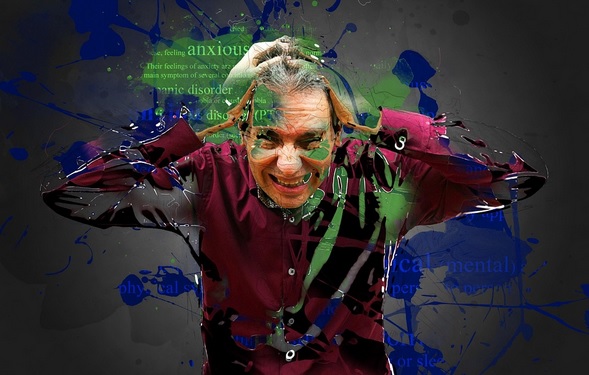
Why anxiety can make you fear happiness or calm and strategies on how to eliminate this fear with psychotherapy. Take control of your mental health with the right modality!
It sounds contradictory, but many people who struggle with anxiety are not only afraid of stress—they are afraid of calm. Moments of happiness, peace, or emotional stability can trigger discomfort, racing thoughts, or even panic. Instead of enjoying the quiet, the mind begins scanning for danger. Instead of embracing joy, the body tightens as if preparing for impact. If this has happened to you, you are not broken. You are conditioned.
Anxiety is not just an emotion; it is a survival response. Over time, when someone experiences chronic stress, trauma, unpredictability, or repeated disappointment, the nervous system adapts. It learns that vigilance equals safety. Hyperawareness becomes protective. Worry becomes preparation. Tension becomes readiness. When this pattern is repeated long enough, the brain wires itself to believe that staying on guard prevents pain.
The problem is that once the nervous system is trained to operate in survival mode, calm feels unfamiliar. And what is unfamiliar often feels unsafe. If your body has spent years bracing for impact, relaxation can feel like vulnerability. The silence after chaos can feel suspicious. Peace can feel like “the calm before the storm.” The mind may whisper, “Something bad is about to happen,” simply because things are going well.
There is also a phenomenon known as fear of positive emotion. For some individuals, happiness in the past was followed by loss, criticism, betrayal, or trauma. The brain connects joy with danger, not because joy is dangerous, but because it was once paired with pain. If you allowed yourself to feel hopeful and were later hurt, your system may have concluded that hope is risky. Anxiety then steps in as a shield. It dulls excitement. It questions good news. It creates “what if” scenarios. It believes it is protecting you from future disappointment.
Control plays another powerful role. Anxiety gives an illusion of control. When you worry, you feel like you are preparing. When you analyze every possible outcome, you feel proactive. Calm, however, requires surrender. It requires trusting the present moment without rehearsing catastrophe. For someone accustomed to controlling outcomes through hypervigilance, letting go can feel terrifying. The mind may think, “If I stop worrying, I’ll miss something important.” This belief keeps the anxiety cycle intact.
Neurologically, this makes sense. The amygdala, the brain’s alarm system, becomes hypersensitive with chronic anxiety. It scans constantly for threats, even neutral or positive ones. Meanwhile, the prefrontal cortex, responsible for rational thinking and emotional regulation, can become overridden by survival responses. The body reacts before logic has a chance to intervene. This is why anxiety during happy moments feels automatic and difficult to control.
Psychotherapy is powerful because it addresses both the cognitive patterns and the physiological conditioning behind this fear. It does not simply tell you to “relax.” It helps retrain your entire system to experience safety again.
One of the first steps in therapy is psychoeducation. Understanding how anxiety works reduces secondary fear. When you learn that your nervous system is reacting out of habit—not because danger is present—you begin separating sensation from reality. Knowledge alone can reduce intensity because the unknown becomes understood.
Cognitive-based therapies help uncover the unconscious beliefs driving fear of calm. Thoughts such as “If I’m happy, something bad will follow,” “I don’t deserve peace,” or “Relaxing makes me weak” are brought into awareness. These beliefs are not criticized; they are explored. Where did they originate? What experiences shaped them? Are they still accurate today? Through restructuring and reframing, the brain gradually adopts healthier interpretations.
For individuals whose anxiety is rooted in trauma or chronic stress, somatic and trauma-informed approaches are essential. Anxiety is not only stored in thoughts; it is stored in the body. Muscle tension, shallow breathing, digestive issues, and sleep disturbances are all signs of a system stuck in survival mode. Therapeutic modalities that focus on body awareness, breath regulation, and gradual nervous system recalibration allow calm to be introduced slowly and safely. The goal is not forced relaxation but regulated safety.
Exposure-based strategies are also useful, but in a nuanced way. Instead of exposing someone to feared external situations, therapy can involve exposure to positive internal states. For example, practicing sitting with calm for short periods and noticing the urge to escape. Gradually increasing tolerance for peaceful sensations teaches the nervous system that nothing catastrophic happens when you relax. This builds emotional resilience.
Mindfulness-based therapies help individuals observe anxious thoughts without immediately reacting to them. Rather than fighting the thought “This won’t last,” you learn to notice it as a mental event, not a prophecy. Over time, this decreases the brain’s reactivity and increases emotional flexibility.
For some clients, deeper work involves identity reconstruction. When anxiety has been present for many years, it can become part of self-concept. You may unconsciously believe that being vigilant is who you are. Therapy helps separate identity from symptoms. You are not your anxiety; you are someone who developed anxiety as an adaptive response.
The process of eliminating fear of happiness does not happen overnight. It requires consistency, patience, and the right modality tailored to your history and nervous system. However, the brain is neuroplastic. It can rewire. Patterns learned through repetition can be unlearned through new repetition. Each time you allow yourself to experience calm without fleeing into worry, you are reshaping neural pathways.
Taking control of your mental health means recognizing that anxiety is not a life sentence. It is a pattern that can be reconditioned. The right psychotherapeutic approach provides structure, safety, and strategy. Whether through cognitive modalities, trauma-focused therapy, somatic work, or integrative approaches, the key is alignment with your specific needs.
Happiness is not a threat. Calm is not a warning sign. Peace does not mean you are unprepared. With effective psychotherapy, you can retrain your mind and body to interpret safety as safety. You can learn that joy does not need to be braced for, and quiet moments do not need to be questioned. When your nervous system feels secure, you no longer fear losing happiness—you learn how to sustain it.

dr.dan
Related Posts

Why do some people live to eat while others, eat to live? The intricacies of food addiction.
There are many food lovers out there enjoying a good meal with friends,...

Numerous strategies to cope with ongoing gaslighting from loved ones and those you care about when facing constant emotional manipulation and distortion of reality.
Experiencing gaslighting from someone you care about can be profoundly...

Facts About Anxiety Disorders That You Need To Know
Anxienty disorders is something typical to feel when somebody faces what is...
The many faces of Trauma: The many strategies in building coping skills for trauma triggers. Not ONE solution fits all!
Trauma can have a profound and lasting impact on an individual’s mental,...