
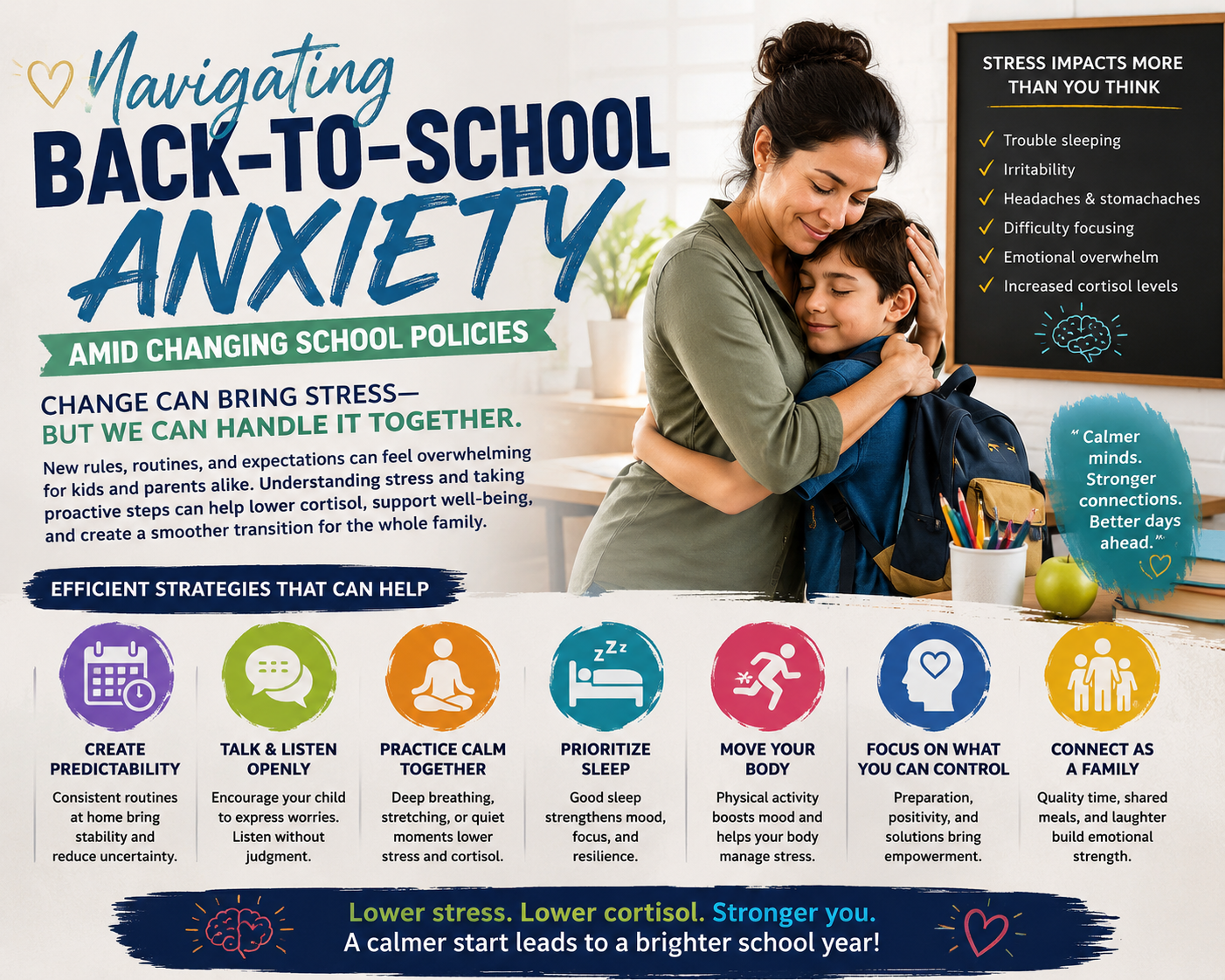
Navigating back-to-school anxiety amid changing school policies. Imminent changes that can bring stress to kids and parents and knowing what to do to reduce the levels of cortisol in your body. Efficient strategies that can help you for school year 2026-2027.
The return to school can be an exciting time filled with new opportunities, friendships, and personal growth, but it can also create anxiety for both children and parents. Changes in school policies, schedules, classroom expectations, transportation, technology, academic requirements, or safety procedures can make an already stressful transition feel even more uncertain. For children, changes to familiar routines may create feelings of fear, confusion, or frustration. For parents, concerns about how their children will adjust can lead to worry, sleepless nights, and emotional exhaustion. Understanding how stress affects the mind and body can help families approach the new school year with greater confidence and resilience.
One of the body’s primary responses to stress involves the release of cortisol, a hormone that plays an important role in helping us respond to challenges. Cortisol itself is not harmful; in fact, it is essential for maintaining energy, alertness, and an appropriate response to stressful situations. The concern arises when stress becomes prolonged and the body remains in a heightened state of alertness without enough opportunities for recovery. When children or adults experience ongoing worry, uncertainty, poor sleep, emotional pressure, and constant stimulation, they may begin to feel mentally and physically overwhelmed. The objective should not be to eliminate cortisol, because that is neither realistic nor desirable. Instead, the goal is to develop healthy habits that help the body regulate its stress response and return to a calmer state.
One of the most effective ways to manage back-to-school anxiety is to create a sense of predictability at home. When many things outside the home are changing, a consistent family routine can provide a powerful feeling of stability. Regular sleep and wake times, predictable meals, preparation for the next day, designated homework periods, family conversations, and opportunities for relaxation can help children feel more secure. Children do not need every moment of their day controlled, but knowing what to expect can reduce uncertainty and make transitions easier. A stable home environment can become an emotional anchor when other parts of life feel unpredictable.
Communication is equally important. Parents should create opportunities for children to talk openly about what they are experiencing without immediately dismissing their concerns or trying to fix everything. A child who says, “I don’t want to go back to school,” may not simply be expressing dislike. They may be worried about making friends, dealing with academic pressure, adjusting to a new teacher, being separated from their parents, or dealing with changes they do not fully understand. Instead of responding with, “Don’t worry, everything will be fine,” parents can ask, “What part of going back to school worries you the most?” This simple question can open the door to a much deeper conversation and help identify what is actually causing the anxiety.
Parents should also be mindful of how they communicate their own concerns. Children are extremely sensitive to the emotional states of the adults around them. If parents constantly express fear, frustration, or uncertainty about school changes, children may interpret those emotions as evidence that something dangerous is happening. This does not mean parents should hide their feelings or pretend that everything is perfect. Instead, parents can model healthy emotional regulation by saying something like, “I know there are some changes this year, and I have questions too. We will learn what we need to know and figure things out together.” This teaches children that uncertainty does not automatically mean danger and that difficult situations can be approached calmly and constructively.
Another important strategy is helping children distinguish between what they can control and what they cannot. School policies, decisions made by administrators, the behavior of other students, and unexpected changes are not always within a family’s control. Spending excessive time worrying about these things can increase stress without producing a solution. Instead, families can focus on the areas they can influence, such as preparing school supplies, establishing routines, communicating with teachers, maintaining healthy sleep habits, and helping children develop problem-solving skills. A useful question for both parents and children is, “Is there something I can do about this right now?” If the answer is yes, take an appropriate action. If the answer is no, learning to accept the uncertainty can prevent unnecessary emotional exhaustion.
Physical health also plays an important role in managing stress. Adequate sleep, regular physical activity, proper hydration, and balanced nutrition can support the body’s ability to cope with daily challenges. When children are tired, hungry, dehydrated, or physically inactive, they may have greater difficulty regulating their emotions and concentrating. The same is true for parents. A parent who is constantly exhausted and running on caffeine may have less emotional capacity to respond calmly to a child’s anxiety. Establishing healthy routines before school begins can therefore benefit the entire family.
Breathing and relaxation techniques can also help individuals manage moments of heightened anxiety. Slow, comfortable breathing with a slightly longer exhale can encourage the body to shift away from a heightened stress response. Parents can practice these techniques with their children rather than presenting them as something the child needs to do because they are “anxious.” Taking several slow breaths together, stretching, going for a walk, listening to calming music, or spending a few quiet minutes together can become simple family rituals that promote emotional regulation.
It is also important to teach children that experiencing anxiety does not mean they are incapable of handling a situation. Sometimes adults unintentionally reinforce anxiety by trying to eliminate every uncomfortable experience for their children. While protecting children is a natural parental instinct, children also need opportunities to develop confidence through manageable challenges. Allowing them to solve age-appropriate problems, communicate with teachers, make decisions, recover from mistakes, and experience normal frustrations can help them discover that they are more capable than they may initially believe. Resilience develops when people learn that discomfort is something they can move through rather than something they must always avoid.
Parents can further help children by teaching them how to challenge catastrophic thinking. Anxiety often focuses on the worst possible outcome. A child might think, “What if nobody likes me?” or “What if I can’t do the work?” Instead of simply saying, “That won’t happen,” parents can help the child consider what they would do if the challenge occurred. They might discuss how the child could approach a classmate, ask a teacher for assistance, seek support from a counselor, or practice a difficult academic skill. This shifts the focus from predicting disaster to developing confidence in one’s ability to respond. The message becomes, “We don’t know exactly what will happen, but we know that we can figure things out.”
Parents should also be careful about consuming too much information about school changes. During uncertain periods, it is natural to repeatedly check emails, social media, school announcements, and online discussions. However, constantly monitoring information can sometimes increase anxiety rather than reduce it. Families can establish reasonable times to review school communications and then return their attention to everyday life. Being informed is valuable, but being consumed by information can keep the brain in a constant state of alertness.
Perhaps one of the most important lessons for families is that stress cannot always be avoided. The goal is not to create a completely stress-free childhood or a perfectly predictable school year. Instead, the goal is to develop the emotional skills necessary to navigate uncertainty. Children need to learn that they can experience nervousness and still move forward. Parents need to recognize that they do not have to know every answer immediately. Families need to understand that change can be uncomfortable without necessarily being harmful.
Back-to-school anxiety can therefore become an opportunity for growth. Instead of viewing every challenge as something that must be eliminated, families can use these experiences to teach emotional awareness, communication, problem-solving, resilience, and self-regulation. When children see their parents responding to uncertainty with patience and confidence, they learn that they too can face difficult situations without becoming overwhelmed by them.
If anxiety becomes persistent or begins to significantly interfere with a child’s ability to attend school, sleep, eat, socialize, concentrate, or function normally, professional support may be appropriate. The same applies to parents whose own anxiety becomes overwhelming or interferes with their daily lives. Seeking support is not a sign of weakness; it can be an important step toward developing healthier coping strategies.
As another school year begins, families should remember that they cannot control every policy, decision, change, or challenge that may arise. What they can control is how they prepare, how they communicate, how they care for their physical and emotional well-being, and how they respond when uncertainty appears. The ultimate goal is not to eliminate stress or cortisol from our lives, but to teach ourselves and our children how to move from stress back toward balance.
We cannot always control what changes around us, but we can learn to control how we respond to those changes. And sometimes, the greatest lesson a new school year can teach us is that we are far more capable of handling change than we ever realized.
Learn More
Substance abuse in marriage: Healthy and effective ways to address the challenges of addiction while keeping family dynamic intact. How can couples counseling can help navigate through these hurdles!
Substance abuse within a marriage is rarely an isolated issue; it is a deeply layered challenge that affects emotional connection, communication, trust, and the overall stability of the family system. Addiction does not exist in a vacuum. It reshapes daily interactions, influences decision-making, and often introduces unpredictability into what should be a space of safety and partnership. Over time, both partners can find themselves caught in patterns that feel impossible to escape—one struggling with dependency, the other struggling with how to respond, support, or protect themselves and the family.
In many relationships, substance abuse gradually shifts roles and responsibilities. The non-using partner may take on more control, attempting to compensate for instability, while the partner struggling with addiction may withdraw, become defensive, or experience shame. This imbalance can lead to resentment, emotional fatigue, and a breakdown in mutual respect. Trust, once compromised, becomes one of the most difficult elements to rebuild. Broken promises, secrecy, and repeated disappointments can leave lasting emotional wounds that do not simply disappear once substance use is reduced or stopped.
At the same time, it is important to recognize that addiction is not solely a matter of willpower. It is often connected to underlying emotional pain, unresolved trauma, stress, or mental health challenges. When couples begin to understand this, the dynamic can shift from one of blame to one of awareness. This does not excuse harmful behavior, but it creates a more productive foundation for addressing it. Acknowledging the deeper roots of substance use allows both partners to approach the issue with greater clarity and intention.
Healthy and effective ways to address substance abuse in marriage require both structure and compassion. Open communication becomes a cornerstone, but it must be intentional and constructive. Conversations should focus on expressing feelings and needs rather than assigning fault. This helps reduce defensiveness and creates space for honest dialogue. At the same time, boundaries are essential. Boundaries are not about punishment; they are about protection. They define what is acceptable within the relationship and help maintain a sense of stability, especially when behaviors become unpredictable or harmful.
Another key element is consistency. Change does not happen overnight, and recovery is often a nonlinear process. There may be progress followed by setbacks, and both partners need to be prepared for this reality. Developing routines that support stability—such as regular check-ins, shared responsibilities, and healthy habits—can provide a sense of grounding. These routines help rebuild a sense of normalcy within the family and reinforce a shared commitment to moving forward.
Equally important is the ability to separate the person from the addiction. When a partner is struggling with substance use, their behavior may not reflect their true intentions or values. Holding onto the distinction between the individual and the addiction can prevent the relationship from becoming defined solely by the problem. This perspective allows for accountability without stripping away empathy, which is critical for long-term healing.
Couples counseling offers a structured and supportive environment to navigate these complexities. It brings both partners into the healing process, rather than isolating the issue to one individual. This shared approach can significantly reduce feelings of loneliness and misunderstanding that often arise in relationships affected by addiction. Within therapy, couples are guided to identify patterns that may be contributing to the cycle of substance use and conflict, and they are equipped with tools to interrupt those patterns.
One of the most powerful aspects of couples counseling is its focus on communication. Many couples dealing with substance abuse fall into cycles of criticism, defensiveness, or avoidance. Therapy helps replace these patterns with more effective ways of expressing needs and listening to one another. Learning how to communicate without escalating conflict can reduce emotional triggers that might otherwise contribute to relapse or further disconnection.
In addition to communication, counseling emphasizes rebuilding trust through consistent, observable actions. Trust is not restored through words alone; it is rebuilt through reliability, honesty, and follow-through over time. Therapists often help couples set realistic expectations, allowing trust to develop gradually rather than expecting immediate repair. This process can be challenging, but it is essential for restoring a sense of safety within the relationship.
Counseling also addresses the emotional toll that addiction takes on both partners. The individual struggling with substance use may experience guilt, shame, or fear of failure, while the other partner may carry feelings of anger, hurt, or helplessness. Providing space for both experiences to be acknowledged is crucial. When both partners feel heard and validated, it becomes easier to move forward without being anchored to past pain.
Beyond the couple itself, the family dynamic must also be considered. Children, if present, are often deeply affected by substance abuse, even if it is not openly discussed. Maintaining a stable and supportive environment for them requires intentional effort. This includes minimizing exposure to conflict, providing reassurance, and modeling healthy coping strategies. Couples counseling can help parents align on how to support their children while also addressing their own challenges.
Recovery within a marriage is not just about eliminating substance use; it is about redefining the relationship. It involves creating new patterns of interaction, rediscovering shared values, and rebuilding a sense of partnership. This process can lead to a stronger and more resilient connection, one that is rooted in honesty, mutual support, and a deeper understanding of one another.
There will be moments of difficulty, and progress may feel slow at times. However, the willingness to confront the issue together, to seek support, and to remain committed to growth can transform even the most strained relationships. When both partners engage in the process with intention, it becomes possible not only to address the challenges of addiction but to emerge from them with a renewed sense of strength and unity.
A marriage tested by substance abuse carries the weight of hardship, but it also holds the potential for profound transformation. With patience, structure, and the right support, couples can move beyond survival and begin to build a relationship that is healthier, more stable, and deeply connected.
Learn More
The ONE of many challenges in Parenting: The art of active listening with teenage kids and create healthy and engaging conversations within family dynamics. The do’s and don’ts of interactions.
Parenting teenagers is often considered one of the most rewarding yet simultaneously challenging stages in family life. Adolescence is a period of tremendous growth, exploration, and self-discovery, but it is also a time of emotional turbulence, evolving social pressures, and an intensified need for independence. For many parents, these changes can feel overwhelming, leaving them uncertain about how to connect meaningfully with their children. Among the numerous challenges that arise during this stage, one skill stands out as both essential and transformative: the art of active listening. Mastering this skill allows parents to create healthy, engaging conversations, maintain strong family bonds, and navigate the complexities of adolescent life with empathy and understanding.
Active listening is far more than simply hearing words. It involves fully engaging with a child’s thoughts, emotions, and intentions, showing genuine interest, and responding in ways that convey understanding. Teenagers are particularly sensitive to whether they are being truly heard or simply tolerated. When parents practice active listening, they demonstrate that their child’s perspective is valued and respected. This acknowledgment fosters trust, encourages openness, and makes it more likely that a teenager will seek guidance or share difficult experiences rather than withdraw in silence or act out through rebellious behavior. Active listening also helps parents understand the root causes of certain behaviors, enabling more thoughtful and effective responses to challenges such as mood swings, conflicts with peers, or academic pressures.
Creating an environment that encourages active, meaningful communication requires careful attention to family dynamics. Parents must cultivate patience, empathy, and emotional intelligence, recognizing that a teenager’s feelings are valid even if their perspective differs from an adult’s. Engaging in conversations with curiosity rather than judgment can transform ordinary exchanges into opportunities for connection. Asking questions that invite reflection, rather than simply eliciting yes or no responses, encourages adolescents to think critically and express themselves more fully. Statements that reflect understanding and empathy, such as acknowledging frustration or validating disappointment, communicate care far more effectively than immediate advice or criticism.
However, the path to effective communication is fraught with potential pitfalls. One of the most common mistakes parents make is dismissing or minimizing their teenager’s emotions. Phrases like “You’re overreacting” or “It’s not a big deal” can unintentionally communicate that their feelings are unimportant, which may lead to withdrawal or resentment. Interrupting a teen mid-sentence, responding with impatience, or immediately attempting to solve a problem can similarly shut down dialogue. Parents must resist the urge to dominate conversations or impose solutions prematurely. Likewise, sarcasm, judgment, or belittling humor can have lasting negative effects on a child’s willingness to communicate openly. By consciously avoiding these behaviors, parents create a space where teens feel safe, respected, and empowered to express themselves.
Active listening also involves recognizing nonverbal cues and emotional undercurrents. Often, teenagers communicate as much through body language, tone, and facial expressions as through their words. Parents who observe these signals and respond thoughtfully are better equipped to understand the full context of a child’s feelings. This attentiveness demonstrates that the parent is fully present, not merely performing a superficial check-in, and reinforces the message that the teenager’s inner world matters.
Another key aspect of effective communication is modeling healthy dialogue. Parents who actively listen, respond empathetically, and express their own thoughts and emotions constructively teach adolescents the skills they need for future relationships. This modeling includes demonstrating patience, using reflective language, and showing that disagreements can be navigated respectfully without escalating into conflict. By witnessing these interactions firsthand, teenagers learn to communicate with self-awareness, respect, and emotional intelligence—skills that will serve them long after they leave the family home.
Importantly, active listening is not a one-time effort but a consistent practice. Family dynamics thrive when parents make conscious, repeated efforts to engage in meaningful dialogue. This involves not only listening during moments of conflict but also during everyday interactions—talking about school, friendships, hobbies, or current events. Regular, thoughtful conversations help normalize open communication, build trust, and reduce the emotional distance that often grows between parents and teenagers. Over time, these interactions contribute to a more cohesive, resilient family unit, capable of navigating challenges together rather than in isolation.
Finally, the benefits of active listening extend far beyond immediate conflict resolution. Teens who feel heard are more likely to develop strong self-esteem, resilience, and emotional regulation. They are more willing to seek guidance, discuss difficult topics such as mental health or risky behaviors, and collaborate with their parents in problem-solving. For parents, the rewards are equally significant: deeper connections, reduced misunderstandings, and the satisfaction of nurturing a healthy, thriving family dynamic.
While parenting teenagers is undeniably challenging, active listening emerges as one of the most powerful tools in fostering meaningful communication and strong family relationships. By fully engaging with their children, validating emotions, avoiding judgment, and modeling constructive dialogue, parents create an environment where teenagers feel supported, understood, and empowered. The art of active listening transforms everyday conversations into opportunities for connection, growth, and mutual respect, enabling families to navigate the complexities of adolescence together. It is through this intentional practice that parents can turn the challenges of teenage years into meaningful opportunities for lasting bonds and enduring understanding.
Learn More