
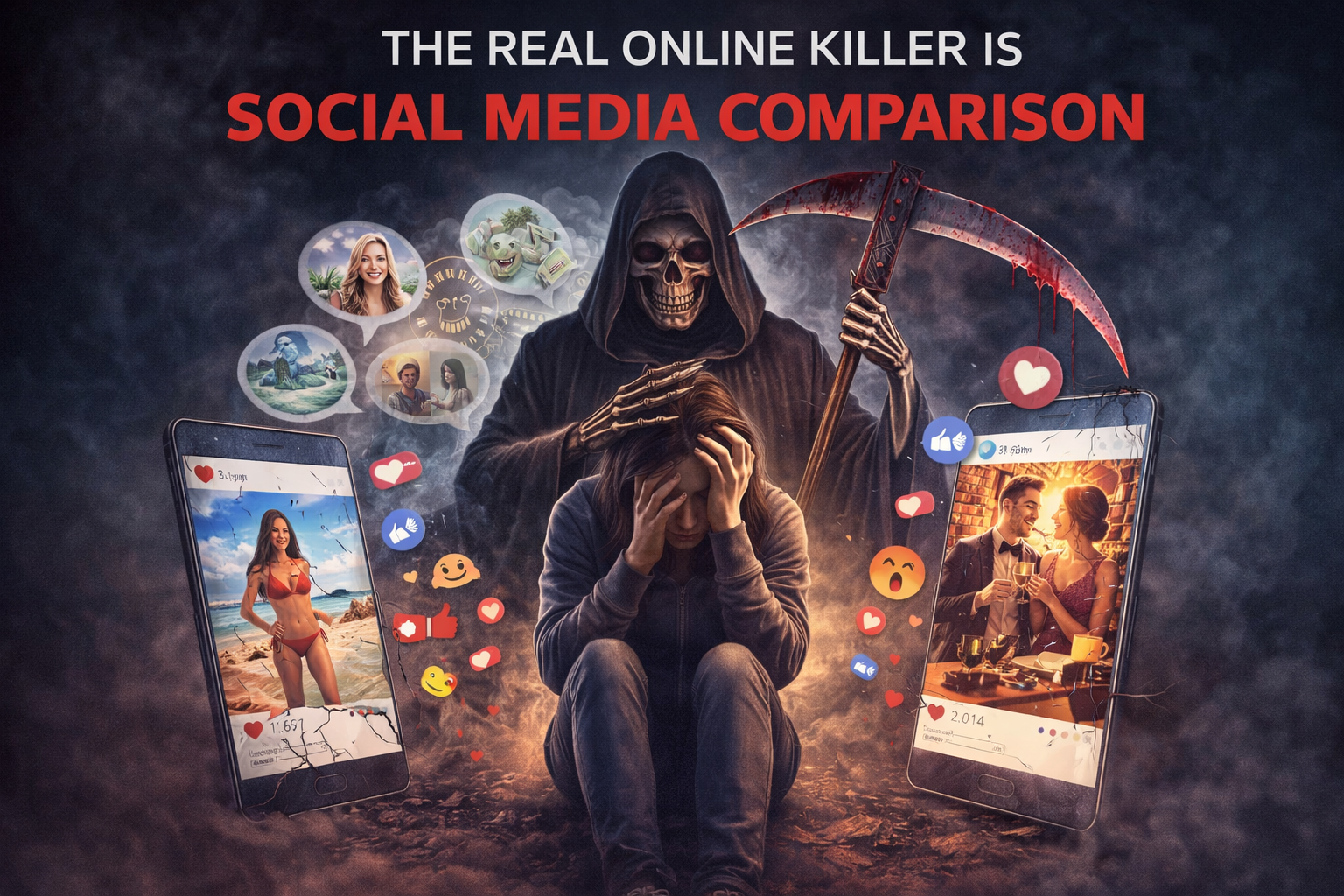
The real ONLINE psychological killer: Social media comparison: How anxiety therapy can assist people comparing themselves to fake online social media successes. Social media DETOX is a must.
The phenomenon often referred to as the “real online killer”—social media comparison—can be most effectively understood through the framework of Social Comparison Theory, originally proposed by Leon Festinger. This theory explains that individuals possess an inherent drive to evaluate themselves, often in relation to others, particularly when objective standards are absent. In the context of social media, this natural psychological tendency becomes amplified and distorted due to the highly curated, filtered, and performative nature of online identities. What individuals are comparing themselves to is not reality, but an edited projection of success, beauty, and happiness, carefully constructed to maximize social approval.
This dynamic fosters a persistent pattern of upward social comparison, in which individuals measure themselves against those they perceive as more successful or fulfilled. Unlike balanced real-world comparisons, social media disproportionately exposes users to highlight reels—vacations, achievements, relationships, and aesthetic ideals—while concealing struggle, failure, and emotional complexity. This asymmetry creates a skewed cognitive environment that reinforces maladaptive beliefs such as “I am not enough,” “I am behind,” or “Everyone else has it figured out.” These beliefs are rooted in cognitive distortions, including selective abstraction, overgeneralization, and catastrophizing, which collectively distort an individual’s perception of self and reality.
Over time, repeated engagement in these distorted comparisons can activate and strengthen negative core schemas, particularly those related to inadequacy, rejection, and unworthiness. These schemas operate at a deep, often unconscious level, influencing emotional responses and behavioral patterns. Individuals may begin to experience chronic self-doubt, diminished self-esteem, and a heightened sensitivity to perceived social evaluation. In more severe cases, this can contribute to the development or exacerbation of anxiety-related conditions, including Generalized Anxiety Disorder and social anxiety, characterized by persistent worry, hypervigilance, and physiological symptoms such as restlessness, muscle tension, and difficulty concentrating.
From a neurobiological standpoint, social media platforms are designed to exploit the brain’s reward circuitry, particularly the dopaminergic system. Intermittent reinforcement—through likes, comments, and shares—creates a variable reward schedule similar to that seen in gambling behaviors. This unpredictability strengthens compulsive engagement, as users repeatedly check their devices in anticipation of social validation. However, this external reinforcement gradually shifts the individual’s locus of self-worth from internal to external sources, making self-esteem increasingly contingent upon digital feedback. The result is a fragile and unstable sense of identity that fluctuates based on perceived online approval.
Additionally, the constant exposure to idealized images and lifestyles can lead to identity diffusion, particularly among individuals in formative developmental stages. Rather than cultivating an authentic sense of self, individuals may begin to model their identity based on external templates, striving to replicate what is socially rewarded online. This process can create internal conflict, as the “performed self” diverges from the “experienced self,” leading to emotional dissonance, dissatisfaction, and a sense of inauthenticity.
Therapeutic intervention plays a critical role in addressing the psychological impact of social media comparison. Approaches grounded in Cognitive Behavioral Therapy are particularly effective in targeting the cognitive and behavioral mechanisms underlying this phenomenon. CBT focuses on identifying and restructuring maladaptive thought patterns, helping individuals challenge the validity of their comparisons and reframe their interpretations of online content. For example, clients are guided to recognize that social media posts represent selective self-presentation rather than objective reality, thereby reducing the emotional intensity associated with upward comparison.
Beyond cognitive restructuring, therapy also emphasizes the development of metacognitive awareness—the ability to observe one’s thoughts without becoming fully identified with them. This awareness allows individuals to disengage from automatic comparison processes and cultivate a more balanced and compassionate self-perspective. Techniques such as mindfulness-based interventions further support emotional regulation by grounding individuals in the present moment and reducing rumination on perceived inadequacies.
A social media detox emerges as a crucial behavioral intervention within this framework. From a psychological standpoint, detoxification functions as a form of stimulus control, reducing exposure to triggers that perpetuate comparison and emotional distress. By intentionally limiting or eliminating social media use for a defined period, individuals create space for cognitive recalibration and emotional recovery. This process allows the nervous system to stabilize, decreases reliance on external validation, and encourages the reestablishment of intrinsic sources of self-worth.
Importantly, a detox is not merely about avoidance, but about intentional re-engagement with one’s internal world. During this period, individuals are encouraged to reconnect with values, goals, and activities that foster a sense of competence, autonomy, and authenticity. This aligns with principles from self-determination theory, which emphasizes the importance of intrinsic motivation in psychological well-being. As individuals shift their focus from external comparison to internal alignment, they begin to rebuild a more stable and resilient sense of identity.
To put it in layman terms, social media comparison happens because of a mix of how we think, how we feel, and how social media is designed to keep us engaged. The platforms themselves aren’t the real problem, but the way they highlight perfect, edited moments can make our natural habits—like comparing ourselves—much stronger and more harmful. This can slowly affect how we see ourselves and lower our confidence or happiness.
Fixing this isn’t just about one change—it takes a few things working together. It means becoming aware of your thoughts, learning how to manage your emotions, and changing certain habits, like how often or why you use social media. With support, like therapy, and by taking intentional breaks from social media, people can step out of the constant comparison cycle. Over time, this helps them reconnect with who they truly are, build real confidence, and develop a healthier relationship with both themselves and the online world.

dr.dan
Related Posts

The dangers of FOMO (Fears Of Missing Out). How to not fall into that trap and find happiness in life.
If you all recall the events that transpired during the peak of the pandemic in...

Discover yourself through various opportunities to attain professional success by managing episodes of anxiety through positive rituals and healthy long term habits.
In the journey toward your professional aspirations, it's important to...

Power of meditation: Can meditation help you reduce the symptoms of anxiety and what are the long term benefits of such a practice?
Meditation has emerged as a powerful tool in managing and reducing the symptoms...

The many ugly faces of trauma. How past traumatic events and circumstances can disrupt motivation and follow-through. Effective strategies to bypass these challenges
Trauma rarely announces itself in obvious ways. While many people associate...