

Behind the Mask: Understanding a Child’s Struggle at School When Pretending Everything Is Fine at Home Is No Longer Possible—and How Parents Can Recognize the Warning Signs and Take Meaningful Action to Help.
For many parents, discovering that their child is struggling at school can come as a painful surprise. A child may come home, eat dinner, laugh with the family, complete their usual routine, and appear perfectly fine, while internally carrying anxiety, loneliness, academic pressure, bullying, social rejection, learning difficulties, or the growing feeling that they simply cannot keep up. Children do not always have the emotional vocabulary to explain what they are experiencing, so instead, they may become remarkably good at hiding it. They may say, “School was fine,” when it wasn’t. They may smile when they feel overwhelmed, insist that they are not worried when they are, or act as though nothing bothers them because they do not want to disappoint their parents.
Sometimes, this façade is not intentional deception. It can be a child’s way of protecting themselves. A child may believe that admitting they are struggling will make their parents disappointed, angry, worried, or frustrated. They may fear being judged by teachers or classmates, or they may simply lack the ability to explain what they are feeling. Over time, they can learn to separate their outside behavior from their internal experience. At school, they may try to appear confident, funny, independent, or unaffected. At home, they may continue maintaining the same image because they do not know how to admit that something is wrong.
The psychological burden of maintaining that façade can become enormous. Imagine carrying a heavy backpack throughout the school day while pretending that it weighs nothing. At first, a child may be able to manage it. But eventually, another difficult assignment, disappointing grade, conflict with a friend, critical comment from a teacher, or stressful interaction can become the extra weight that pushes them toward emotional exhaustion. The child may begin showing changes that parents initially interpret as attitude or defiance. They may become unusually quiet, irritable, emotional, distracted, withdrawn, or resistant to school. Homework may suddenly become a nightly battle. A child who once enjoyed talking about school may stop mentioning it altogether. They may complain about headaches or stomachaches, struggle to sleep, lose interest in activities they once enjoyed, or become increasingly anxious the night before school.
These behaviors should not automatically be interpreted as laziness, defiance, attention-seeking, or a lack of discipline. Sometimes behavior is communication. A child who cannot say, “I am overwhelmed and I don’t know how to handle this,” may communicate through avoidance. A child who cannot say, “I am afraid other students will make fun of me,” may suddenly refuse to go to school. A child who feels academically incapable may stop trying because failing after making an effort can feel more painful than appearing not to care. In some cases, a child may unconsciously protect their self-esteem by convincing themselves that they did not really try. If they fail, they can tell themselves, “I could have done it if I had tried,” rather than confronting the more frightening belief that they tried their hardest and still could not succeed.
This can create a damaging psychological cycle. The child avoids an assignment because it creates anxiety, and the avoidance provides temporary relief. But the assignment remains unfinished, which creates additional academic pressure. Falling behind can then reinforce feelings of inadequacy, and those feelings make the next assignment even more intimidating. Eventually, the child can become trapped in a cycle of stress, avoidance, falling behind, shame, and even greater stress. Parents may understandably respond by pushing harder, saying things such as, “Why aren’t you doing your homework?” “You need to try harder,” or “You’re capable of doing better.” These statements usually come from love and concern, but when a child is already experiencing anxiety or shame, additional pressure can sometimes reinforce the belief that something is wrong with them. Instead of thinking, “I am having difficulty with this,” the child may begin thinking, “I am the problem.”
That distinction is extremely important. A child who understands that they are struggling with a specific problem can learn strategies to address it. A child who believes that they themselves are the problem may begin developing shame, low self-esteem, helplessness, and resistance to asking for help. This is why parents should try to become curious before becoming corrective. Rather than immediately asking, “Why aren’t you doing better?” parents can ask, “What has been feeling difficult lately?” Instead of assuming that their child is not trying, they can explore whether the child understands the material, feels comfortable in the classroom, is experiencing problems with peers, is being bullied, feels overwhelmed by expectations, has difficulty concentrating, or is afraid of disappointing someone.
Sometimes one of the most powerful messages a parent can give a struggling child is simply, “You don’t have to pretend everything is okay with me.” That statement creates emotional permission for the child to remove the mask. Children need to know that telling the truth about their struggles will not automatically result in punishment, disappointment, or judgment. They need to understand that their parents want to understand the problem rather than simply correct the behavior. This does not mean eliminating expectations or accountability. A child can still be responsible for completing schoolwork while receiving emotional support. They can be expected to treat others respectfully while being given the opportunity to explain when they feel excluded, bullied, or overwhelmed. They can be encouraged to improve academically without being made to believe that their grades determine their worth.
Parents should also pay close attention to changes from their child’s normal personality and behavior. A naturally quiet child and a child who has suddenly become withdrawn may be experiencing very different things. A child who has always struggled academically is different from a child whose grades suddenly begin declining. A child who occasionally complains about school is different from one who repeatedly develops physical complaints before school or becomes intensely distressed on Sunday evenings. Changes in sleep, appetite, concentration, energy, social interaction, emotional regulation, school attendance, and interest in activities can all provide important clues that something deserves closer attention.
Parents should also listen to the difference between what their child says and what their child does. A child may insist that everything is fine while their behavior communicates otherwise. Sometimes the body reveals what words cannot. Anxiety may appear through stomachaches, headaches, restlessness, difficulty sleeping, irritability, or avoidance. Sadness may appear through withdrawal, loss of motivation, or changes in behavior. Social difficulties may appear through a sudden reluctance to attend school or participate in activities. These signs do not automatically mean that a child has a mental-health disorder, but they can be signals that deserve compassionate attention rather than immediate judgment.
Creating an environment where children feel emotionally safe is one of the most important things parents can do. The goal is not to interrogate a child until they reveal what is wrong. The goal is to create enough trust that the child eventually feels comfortable talking. Some children open up during a direct conversation, while others may communicate more easily while riding in the car, eating dinner, walking, playing a game, or doing another activity. Some may find it easier to write their feelings down or talk to another trusted adult. There is no single correct doorway into a child’s emotional world.
Parents can also help children develop a stronger emotional vocabulary. A child may know that they feel terrible without understanding whether what they are experiencing is anxiety, embarrassment, loneliness, sadness, anger, fear, or frustration. Instead of asking only, “What’s wrong?” a parent might ask, “Do you feel worried, embarrassed, frustrated, lonely, angry, or overwhelmed?” Giving children language for their emotions can help them recognize what is happening internally and communicate their needs more effectively.
It is also important to consider what is happening within the school environment. A child’s struggle may have little to do with effort and much more to do with the circumstances surrounding them. Academic expectations, relationships with teachers, peer dynamics, bullying, social pressure, learning differences, classroom structure, and a child’s sense of belonging can all influence how they experience school. A child who feels accepted and supported is psychologically positioned very differently from one who spends every school day anticipating embarrassment, rejection, criticism, or failure.
Communication between parents and educators can therefore become an important part of understanding the bigger picture. Teachers may observe behaviors that parents never see, while parents may recognize emotional changes that teachers are unaware of. When these perspectives are shared respectfully, adults can develop a clearer understanding of what the child may be experiencing. The objective should not be to immediately blame the child, teacher, school, or parent. The objective should be to understand the circumstances and determine what kind of support the child needs.
Professional support may also be appropriate when a child’s difficulties persist, intensify, or significantly interfere with school, relationships, sleep, family life, or everyday functioning. A qualified mental-health professional can help explore whether the child’s difficulties may be associated with anxiety, depression, trauma, adjustment challenges, social difficulties, learning concerns, or other factors. Seeking support does not mean labeling a child as broken or incapable. It means taking the child’s emotional experience seriously and providing another layer of support when the family needs it.
Perhaps the most important message parents can communicate is that struggling does not make a child a failure. A difficult semester does not define intelligence. A poor grade does not determine potential. Being rejected by peers does not mean someone is unlikeable. Needing additional academic or emotional support does not mean a child is weak. Children are still developing their identities, and the messages they receive during difficult periods can become part of the story they eventually tell themselves about who they are.
If the message a child repeatedly receives is, “You are disappointing us,” they may internalize shame. But if the message is, “We know you’re capable, and we also want to understand what you’re going through,” the child may begin developing resilience, self-awareness, and the confidence to seek help. The difference is not simply in the words. It is in the emotional environment created around those words.
Parents cannot remove every challenge their children will encounter. They cannot prevent every difficult friendship, disappointing grade, embarrassing moment, stressful assignment, or challenging experience. What they can provide is a secure place where their child does not have to pretend. Because sometimes the most meaningful intervention is not immediately solving the problem. Sometimes it is recognizing that something has changed, sitting beside the child without judgment, listening carefully, and saying, “You don’t have to carry this alone. Let’s figure it out together.”
Behind every child’s behavior is a story that may not yet have been told. When parents become curious about that story instead of simply reacting to the behavior, they create an opportunity to understand what their child is truly experiencing. And when the mask finally comes off, what a struggling child often needs most is not criticism, pressure, or another lecture about doing better. They need someone willing to see them, listen to them, believe them, and remind them that struggling today does not determine who they can become tomorrow.
Learn More
Depression and Feeling “Behind” in Life: How Comparison Can Drain Your Joy—and How to Overcome These Emotional Mood Killers
Have you ever looked around at your life and felt as though everyone else is moving forward while you are standing still? Someone gets married, someone buys a home, a former classmate gets promoted, a friend starts a successful business, or someone you know seems to be traveling the world and living the life you wish you had. Meanwhile, you may find yourself asking, “What am I doing with my life?” or “Why am I not where I thought I would be by now?” These questions can become particularly painful when they are repeated often enough that they begin to shape the way you see yourself.
Comparison can be one of the biggest emotional mood killers because it can quietly transform another person’s success into evidence of our own perceived failure. Instead of appreciating our own journey, we become preoccupied with where we believe we should be. For someone experiencing depression, this pattern can become even more intense. Depression can influence the way we interpret ourselves, our circumstances, our accomplishments, and even our future. A temporary setback can begin to feel like proof that we are permanently falling behind. A missed opportunity can feel like a life sentence. A difficult season can begin to look like our entire story.
But there is something important we often forget: there is no universal timeline for a meaningful life.
Society can make it seem as though life comes with a predetermined schedule. We are expected to graduate by a certain age, establish a career, find a partner, get married, have children, purchase a home, build wealth, achieve professional success, and eventually retire comfortably. These may be meaningful goals for some people, but they are not universal deadlines. When we begin treating them as deadlines, we can start measuring our worth against an imaginary timetable. Instead of asking, “What do I want from my life?” we start asking, “Why don’t I have what everyone else has?”
That shift can have a powerful psychological effect. Feeling behind can create shame, frustration, anxiety, envy, hopelessness, and low self-esteem. Those emotions can then influence our behavior. We may withdraw from people, stop pursuing opportunities, avoid social situations, lose motivation, or convince ourselves that trying is pointless. The result can become a self-reinforcing cycle: we compare ourselves to others, feel inadequate, experience emotional distress, withdraw from life, experience fewer positive opportunities, become even more discouraged, and then compare ourselves even more.
Human beings naturally compare themselves with others. Social comparison is a normal part of how we evaluate ourselves and understand where we stand within the world around us. Comparison isn’t always negative. Seeing someone accomplish something we admire can motivate us to pursue our own goals. The problem begins when inspiration turns into self-condemnation.
There is a tremendous psychological difference between saying, “They accomplished something I would like to accomplish,” and saying, “They accomplished something I haven’t accomplished, therefore I must be failing.” The first thought creates possibility. The second creates shame. The event is the same, but the interpretation is completely different.
Social media has made this challenge even more complicated. Every day, we are exposed to carefully selected images of other people’s careers, relationships, vacations, homes, bodies, businesses, accomplishments, and lifestyles. We can scroll through hundreds of examples of people appearing happy, successful, wealthy, loved, healthy, and fulfilled. But we rarely see the complete story behind those images.
We may see the promotion without seeing the years of rejection that preceded it. We may see the wedding without seeing the relationship struggles. We may see the beautiful vacation without seeing the financial stress. We may see the successful business without seeing the failed ventures, sleepless nights, uncertainty, and sacrifices that came before the success. In other words, we often compare our behind-the-scenes with someone else’s highlight reel.
That is an unfair comparison.
Depression can make this pattern even more damaging because it can influence how we process information. A person struggling with depression may naturally focus more heavily on perceived shortcomings while minimizing accomplishments and positive experiences. Thoughts such as “I should be further along,” “Everyone is doing better than me,” “I wasted too much time,” “I missed my opportunity,” or “Maybe I will never get where I want to be” can begin to feel like objective facts. But a thought is not automatically a fact.
One of the most valuable psychological skills we can develop is the ability to examine our thoughts rather than automatically believe them. When you catch yourself thinking, “I’m behind in life,” pause and ask, “According to whose timeline?” That simple question can challenge an assumption that may have been controlling your emotions for years.
People develop at different speeds because people live different lives. Some discover their career direction in their twenties, while others find their calling much later. Some find meaningful relationships early, while others experience love after years of personal growth. Some achieve financial success quickly, while others spend decades building stability. Some know exactly what they want, while others need several wrong turns before discovering what genuinely matters to them.
Different does not automatically mean deficient.
Your circumstances, experiences, opportunities, challenges, values, decisions, relationships, and starting point are different from everyone else’s. Therefore, expecting your life to follow someone else’s timeline is often a recipe for unnecessary disappointment.
Another important psychological trap is allowing achievements to determine our self-worth. Your salary is not your worth. Your relationship status is not your worth. Your job title is not your worth. Your number of followers is not your worth. Your house, car, possessions, business, or bank account do not determine your value as a human being.
Goals matter. Achievement matters. Growth matters. But self-worth and achievement are not the same thing.You can fail at something without being a failure. You can experience rejection without being unworthy. You can be temporarily lost without being permanently lost. You can be struggling financially without being a failure as a person. You can be single without being incomplete. You can be rebuilding your life without being behind.One of the most effective ways to reduce unhealthy comparison is to change the person you are comparing yourself with. Instead of constantly asking, “Am I doing as well as them?” ask, “Am I moving forward compared with where I was?”
That question changes everything.
Your comparison becomes personal rather than competitive. Yesterday becomes the reference point. Last year becomes the reference point. Your previous habits, confidence, knowledge, emotional maturity, financial situation, or level of discipline become the reference point. Maybe you are not where you ultimately want to be, but perhaps you are not where you used to be either. That matters. Progress doesn’t always announce itself dramatically. Sometimes progress looks like getting out of bed when you didn’t feel like it. Sometimes it means setting a boundary you were previously afraid to establish. Sometimes it means making a difficult phone call, applying for a job, returning to school, starting therapy, ending an unhealthy relationship, improving your health, learning something new, or simply refusing to give up. We often underestimate small steps because we are focused on the destination. But meaningful change is frequently built through consistent small actions rather than one enormous breakthrough.
Another emotional mood killer is the word “should.”
“I should be married by now.”
“I should have more money.”
“I should own a house.”
“I should have figured this out already.”
“I should be more successful.”
“I should be happier.”
Every “should” can become another weapon we use against ourselves. Try replacing “should” with “would like.” Instead of saying, “I should own a home,” you might say, “I would like to own a home, and I can begin exploring the steps that could move me toward that goal.” The first statement creates judgment. The second creates possibility. There is also tremendous value in protecting your mental environment. We understand that our physical surroundings can influence our behavior, yet we sometimes forget that our psychological surroundings can influence our emotional state as well. Pay attention to what you repeatedly consume. If certain social-media accounts consistently leave you feeling inadequate, envious, angry, discouraged, or hopeless, it may be time to reconsider how much exposure you give them. This does not mean you need to resent successful people or avoid anyone who is doing well. It simply means you should become intentional about what you allow to occupy your mental space.
Ask yourself, “After consuming this content, do I feel inspired or inadequate?”
That answer can tell you a lot. Another important shift is learning to celebrate other people’s success without using it as evidence against yourself. Someone else’s success does not subtract from your potential. Their promotion does not prevent you from growing. Their relationship does not mean you are incapable of finding love. Their financial success does not determine your financial future. Their accomplishment can simply be their accomplishment. You can admire someone without competing with them. You can celebrate someone without diminishing yourself. You can learn from someone without believing that you are inferior to them. This is a healthier form of comparison—inspiration without self-condemnation. We should also consider the way we speak to ourselves. Imagine that someone you deeply care about tells you, “I feel like I’ve wasted my life. Everyone is ahead of me. I’m not good enough.” Would you respond by telling them that they’re a failure? Most likely, you would offer compassion, perspective, encouragement, and hope. So why do we sometimes speak to ourselves in ways we would never speak to someone we love?
Self-compassion does not mean making excuses or avoiding responsibility. It means recognizing that being human includes mistakes, setbacks, uncertainty, disappointment, and imperfect progress. You can hold yourself accountable while still treating yourself with kindness. When you feel behind, don’t simply ask, “What’s wrong with me?” Instead, ask, “What is this feeling trying to tell me?”
Maybe you genuinely are dissatisfied with an area of your life. Perhaps you need a new goal. Maybe you need stronger boundaries, deeper relationships, a career change, better habits, or a new direction. Or perhaps you need to recognize that you are actually making progress but have become so focused on what is missing that you have stopped noticing what you have accomplished. The goal isn’t to eliminate every uncomfortable emotion. The goal is to understand what those emotions may be communicating without allowing them to define your identity. One of the most powerful things you can do is create your own definition of success. What does a meaningful life actually mean to you?
Success might mean financial freedom. It might mean meaningful relationships, health, independence, peace, creativity, family, helping others, building a business, traveling, learning, or simply waking up each morning feeling that your life has purpose. There is no requirement that your definition of success match someone else’s. If you don’t define success for yourself, comparison will define it for you.
It is also important to recognize that depression cannot simply be solved by telling someone to “think positively.” Depression can be a serious mental-health condition that affects mood, motivation, energy, concentration, self-esteem, relationships, and daily functioning. When someone is genuinely struggling, dismissing their experience with simplistic advice can make them feel even more isolated. If persistent sadness, hopelessness, loss of interest, isolation, significant changes in sleep or appetite, difficulty functioning, or thoughts of death or self-harm are interfering with daily life, professional mental-health support may be appropriate. Therapy can provide a structured environment to examine negative thought patterns, develop healthier coping strategies, rebuild motivation, improve self-awareness, and address the underlying factors contributing to emotional distress. Seeking help is not a sign of weakness. Sometimes the strongest decision you can make is recognizing that you don’t have to figure everything out alone.
Perhaps you are not where you imagined you would be. Maybe some opportunities passed you by. Maybe you made mistakes. Maybe you experienced losses that changed your direction. Maybe you spent years simply trying to survive when you wish you had been building. Those experiences matter, but they do not have to become your destiny. Your past can explain where you have been without determining where you are going.
The real question isn’t whether your life looks like someone else’s. The question is hether you are willing to participate in creating a life that is meaningful to you. Stop using someone else’s chapter to judge your entire story. Stop treating someone else’s timeline as your deadline. Stop allowing comparison to convince you that your life has already passed you by.
You are not necessarily behind. You may simply be on a different path, moving at a different pace, toward a destination that is uniquely yours. Sometimes the greatest mood killer isn’t the life we actually have. It is the constant comparison to the life we believe we are supposed to have. Your journey doesn’t have to look like theirs to be valuable. Your progress doesn’t have to look impressive to everyone else to be meaningful. And your timeline doesn’t have to match anyone else’s to be worth celebrating.
Keep moving. Keep growing. Keep becoming. Your story isn’t over.
Learn More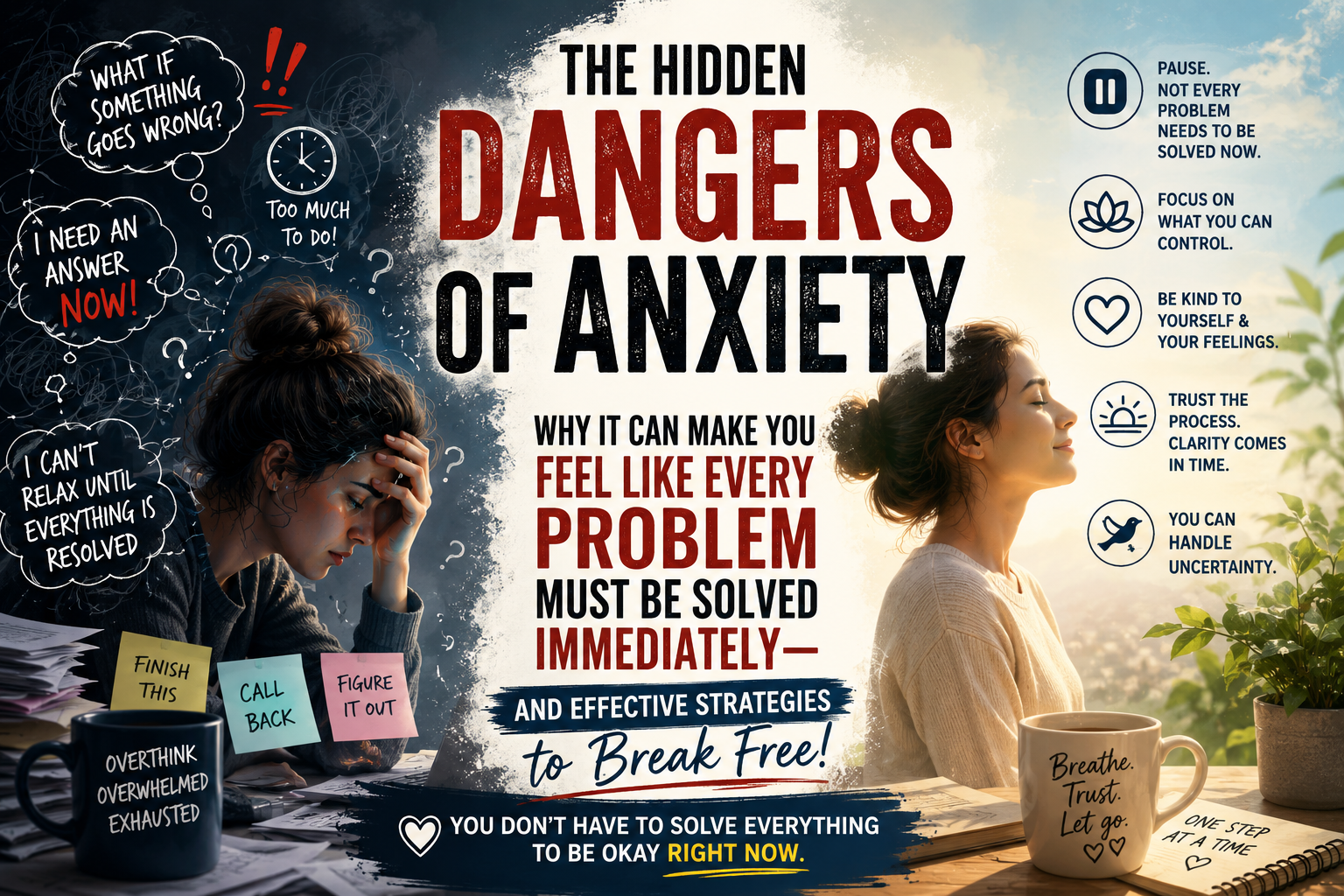
The Hidden Dangers of Anxiety: Why It Can Make You Feel Like Every Problem Must Be Solved Immediately—And Effective Strategies to Break Free From the Cycle
Anxiety is often described as worry, fear, nervousness, or a feeling that something bad might happen. But anxiety can be much more complicated than simply feeling worried. One of its less obvious effects is the intense pressure it can create to fix, resolve, analyze, or control every problem immediately. When anxiety takes over, an unresolved issue can feel almost unbearable. Your mind may tell you that you cannot relax until you have found an answer, made a decision, clarified a misunderstanding, completed a task, or eliminated whatever is causing discomfort. The problem is that life rarely provides immediate solutions. Many situations require time, patience, uncertainty, or simply the willingness to let things unfold. When anxiety convinces you that every uncomfortable feeling must disappear right now, you can become trapped in a cycle that actually makes anxiety stronger.
At the heart of this experience is an understandable desire: you want relief. When something feels uncertain or threatening, the brain naturally looks for ways to restore a sense of safety. Anxiety can intensify this process until the mind begins treating uncertainty itself as a problem that must be eliminated. You might repeatedly replay a conversation, search for reassurance, check your phone, research an issue, plan every possible outcome, send another message to make sure someone is okay, or mentally rehearse what you will do if something goes wrong. These behaviors can provide a temporary sense of control. For a few moments, you may feel calmer because you have done something. Yet the relief often does not last. Soon another question appears, another possibility comes to mind, or another uncertainty demands your attention.
This is one of anxiety’s most deceptive characteristics. The anxious mind can make excessive problem-solving feel productive even when it is actually keeping you stuck. You may believe that thinking about something more will eventually make you feel better, but sometimes additional thinking simply creates additional questions. You solve one hypothetical problem and discover three more. You look for certainty and find more reasons to doubt. You try to eliminate every negative possibility and end up becoming increasingly aware of everything that could potentially go wrong.
The cycle often begins with a trigger. It could be an uncomfortable conversation, an unanswered text message, a mistake at work, a financial concern, a relationship issue, an upcoming event, a health concern, or even a vague feeling that something is not right. The trigger itself may be relatively small, but anxiety can quickly assign enormous importance to it. The mind starts asking, “What if something is wrong?” Then comes the urge to figure it out. “What should I do?” “What does this mean?” “What if I made things worse?” “What if I wait and something happens?” The questions can continue until the person feels compelled to take action. This urgency is important because anxiety often does not merely say, “There is a problem.” It says, “There is a problem, and you must solve it immediately.” That second message is what can turn ordinary uncertainty into emotional exhaustion. You may notice that you have difficulty concentrating on anything else while an unresolved issue is hanging over you. Even when you are watching television, spending time with family, working, or trying to sleep, part of your attention remains locked onto the problem. Your mind keeps returning to it because it believes that continuing to think is necessary. You may even feel guilty when you attempt to relax because a part of you says, “How can you relax when this still hasn’t been figured out?”
This is where anxiety can begin taking away something extremely valuable: your ability to experience the present moment without constantly trying to protect yourself from the future. The human brain is designed to notice potential threats. That ability is incredibly useful. If there is an immediate danger, recognizing it and responding quickly can be lifesaving. But anxiety can activate this threat-detection system in situations where immediate action is unnecessary or impossible. The brain can respond to uncertainty as though uncertainty itself were a threat. Instead of distinguishing between “This is uncomfortable” and “This is dangerous,” anxiety can blur the two.
As a result, an uncomfortable emotion may begin to feel like an emergency.
You might think, “I can’t stand feeling this way,” or “I need to get rid of this feeling.” The natural response is then to do something that promises relief. You seek reassurance. You distract yourself. You analyze. You check. You avoid. You try to control another person’s reaction. You make a decision simply to end the uncertainty, even if you are not ready to make it. The specific behavior can vary, but the underlying goal is often the same: make the uncomfortable feeling stop. There is nothing wrong with wanting to feel better. The difficulty begins when your brain learns that negative emotions are intolerable and must always be removed as quickly as possible. When that happens, ordinary emotional experiences can become frightening in their own right. Ironically, constantly trying to eliminate anxiety can teach the brain to become more afraid of anxiety. Imagine that every time you feel uncertain, you immediately begin researching. Every time you worry that someone is upset with you, you ask for reassurance. Every time you make a mistake, you repeatedly review what happened. Every time you experience an uncomfortable thought, you try to prove that it is not true. Your brain may gradually learn a pattern: “Whenever this feeling appears, we need to do something immediately.” The behavior provides short-term relief, which reinforces the habit. The next time anxiety appears, the urge to act can become even stronger. This is why learning to tolerate uncertainty and uncomfortable emotions can be so powerful. The goal is not to become careless, indifferent, or passive. The goal is to develop the ability to recognize when action is genuinely necessary and when anxiety is simply demanding action because it wants immediate relief. There is an important difference between solving a problem and trying to eliminate uncertainty. If your car has a flat tire, there is a practical problem that requires action. If you have an important deadline tomorrow, creating a plan can be helpful. If you hurt someone’s feelings, having an honest conversation may be appropriate. But many of life’s most distressing questions cannot be solved through immediate mental effort. You cannot always know exactly what another person is thinking. You cannot guarantee that every decision will produce the desired outcome. You cannot control how everyone will respond to you. You cannot predict every future event. You cannot completely eliminate the possibility of disappointment.
Trying to achieve that level of certainty can become an exhausting full-time job.
One of the most helpful strategies is learning to pause before responding to the anxious urge. When you feel the pressure to immediately solve something, give yourself a moment and ask, “Is there actually something I need to do right now, or am I trying to make this uncomfortable feeling disappear?” That question can create valuable space between the emotion and the reaction. Sometimes there is a genuine action you can take. If so, take it calmly and intentionally. But if there is nothing productive to do at that moment, practice allowing the uncertainty to exist without immediately responding to it. This can feel uncomfortable at first. In fact, it may feel extremely uncomfortable. But discomfort is not failure. It is part of learning. You are teaching your mind that uncertainty can be experienced without automatically turning into an emergency.
Another powerful shift is changing the question from “How can I make this feeling go away?” to “How can I take care of myself while this feeling is here?” Those questions may sound similar, but psychologically they are very different. The first treats the emotion as something that must be defeated. The second acknowledges that emotions can be present without controlling your behavior. You might say to yourself, “I am anxious right now, and I don’t have to solve everything this minute.” You might remind yourself, “I can handle not knowing.” You might recognize, “My mind is looking for certainty because it feels threatened, but that doesn’t mean I need to give it certainty.” These statements are not about pretending that everything is fine. They are about creating a healthier relationship with your thoughts and emotions. It can also help to distinguish between thinking and worrying. Thinking generally moves toward something useful: a decision, a plan, an understanding, or an action. Worry often circles around the same questions without producing meaningful resolution. You may repeatedly ask yourself the same thing in slightly different ways, hoping that one more round of thinking will finally create certainty. When you notice yourself going in circles, try asking, “Has this thinking produced anything new?” If the answer is no, continuing to think may not be problem-solving anymore. It may simply be anxiety seeking reassurance. Another important strategy is setting boundaries around problem-solving. Anxiety often tells you that you must think about an issue whenever it appears. Instead, you can consciously decide when you are going to address it. If something does not require immediate attention, you might tell yourself, “I will give this my attention later, but I don’t need to solve it right now.” This can be especially useful when anxious thoughts appear at night. Rather than allowing your mind to turn bedtime into a strategy session, remind yourself that tomorrow is a more appropriate time to address what can actually be addressed.
Learning to tolerate uncertainty does not happen overnight. It is a skill, and like any skill, it develops through practice. The first time you resist an anxious urge, you may feel more anxious rather than less. That does not mean the strategy is not working. Your brain has become accustomed to receiving immediate reassurance or taking immediate action. When you change the pattern, your anxiety may temporarily protest. With repeated practice, however, you can begin discovering something important: you can feel anxious without obeying anxiety. That realization can be transformative.
You may still experience worry. You may still have moments when uncertainty feels uncomfortable. You may still want to know exactly how something will turn out. The goal is not to become a person who never worries. The goal is to become someone who does not allow every anxious thought to dictate what happens next. It is also important to remember that not every thought deserves an answer. Anxiety can produce thoughts that feel urgent, convincing, and important simply because they are emotionally intense. But intensity is not the same thing as truth. A thought such as “Something must be wrong” is a mental event, not automatically a fact. A thought such as “I have to figure this out right now” is an instruction from your anxious mind, not a command you are required to follow. Developing this perspective can create psychological freedom. Instead of arguing with every anxious thought, you can notice it and choose how much attention to give it.
There is also tremendous value in returning your attention to what is happening in front of you. Anxiety frequently pulls attention into imagined futures or endless reviews of the past. Grounding yourself in the present can interrupt that cycle. Notice your surroundings. Pay attention to your breathing. Feel your feet against the floor. Listen to the sounds around you. Focus on the task you are actually doing. These simple acts can remind your nervous system that, in this particular moment, you are here rather than inside every possible future scenario your mind has created. Healthy problem-solving also requires accepting that some answers take time. Sometimes the best decision is not to decide immediately. Sometimes clarity arrives after you sleep, gather more information, speak with someone you trust, or simply allow emotions to settle. Immediate action is not always wise action. There is a difference between urgency and importance. Anxiety can make something feel urgent simply because it feels uncomfortable. But an emotionally urgent feeling does not necessarily mean that immediate action is required.
This distinction can change the way you approach difficult situations. Instead of asking, “How do I make this go away?” you can ask, “What is actually within my control?” You can then direct your energy toward that small area of control and release what is outside it. Perhaps you can communicate clearly, but you cannot control another person’s response. Perhaps you can prepare for an event, but you cannot guarantee the outcome. Perhaps you can make a thoughtful decision, but you cannot guarantee that every consequence will be perfect. Perhaps you can apologize sincerely, but you cannot force someone else to forgive you immediately. Life becomes considerably less exhausting when you stop demanding certainty from situations that cannot provide it.
For some people, anxiety can become severe enough to significantly interfere with daily life, relationships, work, sleep, or the ability to function. When persistent anxiety feels overwhelming or difficult to manage independently, reaching out to a qualified mental-health professional can be an important and courageous step. Approaches such as cognitive behavioral therapy and other evidence-based treatments can help people understand anxiety patterns, change unhelpful responses, and develop greater tolerance for uncertainty. Seeking support is not a sign that you are weak or incapable. Sometimes the strongest decision is recognizing that you do not have to figure everything out alone.
Ultimately, one of the most important lessons about anxiety is that you do not have to solve every problem in order to be okay in this moment. Some problems can wait. Some questions will remain unanswered for a while. Some feelings will come and go without requiring immediate action. Some situations will resolve themselves in ways you could not have predicted. And some challenges will require you to accept uncertainty rather than defeat it. The goal is not to eliminate every negative emotion from your life. That would be impossible, and attempting to do so can create even more suffering. The goal is to develop the confidence to experience difficult emotions without immediately becoming their servant. You can feel worried and still breathe. You can feel uncertain and still continue your day. You can have unanswered questions and still rest. You can experience fear without allowing fear to make every decision.
And you can remind yourself that a problem does not become more solvable simply because you worry about it more intensely. Sometimes the most powerful response to anxiety is not another hour of analysis, another search for reassurance, or another attempt to control the uncontrollable. Sometimes it is a pause. A breath. A decision to wait. A willingness to say, “I don’t know yet, and I can handle not knowing.”
That is not giving up. That is learning to trust yourself.
And with practice, you may discover that the peace you were desperately trying to create by solving everything immediately was never dependent on having every answer. It was built, instead, on developing the courage to face uncertainty and realizing that you are capable of moving forward even when you don’t know exactly what happens next.
Learn More