
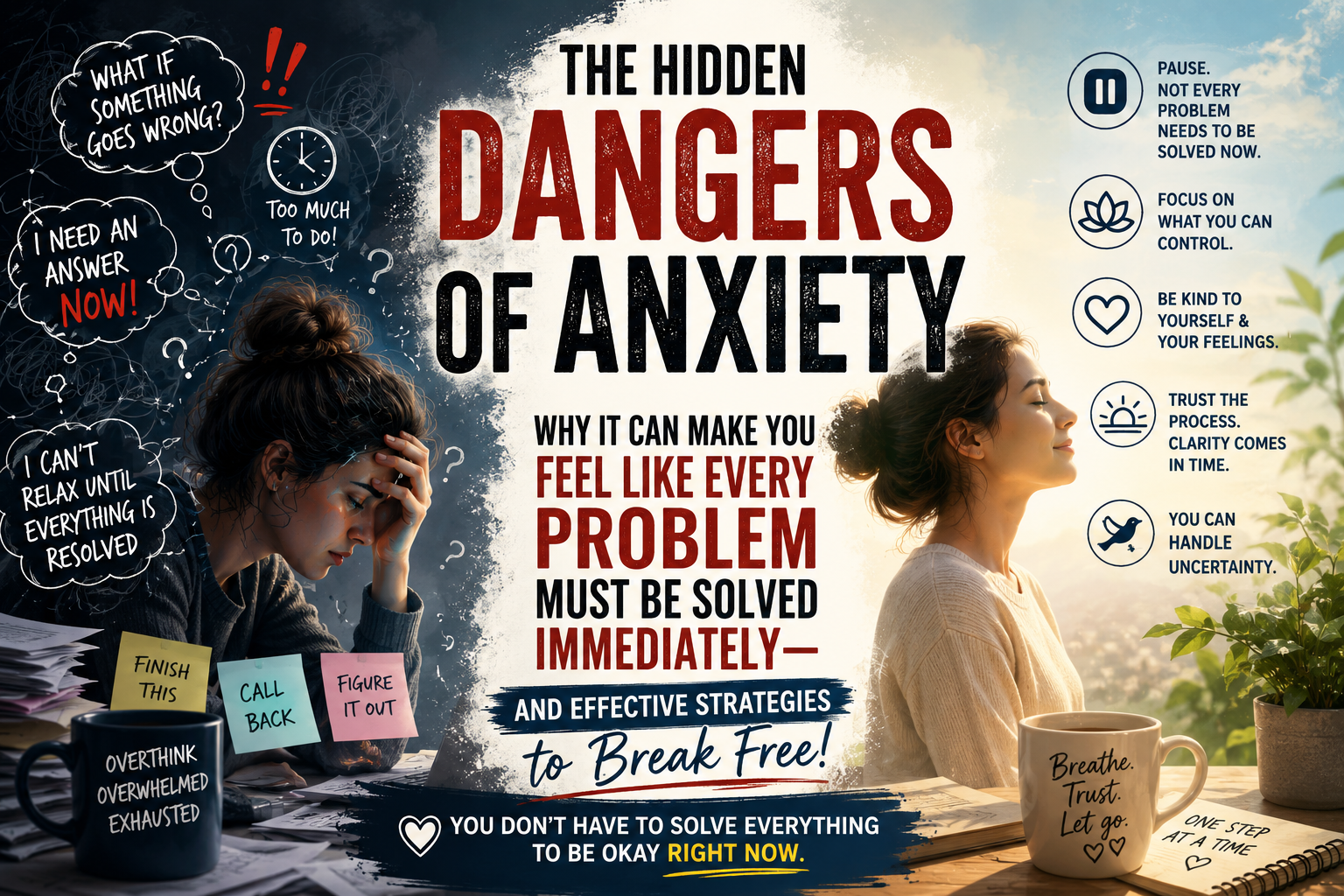
The Hidden Dangers of Anxiety: Why It Can Make You Feel Like Every Problem Must Be Solved Immediately—And Effective Strategies to Break Free From the Cycle
Anxiety is often described as worry, fear, nervousness, or a feeling that something bad might happen. But anxiety can be much more complicated than simply feeling worried. One of its less obvious effects is the intense pressure it can create to fix, resolve, analyze, or control every problem immediately. When anxiety takes over, an unresolved issue can feel almost unbearable. Your mind may tell you that you cannot relax until you have found an answer, made a decision, clarified a misunderstanding, completed a task, or eliminated whatever is causing discomfort. The problem is that life rarely provides immediate solutions. Many situations require time, patience, uncertainty, or simply the willingness to let things unfold. When anxiety convinces you that every uncomfortable feeling must disappear right now, you can become trapped in a cycle that actually makes anxiety stronger.
At the heart of this experience is an understandable desire: you want relief. When something feels uncertain or threatening, the brain naturally looks for ways to restore a sense of safety. Anxiety can intensify this process until the mind begins treating uncertainty itself as a problem that must be eliminated. You might repeatedly replay a conversation, search for reassurance, check your phone, research an issue, plan every possible outcome, send another message to make sure someone is okay, or mentally rehearse what you will do if something goes wrong. These behaviors can provide a temporary sense of control. For a few moments, you may feel calmer because you have done something. Yet the relief often does not last. Soon another question appears, another possibility comes to mind, or another uncertainty demands your attention.
This is one of anxiety’s most deceptive characteristics. The anxious mind can make excessive problem-solving feel productive even when it is actually keeping you stuck. You may believe that thinking about something more will eventually make you feel better, but sometimes additional thinking simply creates additional questions. You solve one hypothetical problem and discover three more. You look for certainty and find more reasons to doubt. You try to eliminate every negative possibility and end up becoming increasingly aware of everything that could potentially go wrong.
The cycle often begins with a trigger. It could be an uncomfortable conversation, an unanswered text message, a mistake at work, a financial concern, a relationship issue, an upcoming event, a health concern, or even a vague feeling that something is not right. The trigger itself may be relatively small, but anxiety can quickly assign enormous importance to it. The mind starts asking, “What if something is wrong?” Then comes the urge to figure it out. “What should I do?” “What does this mean?” “What if I made things worse?” “What if I wait and something happens?” The questions can continue until the person feels compelled to take action. This urgency is important because anxiety often does not merely say, “There is a problem.” It says, “There is a problem, and you must solve it immediately.” That second message is what can turn ordinary uncertainty into emotional exhaustion. You may notice that you have difficulty concentrating on anything else while an unresolved issue is hanging over you. Even when you are watching television, spending time with family, working, or trying to sleep, part of your attention remains locked onto the problem. Your mind keeps returning to it because it believes that continuing to think is necessary. You may even feel guilty when you attempt to relax because a part of you says, “How can you relax when this still hasn’t been figured out?”
This is where anxiety can begin taking away something extremely valuable: your ability to experience the present moment without constantly trying to protect yourself from the future. The human brain is designed to notice potential threats. That ability is incredibly useful. If there is an immediate danger, recognizing it and responding quickly can be lifesaving. But anxiety can activate this threat-detection system in situations where immediate action is unnecessary or impossible. The brain can respond to uncertainty as though uncertainty itself were a threat. Instead of distinguishing between “This is uncomfortable” and “This is dangerous,” anxiety can blur the two.
As a result, an uncomfortable emotion may begin to feel like an emergency.
You might think, “I can’t stand feeling this way,” or “I need to get rid of this feeling.” The natural response is then to do something that promises relief. You seek reassurance. You distract yourself. You analyze. You check. You avoid. You try to control another person’s reaction. You make a decision simply to end the uncertainty, even if you are not ready to make it. The specific behavior can vary, but the underlying goal is often the same: make the uncomfortable feeling stop. There is nothing wrong with wanting to feel better. The difficulty begins when your brain learns that negative emotions are intolerable and must always be removed as quickly as possible. When that happens, ordinary emotional experiences can become frightening in their own right. Ironically, constantly trying to eliminate anxiety can teach the brain to become more afraid of anxiety. Imagine that every time you feel uncertain, you immediately begin researching. Every time you worry that someone is upset with you, you ask for reassurance. Every time you make a mistake, you repeatedly review what happened. Every time you experience an uncomfortable thought, you try to prove that it is not true. Your brain may gradually learn a pattern: “Whenever this feeling appears, we need to do something immediately.” The behavior provides short-term relief, which reinforces the habit. The next time anxiety appears, the urge to act can become even stronger. This is why learning to tolerate uncertainty and uncomfortable emotions can be so powerful. The goal is not to become careless, indifferent, or passive. The goal is to develop the ability to recognize when action is genuinely necessary and when anxiety is simply demanding action because it wants immediate relief. There is an important difference between solving a problem and trying to eliminate uncertainty. If your car has a flat tire, there is a practical problem that requires action. If you have an important deadline tomorrow, creating a plan can be helpful. If you hurt someone’s feelings, having an honest conversation may be appropriate. But many of life’s most distressing questions cannot be solved through immediate mental effort. You cannot always know exactly what another person is thinking. You cannot guarantee that every decision will produce the desired outcome. You cannot control how everyone will respond to you. You cannot predict every future event. You cannot completely eliminate the possibility of disappointment.
Trying to achieve that level of certainty can become an exhausting full-time job.
One of the most helpful strategies is learning to pause before responding to the anxious urge. When you feel the pressure to immediately solve something, give yourself a moment and ask, “Is there actually something I need to do right now, or am I trying to make this uncomfortable feeling disappear?” That question can create valuable space between the emotion and the reaction. Sometimes there is a genuine action you can take. If so, take it calmly and intentionally. But if there is nothing productive to do at that moment, practice allowing the uncertainty to exist without immediately responding to it. This can feel uncomfortable at first. In fact, it may feel extremely uncomfortable. But discomfort is not failure. It is part of learning. You are teaching your mind that uncertainty can be experienced without automatically turning into an emergency.
Another powerful shift is changing the question from “How can I make this feeling go away?” to “How can I take care of myself while this feeling is here?” Those questions may sound similar, but psychologically they are very different. The first treats the emotion as something that must be defeated. The second acknowledges that emotions can be present without controlling your behavior. You might say to yourself, “I am anxious right now, and I don’t have to solve everything this minute.” You might remind yourself, “I can handle not knowing.” You might recognize, “My mind is looking for certainty because it feels threatened, but that doesn’t mean I need to give it certainty.” These statements are not about pretending that everything is fine. They are about creating a healthier relationship with your thoughts and emotions. It can also help to distinguish between thinking and worrying. Thinking generally moves toward something useful: a decision, a plan, an understanding, or an action. Worry often circles around the same questions without producing meaningful resolution. You may repeatedly ask yourself the same thing in slightly different ways, hoping that one more round of thinking will finally create certainty. When you notice yourself going in circles, try asking, “Has this thinking produced anything new?” If the answer is no, continuing to think may not be problem-solving anymore. It may simply be anxiety seeking reassurance. Another important strategy is setting boundaries around problem-solving. Anxiety often tells you that you must think about an issue whenever it appears. Instead, you can consciously decide when you are going to address it. If something does not require immediate attention, you might tell yourself, “I will give this my attention later, but I don’t need to solve it right now.” This can be especially useful when anxious thoughts appear at night. Rather than allowing your mind to turn bedtime into a strategy session, remind yourself that tomorrow is a more appropriate time to address what can actually be addressed.
Learning to tolerate uncertainty does not happen overnight. It is a skill, and like any skill, it develops through practice. The first time you resist an anxious urge, you may feel more anxious rather than less. That does not mean the strategy is not working. Your brain has become accustomed to receiving immediate reassurance or taking immediate action. When you change the pattern, your anxiety may temporarily protest. With repeated practice, however, you can begin discovering something important: you can feel anxious without obeying anxiety. That realization can be transformative.
You may still experience worry. You may still have moments when uncertainty feels uncomfortable. You may still want to know exactly how something will turn out. The goal is not to become a person who never worries. The goal is to become someone who does not allow every anxious thought to dictate what happens next. It is also important to remember that not every thought deserves an answer. Anxiety can produce thoughts that feel urgent, convincing, and important simply because they are emotionally intense. But intensity is not the same thing as truth. A thought such as “Something must be wrong” is a mental event, not automatically a fact. A thought such as “I have to figure this out right now” is an instruction from your anxious mind, not a command you are required to follow. Developing this perspective can create psychological freedom. Instead of arguing with every anxious thought, you can notice it and choose how much attention to give it.
There is also tremendous value in returning your attention to what is happening in front of you. Anxiety frequently pulls attention into imagined futures or endless reviews of the past. Grounding yourself in the present can interrupt that cycle. Notice your surroundings. Pay attention to your breathing. Feel your feet against the floor. Listen to the sounds around you. Focus on the task you are actually doing. These simple acts can remind your nervous system that, in this particular moment, you are here rather than inside every possible future scenario your mind has created. Healthy problem-solving also requires accepting that some answers take time. Sometimes the best decision is not to decide immediately. Sometimes clarity arrives after you sleep, gather more information, speak with someone you trust, or simply allow emotions to settle. Immediate action is not always wise action. There is a difference between urgency and importance. Anxiety can make something feel urgent simply because it feels uncomfortable. But an emotionally urgent feeling does not necessarily mean that immediate action is required.
This distinction can change the way you approach difficult situations. Instead of asking, “How do I make this go away?” you can ask, “What is actually within my control?” You can then direct your energy toward that small area of control and release what is outside it. Perhaps you can communicate clearly, but you cannot control another person’s response. Perhaps you can prepare for an event, but you cannot guarantee the outcome. Perhaps you can make a thoughtful decision, but you cannot guarantee that every consequence will be perfect. Perhaps you can apologize sincerely, but you cannot force someone else to forgive you immediately. Life becomes considerably less exhausting when you stop demanding certainty from situations that cannot provide it.
For some people, anxiety can become severe enough to significantly interfere with daily life, relationships, work, sleep, or the ability to function. When persistent anxiety feels overwhelming or difficult to manage independently, reaching out to a qualified mental-health professional can be an important and courageous step. Approaches such as cognitive behavioral therapy and other evidence-based treatments can help people understand anxiety patterns, change unhelpful responses, and develop greater tolerance for uncertainty. Seeking support is not a sign that you are weak or incapable. Sometimes the strongest decision is recognizing that you do not have to figure everything out alone.
Ultimately, one of the most important lessons about anxiety is that you do not have to solve every problem in order to be okay in this moment. Some problems can wait. Some questions will remain unanswered for a while. Some feelings will come and go without requiring immediate action. Some situations will resolve themselves in ways you could not have predicted. And some challenges will require you to accept uncertainty rather than defeat it. The goal is not to eliminate every negative emotion from your life. That would be impossible, and attempting to do so can create even more suffering. The goal is to develop the confidence to experience difficult emotions without immediately becoming their servant. You can feel worried and still breathe. You can feel uncertain and still continue your day. You can have unanswered questions and still rest. You can experience fear without allowing fear to make every decision.
And you can remind yourself that a problem does not become more solvable simply because you worry about it more intensely. Sometimes the most powerful response to anxiety is not another hour of analysis, another search for reassurance, or another attempt to control the uncontrollable. Sometimes it is a pause. A breath. A decision to wait. A willingness to say, “I don’t know yet, and I can handle not knowing.”
That is not giving up. That is learning to trust yourself.
And with practice, you may discover that the peace you were desperately trying to create by solving everything immediately was never dependent on having every answer. It was built, instead, on developing the courage to face uncertainty and realizing that you are capable of moving forward even when you don’t know exactly what happens next.

dr.dan
Related Posts

How cognitive distortions drive anxiety and how therapy can address them: the various ways we interpret everyday challenges and their impact on our emotions
Anxiety is more than just occasional worry—it’s a persistent, often...
The Unseen Struggles of Anxiety: Understanding Intrusive Thoughts and How to Overcome Them
Anxiety is a common mental health condition that affects millions of people...

Generational trauma: The impact of childhood trauma on adult identity. Exploring the complexities of PTSD and uncovering the hidden truths behind it!
Generational trauma refers to the transmission of traumatic experiences and...

The many ugly faces of trauma. How past traumatic events and circumstances can disrupt motivation and follow-through. Effective strategies to bypass these challenges
Trauma rarely announces itself in obvious ways. While many people associate...