
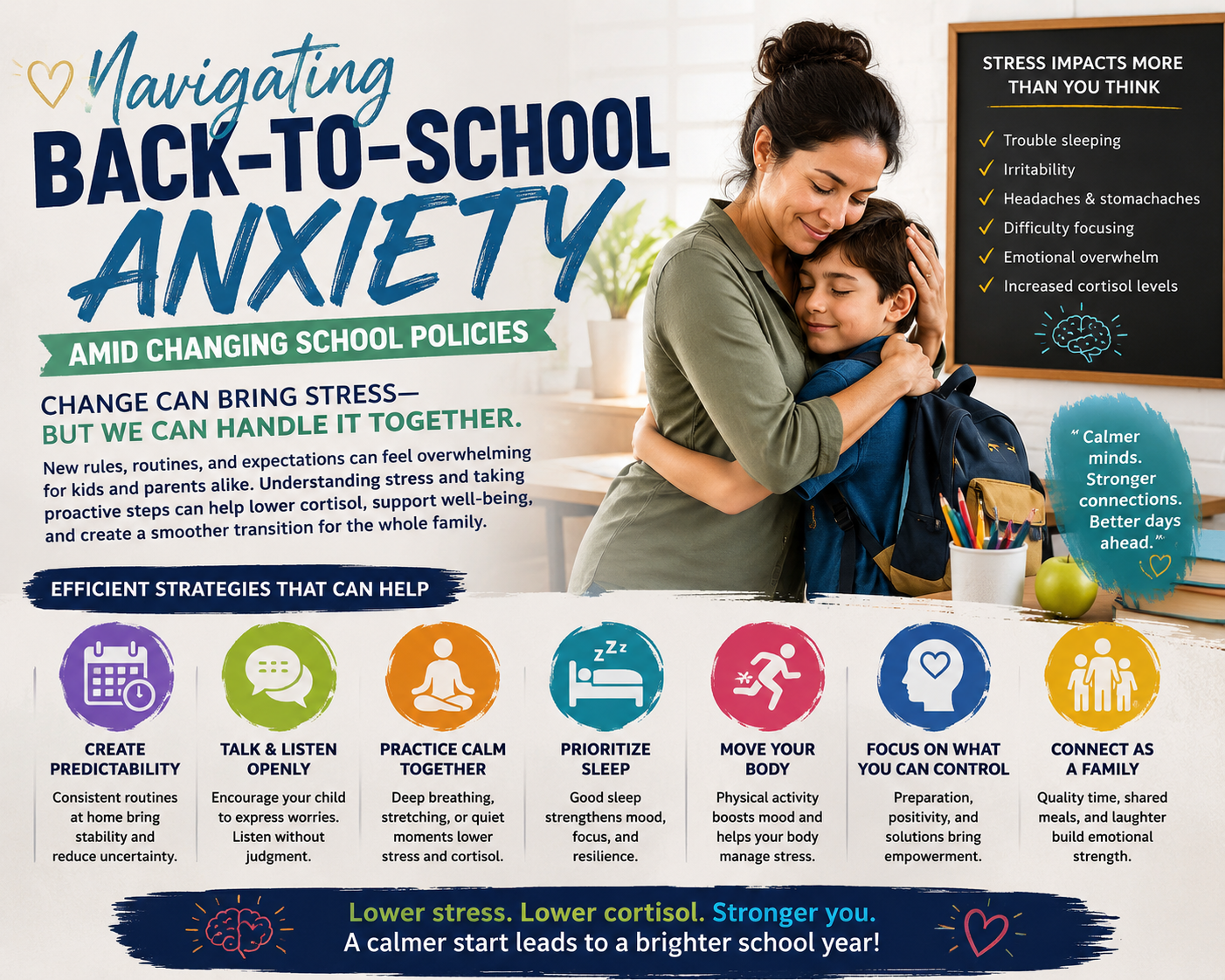
Navigating back-to-school anxiety amid changing school policies. Imminent changes that can bring stress to kids and parents and knowing what to do to reduce the levels of cortisol in your body. Efficient strategies that can help you for school year 2026-2027.
The return to school can be an exciting time filled with new opportunities, friendships, and personal growth, but it can also create anxiety for both children and parents. Changes in school policies, schedules, classroom expectations, transportation, technology, academic requirements, or safety procedures can make an already stressful transition feel even more uncertain. For children, changes to familiar routines may create feelings of fear, confusion, or frustration. For parents, concerns about how their children will adjust can lead to worry, sleepless nights, and emotional exhaustion. Understanding how stress affects the mind and body can help families approach the new school year with greater confidence and resilience.
One of the body’s primary responses to stress involves the release of cortisol, a hormone that plays an important role in helping us respond to challenges. Cortisol itself is not harmful; in fact, it is essential for maintaining energy, alertness, and an appropriate response to stressful situations. The concern arises when stress becomes prolonged and the body remains in a heightened state of alertness without enough opportunities for recovery. When children or adults experience ongoing worry, uncertainty, poor sleep, emotional pressure, and constant stimulation, they may begin to feel mentally and physically overwhelmed. The objective should not be to eliminate cortisol, because that is neither realistic nor desirable. Instead, the goal is to develop healthy habits that help the body regulate its stress response and return to a calmer state.
One of the most effective ways to manage back-to-school anxiety is to create a sense of predictability at home. When many things outside the home are changing, a consistent family routine can provide a powerful feeling of stability. Regular sleep and wake times, predictable meals, preparation for the next day, designated homework periods, family conversations, and opportunities for relaxation can help children feel more secure. Children do not need every moment of their day controlled, but knowing what to expect can reduce uncertainty and make transitions easier. A stable home environment can become an emotional anchor when other parts of life feel unpredictable.
Communication is equally important. Parents should create opportunities for children to talk openly about what they are experiencing without immediately dismissing their concerns or trying to fix everything. A child who says, “I don’t want to go back to school,” may not simply be expressing dislike. They may be worried about making friends, dealing with academic pressure, adjusting to a new teacher, being separated from their parents, or dealing with changes they do not fully understand. Instead of responding with, “Don’t worry, everything will be fine,” parents can ask, “What part of going back to school worries you the most?” This simple question can open the door to a much deeper conversation and help identify what is actually causing the anxiety.
Parents should also be mindful of how they communicate their own concerns. Children are extremely sensitive to the emotional states of the adults around them. If parents constantly express fear, frustration, or uncertainty about school changes, children may interpret those emotions as evidence that something dangerous is happening. This does not mean parents should hide their feelings or pretend that everything is perfect. Instead, parents can model healthy emotional regulation by saying something like, “I know there are some changes this year, and I have questions too. We will learn what we need to know and figure things out together.” This teaches children that uncertainty does not automatically mean danger and that difficult situations can be approached calmly and constructively.
Another important strategy is helping children distinguish between what they can control and what they cannot. School policies, decisions made by administrators, the behavior of other students, and unexpected changes are not always within a family’s control. Spending excessive time worrying about these things can increase stress without producing a solution. Instead, families can focus on the areas they can influence, such as preparing school supplies, establishing routines, communicating with teachers, maintaining healthy sleep habits, and helping children develop problem-solving skills. A useful question for both parents and children is, “Is there something I can do about this right now?” If the answer is yes, take an appropriate action. If the answer is no, learning to accept the uncertainty can prevent unnecessary emotional exhaustion.
Physical health also plays an important role in managing stress. Adequate sleep, regular physical activity, proper hydration, and balanced nutrition can support the body’s ability to cope with daily challenges. When children are tired, hungry, dehydrated, or physically inactive, they may have greater difficulty regulating their emotions and concentrating. The same is true for parents. A parent who is constantly exhausted and running on caffeine may have less emotional capacity to respond calmly to a child’s anxiety. Establishing healthy routines before school begins can therefore benefit the entire family.
Breathing and relaxation techniques can also help individuals manage moments of heightened anxiety. Slow, comfortable breathing with a slightly longer exhale can encourage the body to shift away from a heightened stress response. Parents can practice these techniques with their children rather than presenting them as something the child needs to do because they are “anxious.” Taking several slow breaths together, stretching, going for a walk, listening to calming music, or spending a few quiet minutes together can become simple family rituals that promote emotional regulation.
It is also important to teach children that experiencing anxiety does not mean they are incapable of handling a situation. Sometimes adults unintentionally reinforce anxiety by trying to eliminate every uncomfortable experience for their children. While protecting children is a natural parental instinct, children also need opportunities to develop confidence through manageable challenges. Allowing them to solve age-appropriate problems, communicate with teachers, make decisions, recover from mistakes, and experience normal frustrations can help them discover that they are more capable than they may initially believe. Resilience develops when people learn that discomfort is something they can move through rather than something they must always avoid.
Parents can further help children by teaching them how to challenge catastrophic thinking. Anxiety often focuses on the worst possible outcome. A child might think, “What if nobody likes me?” or “What if I can’t do the work?” Instead of simply saying, “That won’t happen,” parents can help the child consider what they would do if the challenge occurred. They might discuss how the child could approach a classmate, ask a teacher for assistance, seek support from a counselor, or practice a difficult academic skill. This shifts the focus from predicting disaster to developing confidence in one’s ability to respond. The message becomes, “We don’t know exactly what will happen, but we know that we can figure things out.”
Parents should also be careful about consuming too much information about school changes. During uncertain periods, it is natural to repeatedly check emails, social media, school announcements, and online discussions. However, constantly monitoring information can sometimes increase anxiety rather than reduce it. Families can establish reasonable times to review school communications and then return their attention to everyday life. Being informed is valuable, but being consumed by information can keep the brain in a constant state of alertness.
Perhaps one of the most important lessons for families is that stress cannot always be avoided. The goal is not to create a completely stress-free childhood or a perfectly predictable school year. Instead, the goal is to develop the emotional skills necessary to navigate uncertainty. Children need to learn that they can experience nervousness and still move forward. Parents need to recognize that they do not have to know every answer immediately. Families need to understand that change can be uncomfortable without necessarily being harmful.
Back-to-school anxiety can therefore become an opportunity for growth. Instead of viewing every challenge as something that must be eliminated, families can use these experiences to teach emotional awareness, communication, problem-solving, resilience, and self-regulation. When children see their parents responding to uncertainty with patience and confidence, they learn that they too can face difficult situations without becoming overwhelmed by them.
If anxiety becomes persistent or begins to significantly interfere with a child’s ability to attend school, sleep, eat, socialize, concentrate, or function normally, professional support may be appropriate. The same applies to parents whose own anxiety becomes overwhelming or interferes with their daily lives. Seeking support is not a sign of weakness; it can be an important step toward developing healthier coping strategies.
As another school year begins, families should remember that they cannot control every policy, decision, change, or challenge that may arise. What they can control is how they prepare, how they communicate, how they care for their physical and emotional well-being, and how they respond when uncertainty appears. The ultimate goal is not to eliminate stress or cortisol from our lives, but to teach ourselves and our children how to move from stress back toward balance.
We cannot always control what changes around us, but we can learn to control how we respond to those changes. And sometimes, the greatest lesson a new school year can teach us is that we are far more capable of handling change than we ever realized.

dr.dan
Related Posts

The 7 things most men fears in relationships/marriages! Based on clinical research.
Anyone who enters a relationship with a potential mate will always experience...

Generational trauma: The impact of childhood trauma on adult identity. Exploring the complexities of PTSD and uncovering the hidden truths behind it!
Generational trauma refers to the transmission of traumatic experiences and...

The Many Facets of Anxiety: How It Manifests as Irritability or Anger and Managing Them for a Happier, Serene Life
Anxiety is a complex and often misunderstood emotion. While most people...

Perfectionism and anxiety: The terrible duo making lives a living hell. How to let go of that obsession of always wanting to be perfect? Challenge accepted!
In the pursuit of perfection, many find themselves trapped in a cycle of anxiety...