
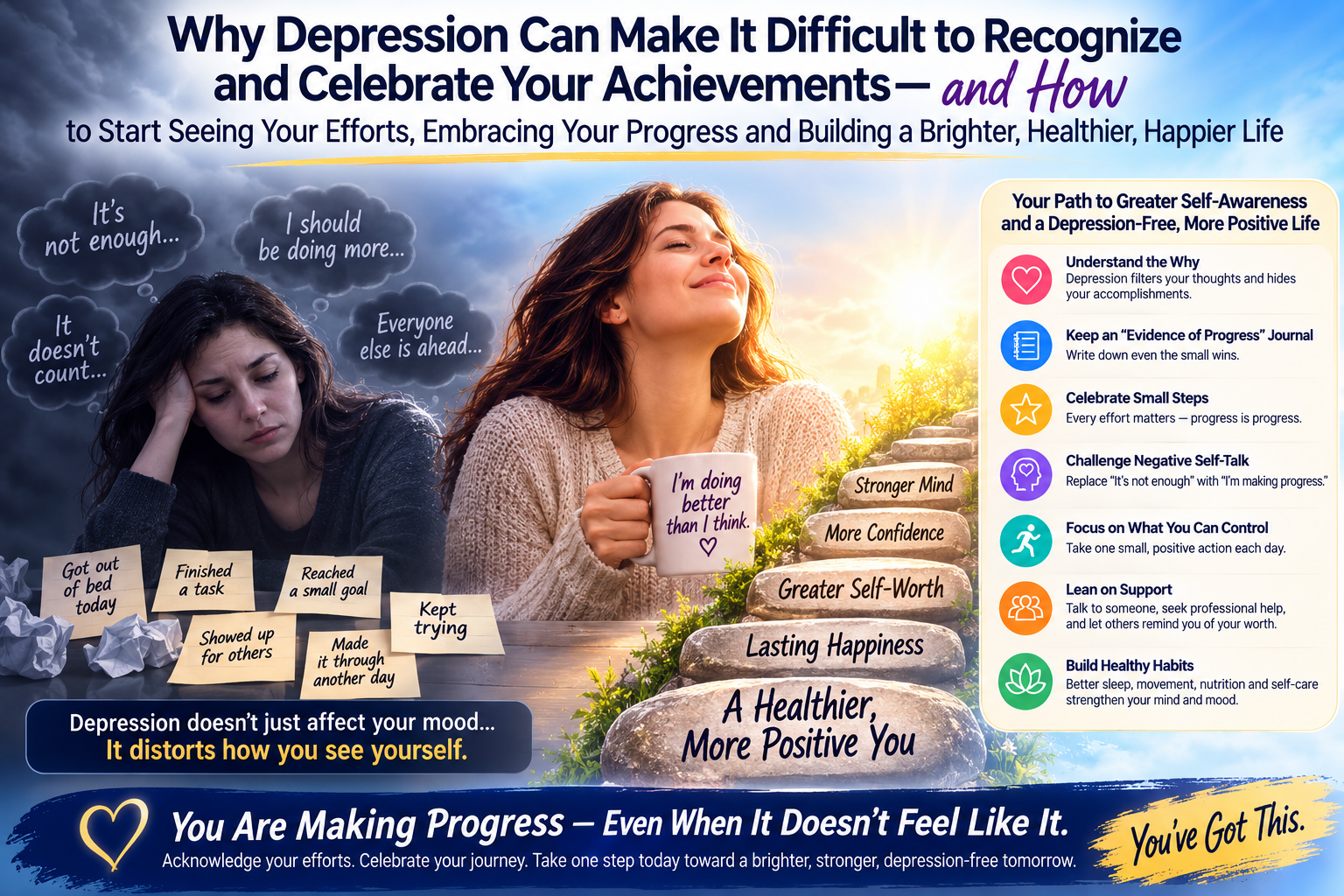
Why depression can make it difficult to recognize and celebrate your achievements—and how to begin acknowledging your efforts, embracing your progress, and taking empowering steps toward a healthier, more positive, and depression-free life.
Depression has a way of changing the way we see ourselves, our accomplishments, and even the meaning of success. You can accomplish something you once worked incredibly hard to achieve, receive recognition from others, reach an important milestone, or overcome an obstacle that once seemed impossible—and still feel little or nothing inside. Instead of excitement, you may feel emptiness. Instead of pride, you may hear an inner voice telling you that what you accomplished was not important, not good enough, or simply what you were “supposed” to do. This can be one of the most frustrating and misunderstood experiences of depression.
One of the most important things to understand is that difficulty celebrating an achievement does not necessarily mean that you are ungrateful, lazy, negative, or incapable of appreciating the good things in your life. Depression can affect motivation, emotional responsiveness, self-esteem, concentration, and the ability to experience pleasure. As a result, something that objectively deserves celebration may not emotionally register as something worth celebrating. Your circumstances may have changed, but your internal experience may still be telling you that nothing has really changed.
Depression can also create a powerful tendency to minimize accomplishments. You might complete a difficult project and immediately think, “Anyone could have done that.” You might reach a personal goal and respond with, “It wasn’t that difficult.” You might receive a compliment and immediately dismiss it. You may compare yourself to someone who appears to be further ahead and conclude that your achievement is insignificant. Over time, this pattern can make you feel as though you are constantly moving forward without ever allowing yourself to recognize how far you have traveled.
Another challenge is that many people unintentionally make achievement the condition for self-worth. They tell themselves, “I’ll be proud of myself when I succeed,” or “I’ll finally feel good about myself when I accomplish this.” The problem is that when success becomes the requirement for feeling worthy, there is always another mountain to climb. Even after reaching the goal, the mind may quickly create a new standard. What was once a dream becomes an expectation, and what should have been a moment of satisfaction becomes another reason to feel inadequate.
Depression can intensify this cycle because the mind often becomes more focused on perceived failures than genuine progress. You may remember the one thing that went wrong while forgetting the ten things that went right. You may focus on what you still need to accomplish instead of acknowledging what you have already overcome. This does not mean that you are choosing to think negatively. Depression can influence attention and interpretation, making negative information feel more convincing and positive information easier to dismiss.
This is why learning to acknowledge your effort is so important. Your achievement is not only the final outcome. It is also the courage, persistence, sacrifices, lessons, disappointments, and small decisions that allowed you to get there. Sometimes the greatest accomplishment is not reaching the destination but continuing to move forward when you were emotionally exhausted and uncertain about whether you could continue.
You deserve to recognize the effort behind your progress.
Perhaps you got out of bed on a difficult morning. Perhaps you made an important phone call that you had been avoiding. Perhaps you went to work despite feeling emotionally drained. Perhaps you asked for help instead of pretending everything was fine. Perhaps you established a healthier boundary, returned to therapy, reconnected with someone you trust, or simply decided that you would give yourself another day to try. These moments may not look impressive from the outside, but they can represent enormous victories for someone struggling with depression.
One powerful shift is learning to replace “Is this accomplishment big enough to celebrate?” with “What did this accomplishment require from me?” This question moves your attention away from comparing your achievement to someone else’s and toward understanding your own journey. Maybe what you accomplished required courage. Maybe it required patience. Maybe it required you to overcome fear. Maybe it required you to keep going when giving up felt easier. Your progress becomes meaningful when you understand what it took to create it.
You also do not have to wait until you feel proud before acknowledging yourself. Sometimes the action comes before the emotion. You can say, “I am proud of myself for making this effort,” even if you do not emotionally feel proud yet. You can recognize your progress even when your mind tells you that it does not matter. Over time, repeatedly practicing this form of self-recognition can help create a different relationship with your accomplishments.
Start with small victories rather than waiting for major milestones. Depression often encourages an all-or-nothing mentality: either you completely succeed or you have failed. A healthier perspective recognizes progress in degrees. Getting through a difficult day can be progress. Completing one task can be progress. Taking care of yourself can be progress. Having an honest conversation can be progress. Trying again after disappointment can be progress. Small steps become significant when they are repeated consistently.
It is also important to separate your identity from your productivity. You are not valuable because of how much you accomplish. You are not more deserving of love because you earn more money, achieve more professionally, maintain a perfect relationship, or constantly perform at your highest level. Achievement can be meaningful, but it should not be the foundation of your worth.
You are a human being before you are a performer, employee, parent, partner, entrepreneur, student, caregiver, or professional.
This distinction can be particularly important for people who have spent years being “the strong one.” When everyone expects you to be capable, independent, successful, and resilient, you may begin believing that you are only worthy when you are functioning at full capacity. Depression can then feel like a personal failure because it challenges the identity you have built around being strong.
But strength is not the absence of struggle.
Strength can also mean admitting that you are struggling. Strength can mean asking for support. Strength can mean slowing down. Strength can mean recognizing that you cannot solve everything by yourself. And sometimes strength means allowing yourself to be human without turning every difficult moment into evidence that something is wrong with you.
Another important step is becoming aware of your internal dialogue. Listen to how you speak to yourself after an accomplishment. Would you speak to a close friend the same way? If your friend completed something difficult and told you, “It wasn’t a big deal,” would you agree with them? Or would you remind them of everything they had overcome to get there?
Try offering yourself the same compassion.
Instead of saying, “I should have done more,” try saying, “I did what I could with what I had at that time.” Instead of “Anyone could have done this,” try “This mattered to me, and I worked for it.” Instead of “I’m still not where I want to be,” try “I may not be where I want to be yet, but I am not where I started.” This does not mean pretending everything is wonderful. It means developing a more balanced and compassionate perspective.
There is also tremendous value in allowing other people to celebrate you. Depression can make compliments uncomfortable. You may instinctively reject praise or explain away your accomplishments. Someone tells you, “You did an amazing job,” and you respond, “It wasn’t anything.” The next time someone genuinely acknowledges something you have accomplished, try simply saying, “Thank you.” You do not have to convince yourself that their praise is completely true. Just allow yourself to receive it.
Celebration does not have to mean throwing a party or feeling overwhelming happiness. Celebration can be quiet. It can be taking a moment to breathe and recognize what you accomplished. It can be treating yourself with kindness. It can be sharing your success with someone who genuinely cares about you. It can be writing down what you accomplished and allowing yourself to acknowledge it without immediately moving on to the next goal.Creating a daily practice of recognizing effort can also be helpful. At the end of the day, ask yourself: “What did I do today that required effort?” The answer does not need to be extraordinary. You are training your mind to notice progress rather than automatically searching for shortcomings.
Another powerful question is, “What would the version of me from five years ago think about where I am today?” We often become so focused on our current destination that we forget to look backward. The person you are today may possess skills, wisdom, resilience, relationships, experiences, and knowledge that your younger self desperately wanted. Your progress may be invisible to you simply because you have become accustomed to it.
Healing also requires patience. There is no single decision that makes depression disappear forever. For many people, recovery involves a combination of professional support, healthy routines, meaningful relationships, self-awareness, and sometimes medication as recommended by a qualified healthcare professional. Seeking professional help is not a sign that you have failed. It is a sign that you are willing to invest in your well-being.
If depression has made it difficult to experience pleasure, motivation, hope, or satisfaction for an extended period, consider speaking with a mental health professional. Depression is treatable, and you do not have to navigate it alone. If you ever experience thoughts of harming yourself or believe you may not be safe, seek immediate professional or emergency support in your area.
Most importantly, remember that the absence of celebration does not erase the achievement. You can accomplish something meaningful and still feel emotionally numb. You can make progress and still feel exhausted. You can be proud of yourself and still have difficult days. Healing is not about forcing yourself to be positive every moment. It is about learning to make room for hope while honestly acknowledging what you are experiencing. Your life does not have to become perfect before you are allowed to appreciate it. Your journey does not have to be finished before you are allowed to acknowledge how far you have come. And you do not have to become someone else before you are worthy of compassion, respect, and love.
Perhaps the first step toward a healthier relationship with yourself is simply recognizing this: you are trying. You are learning. You are growing. You are still here. And even if you cannot celebrate your achievements today, you can begin by acknowledging the effort it took to get this far. Greatness is not always found in extraordinary accomplishments. Sometimes greatness is found in the quiet decision to keep moving forward when life feels extraordinarily difficult. Give yourself permission to notice that.
Give yourself permission to appreciate that. And give yourself permission to believe that your next chapter can be different from your last.

dr.dan
Related Posts

The Science Behind Exercise Reducing Symptoms of Depression: The Connection Between Physical Activity and Mental Health
Depression, a prevalent mental health disorder, affects millions of people...

Breaking the Silence: Depression in Men and the Role of Cognitive Behavioral Psychotherapy to assist them into better mental health
Depression is often perceived as a condition that affects women more than men....

The Side Effect of Depression: How Isolation Exacerbates the Pain—And How Therapy Can Guide You Out of the Vortex
Depression is not just a mood—it’s a powerful force that can alter how we...
Clinical Variability in Depressive Disorders: Why Individuals May Experience Different Symptom Patterns Across Time. Understanding them is key to mental health.
Depressive disorders are often misunderstood as a single, static emotional...